
I teach business law courses that involve planning and drafting in connection with business transactions. I know many of you do, too. My question is, how do you teach your students to find drafting precedents (if that is part of your teaching) for transactional business law projects/tasks? Do you advise students to use forms or to walk back provisions in fully negotiated agreements?
In our capstone 3L planning and drafting course at UT Law, Representing Enterprises, I let students take their own path in finding drafting precedents and ask them to report out their process to the class. We talk through the pros and cons of their individual approaches, which I capture on the whiteboard. My board notes from a recent class (during which we talked through how students located precedent bylaws for a closely held–preferably Tennessee–corporation) are included below.
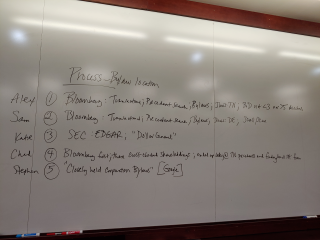
Although Bloomberg Law was a popular resource for students who shared their process in this particular class meeting, the Securities and Exchange Commission’s website and Google also got some love. In the ensuing discussions, a student also mentioned Westlaw’s Practical Law as a resource, although that’s not reflected in this picture.
In other advanced business law planning/drafting courses, I invite representatives from Bloomberg Law, Lexis, and Westlaw into my classroom to train my students in how to find precedent documents (and other transactional resources) using their database’s search tools. One student involved in the discussion reflected in the photo above was enrolled in one of those advanced courses with me in the fall (and also had been a student in our transactional business law clinic). He was among the folks who started his search process with Bloomberg Law. His classmates told me he had been teaching them some of what he had learned in my course and the law clinic! #peerteaching–loved it!
How do you help students find drafting precedents (and in what business law and legal education contexts)? I am always willing to learn new methods and tricks.