I recently listened to an episode of EconTalk: “Dani Rodrik on Neoliberalism.” What follows is an excerpt from the show, wherein Rodrik defines neoliberalism:

What I mean by neoliberalism is really mostly a frame of mind that places the independent functioning of markets and private incentives and pricing incentives at the center of things. And I think in the process downgrades certain other values, like equity and the social contract, and certain restraints on private enterprise that are often required to achieve economic ends that are more compatible with social goals.

For whatever it’s worth, I’d change this definition as follows:

What I mean by neoliberalism is really mostly a frame of mind that places the independent functioning of markets and private incentives and pricing incentives at the center of things. And I think in the process [posits that] certain other values, like equity and the social contract, and certain restraints on private enterprise that are often required to achieve economic ends that are more compatible with social goals [are optimized via free markets compared to the historical failures of central planning].

Two other comments from the show that stuck out to me:

  • what both Foxconn and the

I did not manage to do much outside reading over the summer, given a move to the Nashville suburb of Franklin. 

Always open to recommendations. I am also interested in podcast recommendations for my new commute. 

On Paradise Drive – David Brooks (Social Commentary) (2004). Rough satire (or is it satire?) to read right before we moved to the suburbs. 

Running for My Life – Lopez Lomong and Mark Tabb (Biography) (2012). Recommendation from Colleen Baker. Inspiring story of how one of the lost boys of Sudan became a US Olympic athlete. Just a few weeks ago, Lopez Lomong won both the 5000m and 10,000m at the U.S. Championships

Deep Work – Cal Newport (Self-Help) (2016). Georgetown computer science professor argues that there are increasing rewards for “deep work” (challenging work, requiring full concentration), but that society is pushing us toward “shallow work” with social media, constant e-mailing, open office, and the like. He suggests setting routines, fully resting (embracing boredom), and scheduling internet use (and avoiding the internet outside of those times).

Advanced Marathoning – Pete Pfitzinger and Scott Douglas (Fitness) (2d. 2009). Recommended by two of the best runners I know. Will use this book (along

This was a busy semester, but I still managed to read a few books. Always open to recommendations. 

Enough. John Bogle (Business) (2009). Vanguard’s founder reflects on business, money, satisfaction, and life. Easy read. Read this during a 2+ hour faculty meeting.   

Dandelion Wine – Ray Bradbury (Novel) (1957). A Walter Effross recommendation. A story of boyhood and summer and wonder and magic.

Half an Inch of Water – Percival Everett (Fictional Short Stories) (2015). A series of stories situated in the western U.S.–about loss, love, youth, aging, corruption, animals, and the wilderness. My favorite story is “A High Lake” because it reminds me of my grandmothers’ independence, intelligence, and care before they died.  

The Enduring Community – Brian Habig and Les Newsom (Religion) (2001). Co-authored my a minister to two of my siblings while they were at the University of Mississippi (Newsom). Attempts to clarify the roles of the Church in community.

Heavy – Kiese Laymon (Memoir) (2018). Raw memoir in which the author struggles with his weight, abuse, racism, addiction, and depression. Laymon was raised in Jackson, MS and is an English professor at University of Mississippi, after a number of years on the faculty

I recently received a copy of Citizen Capitalism: How a Universal Fund Can Provide Influence and Income to All from Sergio Gramitto. While I have not yet read the book, I didn’t want to let another blog post go by without passing along at least some of its highlights, as well as why I am particularly interested in its proposals.

In addition to Sergio, the authors of Citizen Capitalism include Tamara Belinfanti and the late Lynn Stout. Suffice it to say that Lynn was one of our true superstars, and I would hate to miss any presentation by either Sergio or Tamara. I’ve had the pleasure of engaging professionally with all of them in some capacity, and I hold them each in the highest regard.

Sergio and Lynn first discussed the idea of a Universal Fund in their article Corporate Governance as Privately-Ordered Public Policy: A Proposal, and then expanded on that idea with Tamara in Citizen Capitalism. The book has been reviewed in numerous places (see, for example, here and here). What follows is a descriptive excerpt from Cornell’s Clarke Program on Corporations & Society.

We offer a utopian-but feasible-proposal to better align

I posted about my summer reading here, and I have decided to write this sort of post each semester, at least for a few semesters. 

This semester was incredibly busy, and I didn’t read as much as I would have liked, but I am glad I finished at least a few books. Nearly all of these books were pretty light

Always looking for interesting books to read – and I am open to reading in most areas – so feel free to leave a comment with suggestions or e-mail me

The Honest Truth About Dishonesty – Dan Ariely (Non-Fiction – Ethics/Behavioral Economics, 2013). Duke University behavioral economist examines the environs/structures that encourage or discourage honesty.

Hannah Coulter – Wendell Berry (Fiction-Novel, 2005). Elderly lady, twice widowed, reflects on her life and the lives of her family members as the world changes after World War II, and as the modern world diverts from rural, farming communities like Port William, KY. Berry’s first novel with a female narrator.

The Most Important Year – Suzanne Bouffard (Non-Fiction – Education, 2017). Discusses the importance of the year before kindergarten. (My oldest child starts kindergarten this coming fall). Biggest takeaway was to engage

I’d like to thank the Business Law Prof Blog for the opportunity to be a guest blogger!  In this first post, I build on a subject of previous posts (here, here, and here): Theranos, a now defunct Silicon Valley health-care start-up.

I rely heavily on the Financial Times to follow developments in one of my main research areas: financial market clearing and settlement (I’ll plan to report next week on the upcoming December 4th meeting of the Market Risk Advisory Committee, sponsored by CFTC Commissioner Rostin Behnam).  The FT recently announced that Wall Street Journal investigative reporter John Carreyrou’s book, Bad Blood: Secrets and Lies in a Silicon Valley Startup, had been named the FT/McKinsey Business Book of the Year 2018.  Having immensely enjoyed reading past winners, I wasted no time in ensuring that Amazon Prime speedily delivered it to my doorstep. 

Bad Blood is a riveting tale of Theranos’ spectacular rise and fall, and well-worth the reader’s time.  A fun fact is that a pathologist blogger, Adam Clapper (founder of the former Pathology Blawg), tipped Carreyrou onto the Theranos story (Chapter 19).  Additionally, in the months after Bad Blood’s publication, its

There is a “post 7 book covers of books you love, without comment” campaign sweeping Facebook, and I have been tagged.

I am breaking all the rules.

Below are 8 books, 9 if you count both of the books I read by Mohsin Hamid. I don’t love all the books below, but I did read them all this summer. I am not posting a picture of the covers (but I do provide links to the books), and I couldn’t help including a brief comment on each.

Again to Carthage – John Parker Jr. (Fiction, Novel). Sequel to Once a Runner and not nearly as good. The sequel is more focused on the primary character’s midlife crisis than his running.

Inside the Magic Kingdom – Tom Connellan. (Non-Fiction, Pop-Business). My mother-in-law was reading this for her job at the beach, and I ran out of reading material. Cheesy, pop-business book, but interesting for the way Disney’s C-level executives assist in picking up the trash at the parks, and the parties at the parks they held for the families of the construction crew members. Plus, the books was more interesting to me because we plan to go to Disney World as a

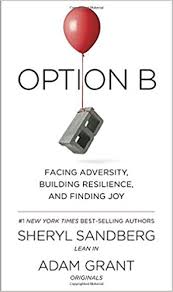
OptionB

Shortly after hearing Sheryl Sandberg and Adam Grant speak on a Harvard Business Review podcast, I purchased Option B.

After listening to the podcast, I expected the book to contain more references to the research on resilience than it ultimately did. While I knew the book was popular press, I expected Penn Professor Adam Grant to add a more scholarly flavor. As it was, the book was a relatively short memoir focused on the death of Sheryl Sandberg’s husband Dave. Had I started the book expecting a window into Sandberg’s grieving process rather than an accessible integration of the resilience research, I think I would have appreciated the book more.  

On the positive side, the book is an extremely easy read and is written with a punchy, engaging style. Sandberg is quite honest, and is blunt in sharing with the readers what is and isn’t helpful in interacting with those who have experienced great personal loss. In Sanberg’s opinion, you should address the elephant in the room, and should not worry about reminding them of their loss, as they are already thinking about it all the time. Vague offers like “let me know if I can do anything to help”

These days it is easy to get discouraged on how divided our nation seems to be on a number of issues. John Inazu, Distinguished Professor of Law, Religion, and Political Science at Washington University, maps a way forward in his book Confident Pluralism (2016).

The book is divided into two parts: (1) Constitutional Commitments, and (2) Civic Practices.

The first part “contend[s] that recent constitutional doctrine has departed from our longstanding embrace of pluralism and the political arrangements that make pluralism possible.” (8) Further, the first part offers guideposts for future decisions and political solutions. The first part argues for both inclusion and dissent, for the free formation of voluntary groups, for meaningful access to public forums, and for access to publicly available funding for diverse organizations. Provocatively, Inazu claims that Bob Jones case – which stripped tax-exempt status from Bob Jones University due to its prohibition of interracial dating/marriage – is “normatively attractive to almost everyone, [but] is conceptually wrong.” (75) Inazu claims that “[t]he IRS should not limit tax-exempt status based on viewpoint of ideology.” (79) He extends the argument to “generally available resources.” While the Trinity Lutheran case was decided by the Supreme Court after publication

ABABookCover

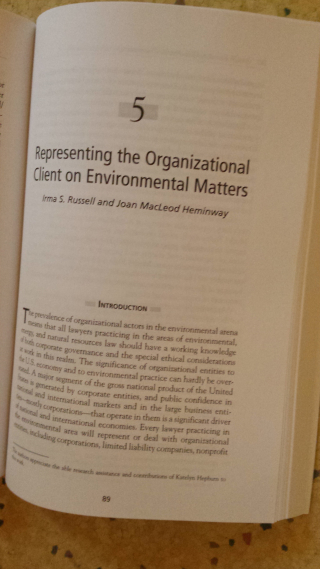
My good friend and long-time mentor Irma Russell and I wrote a chapter for the recently released ABA book, Ethics and the Environment: A Lawyer’s Guide.  Irma also is a co-editor of the book (with Vicki Wright).  In our joint contribution, the chapter entitled “Representing the Organizational Client on Environmental Matters,” Irma and I cover issues involving professional responsibility, corporate governance, and environmental compliance.  Guess which part was my primary responsibility . . . ?!)  Covering some 37 pages of the 242-page book, the rules we cover and the observations we make are fairly wide-ranging.  We hope, as we noted in our conclusion to the chapter, that we supply legal counsel representing corporations and other organizations with “foundational tools to assist them in providing advisory and advocacy-oriented services to organizational clients in the environmental law context.”  Irma and I received our copies last week.  The book soon will be available through the ABA and other outlets.


ABABookChapterPage

SaveSaveSaveSave

SaveSave