
Tomorrow morning, the U.S. Supreme Court will be hearing oral arguments on a securities fraud case for which I am an amicus brief coauthor.  The case is: Macquarie Infrastructure Corporation, et al. v. Moab Partners, L.P., et al. (No. 22–1165, Certiorari to the C. A. 2nd Circuit).  The Court convenes at 10 am and has allotted one hour for oral argument: 30 minutes for the petitioners, 20 minutes for the respondent, Moab Partners, and 10 minutes for the U.S. Securities and Exchange Commission (“SEC”), as amicus supporting the respondents.  An audio feed of the argument is live-streamed on the Court’s website, and the Court posts the audio later in the day.

The question presented to the Court is: “May a failure to make a disclosure required under Item 303 of SEC Regulation S-K support a private claim under Section 10(b) of the Securities Exchange Act of 1934, even in the absence of an otherwise misleading statement?”  The issue in the case, in essence, is whether a mandatory disclosure rule properly adopted by the SEC gives rise to a duty to disclose that can be the basis of a securities fraud claim under Section 10(b) of and Rule 10b-5 under

In June, at the National Business Law Scholars Conference in Knoxville, I sat in on a paper panel featuring Sarah Williams’s work in process, Regulating Congressional Insider Trading: The Rotten Egg Approach.  A draft of the resulting paper, forthcoming in the Cardozo Law Review, has been made available on SSRN.  The abstract is copied in below.  

A 2004 study revealed that the stock portfolios of members of Congress were consistently outperforming those of the investing public. The financial success of federal lawmakers was statistically correlated to the use of nonpublic information obtained in connection with the performance of legislative responsibilities – reasonably characterizable as insider trading. Cries of dismay over such profiteering by lawmakers have been echoing in the public domain since Samuel Chase, Maryland’s representative in the Continental Congress, cornered the flour market in 1788 after learning that copious quantities of the product would be purchased by the government to support the Continental Army. Notwithstanding efforts to apply insider trading law to curb this behavior and the enactment of the Stop Trading on Congressional Knowledge (“STOCK”) Act, fortuitous securities transactions by members of Congress continue to occur in connection with headlining national events; it was recently observed

Over the summer, friend-of-the-BLPB Bernie Sharfman posted a draft paper to SSRN that was the subject of a short colloquy between us.  The paper, The Ascertainable Standards that Define the Boundaries of the SEC’s Rulemaking Authority, asserts, among other things, that materiality is one of three “ascertainable policy standards that Congress has placed in the Acts to guide the SEC’s rulemaking discretion.”  The reasoning? 

  • “[T]here are multiple references to materiality in the Acts.”
  • The SEC’s 1972 annual report avers that “[a] basic purpose of the Federal securities laws is to provide disclosure of material financial and other information on companies seeking to raise capital through the public offering of their securities, as well as companies whose securities are already publicly held.”
  • “As observed by Professor Ruth Jebe, it is fair to say that materiality ‘constitutes the primary framing mechanism for financial reporting.'”

Bernie acknowledges that “there is no explicit statutory language in the Acts that forbids the SEC from promulgating rules requiring non-material disclosures.”  I might add that nothing in either the Securities Act of 1933, as amended (“1933 Act”), or the Securities Exchange Act of 1934, as amended (“1934 Act”), explicitly limits the SEC’s rulemaking

It was so much find to have our business law prof colleague Erik Gerding and two fabulous key members of his staff here in Knoxville yesterday.  I had posted on this visit last week.  Our visitors regaled us on the role of the U.S. Securities and Exchange Commission (“SEC”) Division of Corporation Finance, the registration requirements and exemptions under the Securities Act of 1933, as amended (“1933 Act”), and the rule-making part of the Division’s (and SEC’s) mission.

Erik explained how, when he is teaching Securities Regulation, he spends two classes at the beginning of the semester putting the “fear of God” into his students about the registration requirement in Section 5 of the 1933 Act.  (His point is to make the dangers clear up front, since students tend to drop the class who should take it, given that they plan to practice business law in one way or another.)  Erik’s colleague, Jennifer Zepralka, Chief of the SEC’s Office of Small Business Policy, similarly noted in her remarks that there are only three kinds of securities offerings: registered, exempt from registration, and illegal.  Erik’s Counsel, Jeb Byrne, echoed this.  And in the session at lunch time, one of my

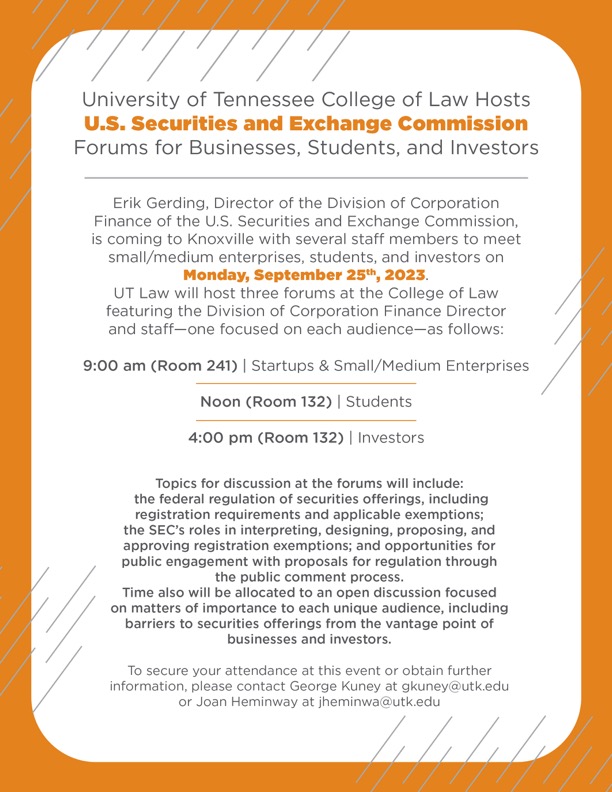
We are excited to welcome our colleague Erik Gerding, the Director of the U.S. Securities and Exchange Commission Division of Corporation Finance, together with members of his staff, to The University of Tennessee College of Law a week from today. Information about the visit is included below.  If you are in the neighborhood, stop by!

SECFlyer

Thanks to Ann for her great “So, Ripple” post last week.  I have been waiting for a case like this—one that engages a court in the details of how the Howey test applies to the way different types of  cryptoassets work.  I was especially interested in how the court in the SEC v. Ripple Labs opinion would handle the different ways in which cryptoassets are sold and traded.  Well, now we have an opinion to work with.

I especially appreciate Ann setting the stage so well with the doctrinal legal background of the case.  Well done, friend!  Like Ann, I teach Securities Regulation every year.  Unlike Ann, I am gleeful about teaching definitional content in the federal securities laws, including the definition of the term “security.”  It is amazing how, as financial investment instruments have evolved, significant numbers of practitioners and their clients have paid insufficient attention to the niceties of that definition and the definition of the embedded term “investment contract.”

Like Ann, I am comfortable that a single financial instrument can be a security in some contexts and not in others.  And, like Ann, I have questions about the court’s analysis in Ripple.  Specifically, I

Ciao, from Italy.

Tomorrow, I have the privilege of sharing my work in an international symposium at the University of Genoa at the invitation of Vanessa Villanueva Collao.  This symposium offers a unique opportunity for transnational collaboration among corporate governance scholars.  We also are celebrating Vanessa’s completion of her J.S.D. degree (University of Illinois 2023).  

I am presenting my paper, forthcoming in the Michigan State Law Review, on civil insider trading in personal networks.  This is the companion paper to my article on criminal insider trading in personal networks, recently published in the Stetson Business Law Review and part of my larger, long-term project on U.S. insider trading in friendships and family situations.  As many readers may know, this project has fascinated me for a number of years now.  Each phase of the project offers new insights.  And each audience helps provide valuable food for thought. I am confident that the participants in and audience members at tomorrow’s symposium will be no exception.  I look forward to the interchanges on my work and the work of others being featured.

The program for the symposium is included below.  You will see more than a few fascinating members of the U.S.

The following message was received by me earlier this evening from the SEC Historical Society.  I thought many of you would want the information.  I interviewed with Harvey Pitt back at Fried Frank in 1984.  He then was already a securities regulation icon.  I was impressed (even though I did not end up working at Fried Frank–but together with Skadden’s Washington, DC office, it was at the top of my list if I had decided to go to DC instead of Boston).  May he rest in peace and may his memory be for a blessing.

+++++

SECHistoricalSocietyLogo

Dear Friends,

I write to pass along the very sad news that former SEC Chairman and one of the Society’s founders, Harvey Pitt, passed away today.

There will be a service on Monday, JUNE 5th at 1:00 PM at the Washington Hebrew Congregation at 3935 Macomb Street, NW, Washington, DC 20016.

I understand that for anyone who would like to reach out to his wife, Saree, it was recommended by his family to give her a day or two before doing so.

I will pass along any additional helpful information that I may receive.

Sincerely,
Jane

Jane Cobb
Executive Director
j.cobb@sechistorical.org
202-756-5015

For those of you interested in watching or listening to the inaugural Peter J. Henning lecture (the subject of my blog post last Monday), you can find the recording here.  Friend-of-the-BLPB Chris Lund was kind enough to send the link along.  As you’ll note, Judge Rakoff’s remarks (which were introduced by Chris) begin with comments about Peter, his contributions to our field, and his service to the general public.  Judge Rakoff’s thoughts in that regard are so well taken.  The whole presentation was such a fitting tribute.

I hope you all enjoy the lecture as much as I did!

Dear BLPB Readers:

My colleague Professor Joseph Thai  at OU College of Law shared the following:

“Do you have an interest in securities fraud and investor protection? Want to ask national experts about the current banking crisis and its implications for regulators, investors, and the general public?

On behalf of OU College of Law, please join us for the Wilkinson Family Speaker Series (WFSS) in the Bell Courtroom at OU College of Law on Friday, March 24, 2023, from 9:15 a.m. – 1:15 p.m. The event is free, breakfast and lunch are included, and you are welcome to come and go if you cannot stay the entire duration.

Please see the flyer and attached program, and RSVP at the link below. Thank you!”

Program flyer is here: Download WSS Program

RSVP here

