
Delaware’s Division of Corporations released its Annual Report recently for 2025. As expected, Delaware’s overall number of business entities continues to grow, with “a more than fifteen percent increase over 2024” in terms of entity formations.
But one thing about this year’s report popped out at me because it differed from years past. Delaware reported that its percentage of the IPO market in 2025 came in at “Nearly 70% U.S. IPOs.” It provided that information in this graphic.
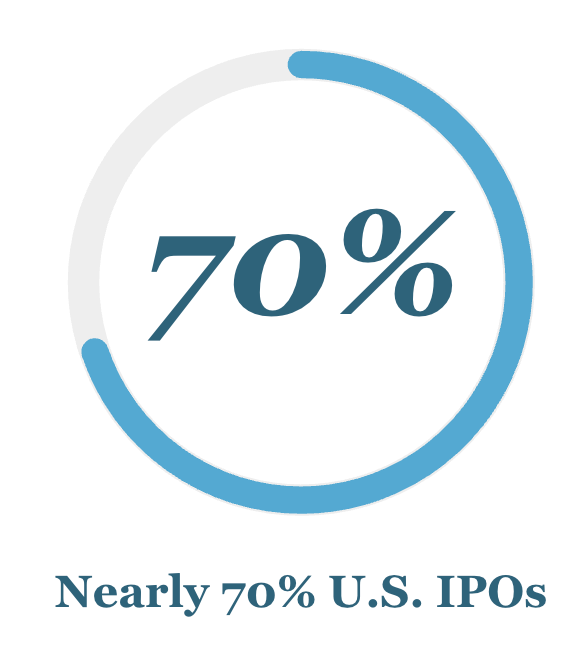
This is consistent with Houlihan Lokey data that had Delaware at 61.8% for U.S. Non-SPAC IPOs last year. I assume Delaware counts SPACs toward its total.
But this is also a notable change from how it presented this information the year before. In 2024, Delaware reported that “81.4 percent of U.S. based Initial Public Offerings in 2024 chose Delaware as their corporate home.” It also expanded on this statistic, stating that:
This is why Delaware is home to more than 2.1 million active business entities. Eighty one percent of companies that launched an initial public offering on a U.S. stock exchange chose Delaware as their state of incorporation in 2024, an increase from 2023. That such an overwhelming proportion of newly public companies chose Delaware as their jurisdiction of choice underscores the premium the public markets continue to place on Delaware’s approach to corporate law and governance, where clarity, predictability, balance and unrivaled customer service are long-standing hallmarks.
If the 2024 percentage was something that “underscore[d] the premium the public markets continue to place on Delaware’s approach to corporate law and governance,” what does the shift from 81.4% to “nearly 70%” mean?
This takes some math to work out. Delaware’s decision to depart from last year’s clear figure to instead announce “nearly 70%” obscures the true percentage. Delaware’s market share, by its calculation, likely stands somewhere between 65% and 69.9%. This is a bit speculative because Delaware didn’t give the actual number, but it’s defensible to round up to 70% in that range so we’re looking at a likely 11.5% to 16.4% drop from the year before for where the actual number is. How signifiant is that?
Professor Bainbridge ran the numbers on past IPO data in his DExit Driver paper. He used past reports to break out Delaware’s percentage of the IPO market from 2012 to 2022. This is the table he created:

The decision to shift away from a clear number will make it harder to do this in the future, but Professor Bainbridge took these numbers and calculated that over that 11 year period, the mean was 86.6% of IPOs for Delaware with a median of 89 and a standard deviation of 4.7.
To put the rough 65% to 70% range in perspective, splitting the difference for a 67.5% share of the IPO market is over four standard deviations from the mean. Statistically, this puts it at a roughly 1 in 40,000 event if we assume a normal distribution.
Notably, 2025 had a significant number of IPOs–347 according to the SEC. That’s a decent sample.
If you extend Professor Bainbridge’s data set to include 2023 (80%) and 2024 (81.4%), the picture gets a bit better for Delaware with the mean shifting to 85.72, the median to 86, and the standard deviation to 4.86. A 67.5% share of the IPO market then comes to about 3.75 standard deviations from the mean, or roughly a one in 9,000 event for a normal distribution.
As Delaware hasn’t told us what the actual figure is, this table shows the distance from the mean and rough probabilities for whatever the true figure is from 65-69%. (Disclosure — I had Claude prepare the table)
| Value | z (pop SD 4.86) | Approx. 1-in-x (one-tailed) |
| 65 | −4.26 | ~1 in 47,000 – 99,000 |
| 66 | −4.06 | ~1 in 20,500 – 40,000 |
| 67 | −3.85 | ~1 in 9,300 – 17,000 |
| 68 | −3.65 | ~1 in 4,300 – 7,500 |
| 69 | −3.44 | ~1 in 2,100 – 3,400 |
I’m hoping to pull together 2026 IPO statistics by state soon, but Delaware’s “nearly 70%” figure shows a remarkable downturn in Delaware’s market share for IPOs.
Of course, none of this means that Delaware isn’t going to continue to grow or that the trend will necessarily continue in future years, but it does provide a strong data point that many companies made different decisions in 2025 than in past years. If this continues, other jurisdictions may accumulate enough public companies to build broader corporate law ecosystems and turn into more stable competitors.
Notably, Delaware has also taken to comparing itself to other jurisdictions and is directing people to the Council of Institutional Investors’ comparison chart. I shared some notes on that chart here.