
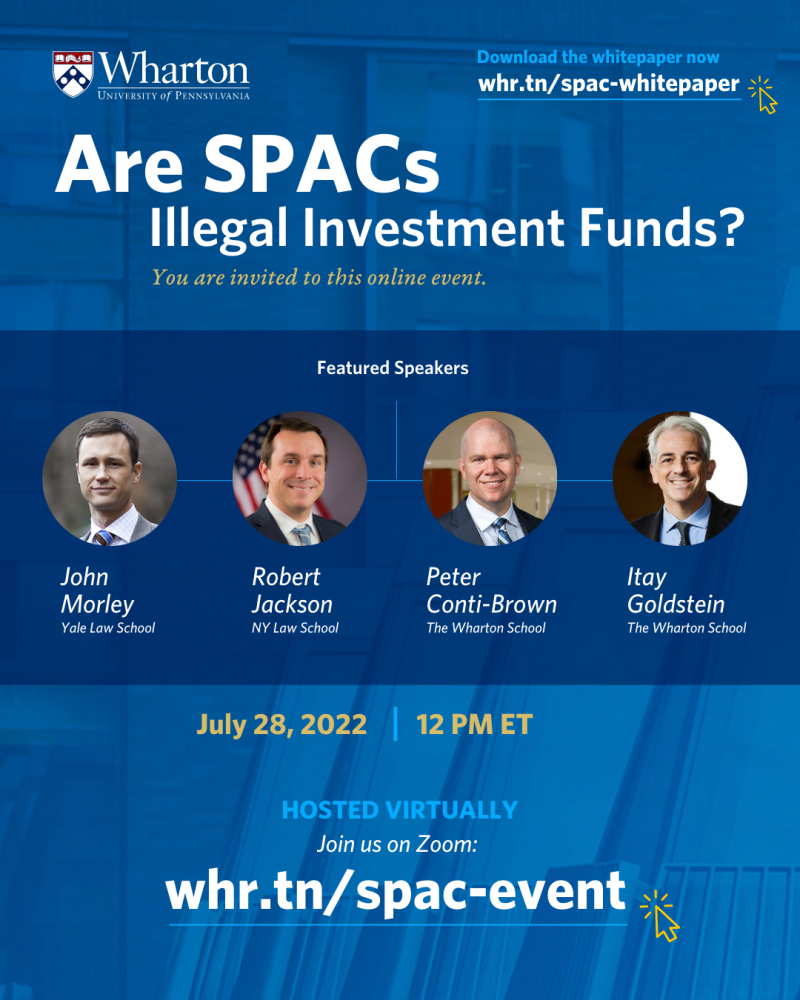
Tomorrow, the Wharton Initiative on Financial Policy and Regulation is hosting a webinar entitled, Are SPACs Illegal Investment Funds? I encourage you to register (here) and decide what you think about this issue!

UPenn Law Inaugural Junior Faculty Business and Financial Law Workshop
Dear BLPB Readers:
“The Institute for Law & Economics (ILE) at The University of Pennsylvania Carey Law School is pleased to announce its inaugural Junior Faculty Business and Financial Law Workshop. The Workshop will be held in person on December 8, 2022 at Penn Law School, unless pandemic protocols require otherwise.
The Workshop supports and recognizes the work of untenured legal scholars in accounting, banking, bankruptcy, corporations, economics, finance and securities regulation and litigation , while promoting interaction among them and selected tenured faculty and practitioners. By providing a forum for the exchange of creative ideas in these areas, ILE also aims to encourage new and innovative scholarship in the business and financial arena.”
The complete call for papers is here.
Baker on Derivatives and ESG
I’m excited to share that my most recent article, Derivatives and ESG, is forthcoming in the American Business Law Journal (Vol. 59, no.4)! I recently posted a draft of this article to SSRN. As the abstract below suggests, it examines the role of the derivatives ecosystem – the instruments themselves, trading exchanges, and clearinghouses – in promoting ESG objectives.
I’ve written a lot about credit default swaps (for example, here and here). So, in researching this topic, I was especially struck by the potential for well-known past and existing challenges in credit default swap markets – specifically, decentralized decision-making and conflicts of interest – to eventually become issues in the currently nascent sustainability-linked derivatives (SLDs) market, a type of over-the-counter ESG derivative. Undoubtedly, the SLDs market is set to grow, so I’ll likely be posting on this topic again in the future!
Here’s the abstract:
“Financial markets are increasingly developing innovative, ESG-related derivatives and relying upon these instruments to hedge ESG-related risks. The global derivatives markets are among the largest, most consequential financial markets in the world. Derivatives are financial contracts that derive their value from an underlying reference entity which can be almost anything, including
Kühling on Companies Using Climate Change as an Excuse to Obtain More Market Power
Jürgen Kühling is the chair of Germany’s Monopolies Commission. The following is a hopefully interesting excerpt from a recent interview he did with ProMarket (here).
When the Federal Cartel Office blocks a merger in Germany, the merging parties can seek an exemption from the minister of economic affairs to clear the merger. And we had a case three years ago where companies argued that the merger would lead to sustainable efficiencies that would benefit the economy as a whole in such magnitude that the efficiencies would outweigh the merger’s adverse effect on competition completely. We had concluded that the alleged environmental public benefits were either not demonstrated or ultimately represented self-serving benefits. In general, we think such sustainable benefits that are in the consumers’ interest can already be addressed under the current competition law. All sustainability aspects that consumers do not value lie outside the scope of competition law, in our view, and require regulation.
Kühling then provided some additional details:
As I mentioned before, there was a merger in 2019 that came under ministerial review, which we advised the ministry of economics on as well. After a substantial assessment, we concluded that the merger would not have
Berlau on the Declaration of Independence and the Administrative State
Over at Law & Liberty (here), John Berlau has posted a comment on Jarkesy v. SEC, in which the Fifth Circuit recently ruled that “(1) the SEC’s in-house adjudication of Petitioners’ case violated their Seventh Amendment right to a jury trial; (2) Congress unconstitutionally delegated legislative power to the SEC by failing to provide an intelligible principle by which the SEC would exercise the delegated power, in violation of Article I’s vesting of ‘all’ legislative power in Congress; and (3) statutory removal restrictions on SEC ALJs violate the Take Care Clause of Article II.” Jarkesy v. Sec. & Exch. Comm’n, 34 F.4th 446, 449 (5th Cir. 2022). What follows is a brief excerpt from Berlau’s post, but please go read the whole thing.
Critics and proponents of the ruling by the U.S. Court of Appeals for the Fifth Circuit in Jarkesy v. SEC have called revolutionary the new limits it places on federal regulatory agencies’ use of administrative law judges, a core tool of the administrative state…. Jarkesy is indeed revolutionary—both in the jurisprudence it could usher in limiting the power of the administrative state and in its concern for issues involved in the American Revolution.
The Duty of Care and Moving Operations Out of Pro-Life States
Abortion is obviously one of our most divisive political issues. Thus, when corporate leaders make decisions related to abortion laws, such as moving out of a pro-life state (see, e.g., CEO: Duolingo will move operations should Pennsylvania ban abortion), a specter of political bias is arguably raised. One normative question that then arises is whether such a decision is sufficiently conflict-prone to warrant enhanced scrutiny, as I have argued here. There is certainly a shareholder-wealth-maximization case to be made for moving out of a pro-life state — specifically, the argument that high-value employees demand such action. But this determination should be supported by something more than trending Twitter comments or the personal biases of decision-makers. Corporate fiduciaries are required to consider all material information reasonably available, and where decision-making is sufficiently prone to conflicts of interest the accountability concerns of corporate governance should trump its protection of discretion.
As a perhaps related aside, one may compare the argument against state universities having official positions on whether the Constitution should be read as protecting abortion. As Prof. Leslie Johns noted in an e-mail she sent to the UCLA Chancellor following his related public statement asserting that Dobbs “is antithetical
George Will: “‘stakeholder’ capitalism is parasitic progressivism”
In February 2021, Samuel Gregg argued (here) that: “To expect the rest of the world simply to accept whatever stakeholder-corporatist insiders have decided to be the new global consensus on any given topic seems disconcertedly utopian. It also increases the possibility of more populist backlashes on an international level.”
Yesterday, George Will published an op-ed in the Washington Post that appears to capture some more of this sentiment. You should go read the whole thing (here), but here is a brief excerpt:
The New York Times recently interviewed two advocates of ESG investing. One said, in effect, that only such investing fulfills fiduciary obligations because the welfare of those whose money is being used depends on “a planet that is livable.” Meaning: Politically enlightened ESG advocates know what unenlightened investors would want if they were as intelligent and virtuous as the advocates. The other ESG enthusiast the Times interviewed said “social justice investing” is “the deep integration of four areas: racial, gender, economic and climate justice.” And the “single-issue CEO” — the kind focused on maximizing shareholders’ value — is “not the way of the future.” This is often the progressives’ argument-ending declaration: Non-progressives are on
Cunningham: “Twenty-Two National Professors of Law and Finance Renew Request that SEC Withdraw Climate Disclosure Proposal”
Today’s press release from Prof. Lawrence Cunningham states in part:
Twenty-two of the nation’s leading professors of law and finance today wrote the Securities and Exchange Commission (SEC) to renew their doubts about the agency’s authority to adopt a new far-reaching climate disclosure regime and to urge an immediate withdrawal of the proposal. Initially writing in response to the SEC’s proposed rule requiring U.S. public companies to create and disclose extensive information on greenhouse gas emissions, the professors submitted a public letter in April questioning the authority of a federal financial regulator to collect climate-related information and identifying numerous reasons the proposal may face a challenge in federal courts. Since then, the debate has been joined by a number of other professors who have submitted letters supporting the SEC’s authority. In the letter filed today, the professors weigh these arguments and explain their contrary conclusion.
The full comment letter can be found here. A relevant excerpt:
[T]he clear purpose (and certain effect) of these disclosures is to give third parties information for use in their campaigns to reduce corporate emissions, regardless of the effect on investors…. Imposing substantial costs on some companies to prepare for a “potential transition to a lower
Recommended: Oren Cass and David Bahnsen Discuss Private Equity
On the June 16, 2022, episode of the Capital Record podcast, David Bahnsen and Oren Cass have a lively and stimulating conversation about the social utility of private equity. You can find the episode here. Below is a brief description.
David is joined once again by Oren Cass of American Compass, this time to discuss the state of American financial markets. The two have a congenial conversation about private equity and venture capital, what is going wrong with the two, and what the solutions may be. There is more disagreement than agreement, but there is a mutual and sincere effort to identify issues and present thoughtful remedies. Whatever your view may be on what is right or wrong in the evolution of financial markets, you’ll find this robust discussion thoughtful, provocative, and engaging.
Padfield on Stakeholder Capitalism’s Viewpoint Diversity Problem
I just posted Does Stakeholder Capitalism Have a (Viewpoint) Diversity Problem?, U. Puerto Rico Bus. L.J. (forthcoming) on SSRN (here). The abstract:
Does stakeholder capitalism have a viewpoint diversity problem? What follows constitutes an initial inquiry into that issue.
Following the Introduction, Part II provides an overview of the Free Enterprise Project’s (FEP’s) 2021 Investor Value Voter Guide, which focuses at least in part on both stakeholder capitalism and viewpoint diversity in a way that provides a good introduction to a perceived tension between the two. This part of the essay contains three sub-parts. Sub-parts A and B provide at least some support for connecting stakeholder capitalism (in all its forms) to partisanship as well as a lack of relevant viewpoint diversity. Sub-part C then unpacks specific proposals that the FEP is submitting and/or recommends supporting/opposing. This sub-part is further broken down into brief overviews of the FEP’s viewpoint diversity and stakeholder capitalism proposals.
Part III shifts attention to related research and commentary. This part includes four sub-parts (A-D). Sub-part A addresses the issue of stakeholder capitalism as greenwashing. Sub-part B addresses some of the possible problems caused by a lack of viewpoint diversity in stakeholder capitalism