
Photo of Haskell Murray

Professor Murray teaches business law, business ethics, and alternative dispute resolution courses to undergraduate and graduate students. Currently, his research focuses on corporate governance, mergers & acquisitions, sports law, and social entrepreneurship law issues.

Professor Murray is the 2018-19 President of the Southeastern Academy of Legal Studies in Business (“SEALSB”) and is a co-editor of the Business Law Professor Blog. His articles have been published in a variety of journals, including the American Business Law Journal, the Delaware Journal of Corporate Law, the Harvard Business Law Review, and the Maryland Law Review. Read More

I was going to blog today about Usha Rodrigues’s article on section 12(g) of the Exchange Act, but my co-blogger Ann Lipton stole my thunder over the weekend. If you’re interested in securities law and you haven’t read Ann’s excellent post on section 12(g), you should. Ann discusses Usha Rodrigues’s article on the history and policy of section 12(g); if you haven’t read it, I strongly recommend it. It’s available here. (Even if you’re not interested in reading about section 12(g), I highly recommend Usha’s scholarship in general. I’ve read several of her articles and blog posts over the last few years; she has become one of the leading commentators on securities and corporate law. She blogs at The Conglomerate.)

Instead of discussing section 12(g), I’m going to talk about exams. I finished grading my fall exams about a month ago and I’ve had time to reflect on them. The main reason students don’t do well on exams is that they don’t know or understand the material. But I’ve been reflecting on the difference between exams that are pretty good and exams that are excellent. Those students all know the material, so that’s not the

Call me Ishmael.”

Legal scholarship is in many ways like whaling. We don’t use harpoons, except in especially contentious symposia. And most of the mammalian harm is emotional, rather than physical. But there are many similarities.

1. Whales, Once Abundant, Are Disappearing

In the early days of legal scholarship, novel ideas were abundant. Blackstone, Story, and Kent were out there as background, but there was much unexplored territory—both general theoretical work and summaries of the law. Whales were abundant. Today, the major theoretical positions have been staked out ad infinitum, summaries and restatements of the law are abundant, and the few remaining whales lie on the edges—inspired primarily by new developments in technology and markets.

Much of today’s scholarship merely applies old ideas to new marginal questions. (Witness the work of many late-arriving law-and-economics and critical-legal-studies scholars.) The number of truly novel ideas is dwindling; most of the whales are gone.

2. To a Desperate Whaler, Everything is a Whale

The whales are rare, but the demand for “cutting-edge” scholarship has not ceased. Tenure at most schools depends on it. And the number of legal writers has increased substantially since those early days. Fewer whales; more whalers.

Faced
I, like many law professors, recently returned from the annual meeting of the Association of American Law Schools. I attended a number of interesting presentations, but the highlight of the conference for me was the opportunity to hear Frank Easterbrook speak on “The Corporate Law and Economics Revolution.”

I assume that most of our readers are familiar with Judge Easterbrook. He was a prominent corporate law scholar prior to (and after) being appointed to the Seventh Circuit Court of Appeals by President Reagan.

I have never met Judge Easterbrook. He left the academy two years before I began teaching. But I am certainly familiar with his writing. I have read several of his articles, and a well-used copy of his book (with Daniel Fischel) The Economic Structure of Corporate Law sits on my office bookshelf. And we do have a connection of sorts: my first citation ever came from him. He was kind enough to cite my very first article in one of his opinions, Amanda Acquisition Corp. v. Universal Foods Corp., 877 F.2d 496 (7th Cir. 1989).

At the conference session I attended, Judge Easterbrook’s views on law and economics were forcefully challenged by one of the other

Assume you acquire some nonpublic information about a company that will have no predictable effect on the company’s stock price, but will affect the volatility of that stock price. Is that information material nonpublic information for purposes of the prohibition on insider trading?

That’s one of the issues addressed in an interesting article written by Lars Klöhn, a professor at Ludwig-Maximillian University in Munich, Germany. The article, Inside Information without an Incentive to Trade?, is available here. His answer (under European law)? It depends.

Here’s the scenario: one company is going to make a bid to acquire another company. The evidence shows that, on average, the shareholders of bidders earn no abnormal returns when the bid is announced. There’s a significant variation in returns across bids: some companies earn positive abnormal returns and some companies earn negative abnormal returns. But the average is zero. Of course, the identity of the target might affect the expected return, but to pose the problem in its most complex form, let’s assume that you don’t know the target, just that the bidder is planning to make a bid for some other company.

In that situation, the stock is just as likely to

Happy New Year!

Last year I wrote a bit about New Year’s resolutions.

As some of you know, I wasn’t able to go the full year without checking my e-mail on Saturdays. In fact, that resolution was toast a few weeks into 2015.

One of the problems, I think, was that I had 20 resolutions in 2015. We all have limited self-control, and we can experience overload in January.

I have been doing New Year’s resolutions for as long as I can remember, with varied amounts of success, but I am going to try something a bit different this year.

The Cass Sunstein article I included last year gave me the idea. In the article, he states “But how can we ensure that our resolutions actually stick? Behavioral economists have three answers: Make them easy and automatic, make them a matter of habit, and make them fun. A resolution is more likely to work if it is concrete and can be translated into a simple routine.”

This year, instead of a long list of resolutions, I plan to focus on forming one habit each month. I hope the habits will continue after that month, but after one month of intense focus

Andrew Schwartz, a professor at the University of Colorado, has recently published an interesting article discussing how crowdfunding deals with the fundamental problems of startup finance: uncertainty, information asymmetry, and agency costs. His article, The Digital Shareholder, 100 MINN. L. REV. 609 (2015), is available here.

Here’s the abstract:

Crowdfunding, a new Internet-based securities market, was recently authorized by federal and state law in order to create a vibrant, diverse, and inclusive system of entrepreneurial finance. But will people really send their money to strangers on the Internet in exchange for unregistered securities in speculative startups? Many are doubtful, but this Article looks to first principles and finds reason for optimism.

Well-established theory teaches that all forms of startup finance must confront and overcome three fundamental challenges: uncertainty, information asymmetry, and agency costs. This Article systematically examines this “trio of problems” and potential solutions in the context of crowdfunding. It begins by considering whether known solutions used in traditional forms of entrepreneurial finance—venture capital, angel investing, and public companies—can be borrowed by crowdfunding. Unfortunately, these methods, especially the most powerful among them, will not translate well to crowdfunding.

Finding traditional solutions inert, this Article presents five novel solutions

I mentioned back in October that I spoke in Munich on Regulating Investment Crowdfunding: Small Business Capital Formation and Investor Protection. I discussed how crowdfunding should be regulated, using the U.S. and German regulations as examples.

If you’re interested, that talk is now available here. I expect this to be the top-rated Christmas video on iTunes.

If you want to know more about how Germany regulates crowdfunding, I strongly suggest this article: Lars Klöhn, Lars Hornuf, and Tobias Schilling, The Regulation of Crowdfunding in the German Small Investor Protection Act: Content, Consequences, Critique, Suggestions (June 2, 2015).

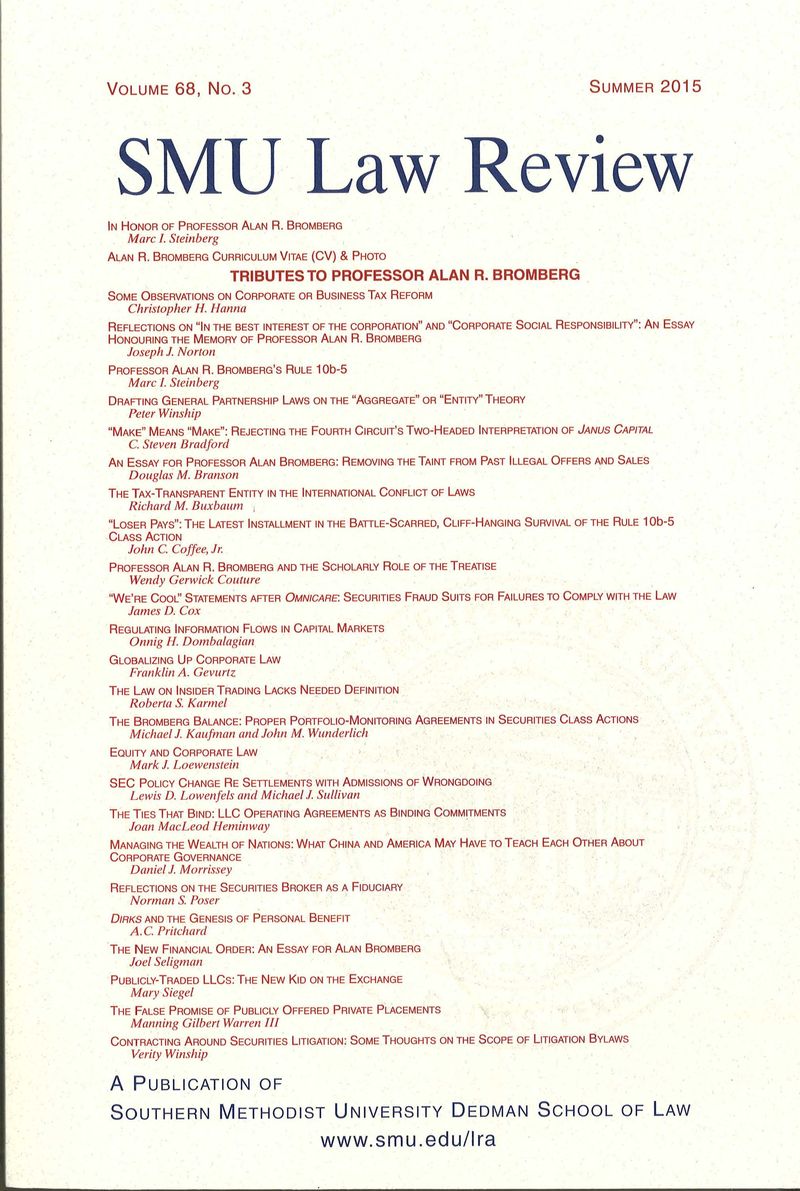
If you’re interested in securities law, there’s a new law review symposium issue worth reading. The SMU Law Review has posted an issue honoring the late securities law scholar Alan Bromberg. The symposium includes a number of interesting essays written by leading securities law scholars, including a piece by my co-blogger Joan Heminway. (I also have an article in the issue, so there’s also at least one non-interesting article by a non-leading scholar.). Here’s a copy of the cover, listing all of the articles:

SMU Cover

Here’s  a PDF copy of the cover, if you can’t see the image.

David Epstein asked me to post the following. I was a commercial law teacher earlier in my career, so I’m happy to.

COMMERCIAL LAW CURRICULUM REDO

We – Wayne Barnes, David Epstein, Paula Franzese and Kevin Tu – are asking for your help.

More and more law schools are no longer regularly offering three-credit courses in (1) payment systems, (2) secured transactions, and/or (3) sales. In part because these schools do not have faculty members who want to teach the courses. And, in part because students do not sign up for commercial law courses. Even if the commercial law courses are taught from 11-12:e30 on Tuesdays and Thursdays.

And, the students are, of course, right. Most students do not need 42 class hours of payment systems or 42 hours of secured transactions or 42 hours more of sales. However, lawyers in a general civil practice do need to have familiarity with core commercial law concepts in order to master the specific statutory provisions that govern the transaction or litigation matter that they are working on. And, before that, there is a need to pass the state bar exam.

We propose that our students’ needs can best be meet in a