Photo of Joan Heminway

Professor Heminway brought nearly 15 years of corporate practice experience to the University of Tennessee College of Law when she joined the faculty in 2000. She practiced transactional business law (working in the areas of public offerings, private placements, mergers, acquisitions, dispositions, and restructurings) in the Boston office of Skadden, Arps, Slate, Meagher & Flom LLP from 1985 through 2000.

She has served as an expert witness and consultant on business entity and finance and federal and state securities law matters and is a frequent academic and continuing legal education presenter on business law issues. Professor Heminway also has represented pro bono clients on political asylum applications, landlord/tenant appeals, social security/disability cases, and not-for-profit incorporations and related business law issues. Read More

It was so much find to have our business law prof colleague Erik Gerding and two fabulous key members of his staff here in Knoxville yesterday.  I had posted on this visit last week.  Our visitors regaled us on the role of the U.S. Securities and Exchange Commission (“SEC”) Division of Corporation Finance, the registration requirements and exemptions under the Securities Act of 1933, as amended (“1933 Act”), and the rule-making part of the Division’s (and SEC’s) mission.

Erik explained how, when he is teaching Securities Regulation, he spends two classes at the beginning of the semester putting the “fear of God” into his students about the registration requirement in Section 5 of the 1933 Act.  (His point is to make the dangers clear up front, since students tend to drop the class who should take it, given that they plan to practice business law in one way or another.)  Erik’s colleague, Jennifer Zepralka, Chief of the SEC’s Office of Small Business Policy, similarly noted in her remarks that there are only three kinds of securities offerings: registered, exempt from registration, and illegal.  Erik’s Counsel, Jeb Byrne, echoed this.  And in the session at lunch time, one of my
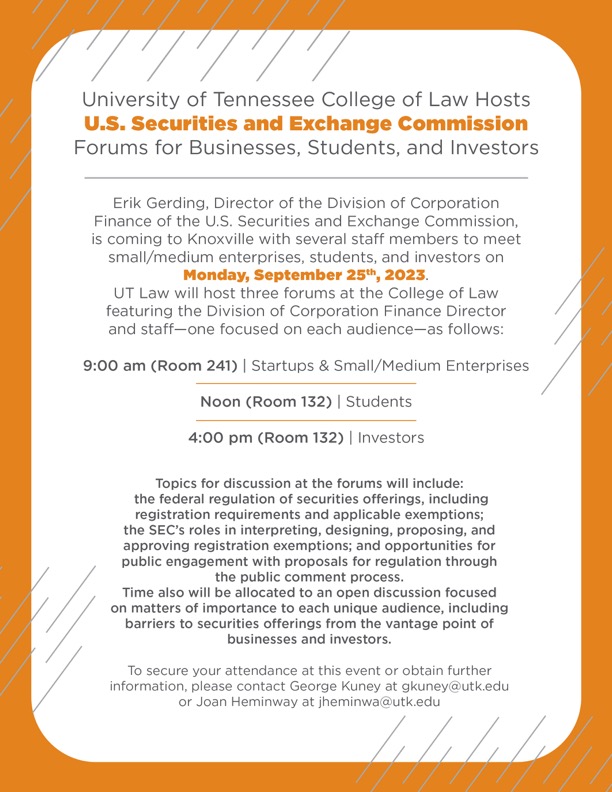
We are excited to welcome our colleague Erik Gerding, the Director of the U.S. Securities and Exchange Commission Division of Corporation Finance, together with members of his staff, to The University of Tennessee College of Law a week from today. Information about the visit is included below.  If you are in the neighborhood, stop by!

SECFlyer

Thanks to my dear and patient friend and colleague Nizan Packin, I set out on a research and writing adventure a bit more than eighteen months ago.  The result is a book chapter on NFTs for her forthcoming edited volume, The Cambridge Handbook for the Law and Policy of NFTs.  The chapter is entitled “Non-investment Finance in an NFT World.”  At her suggestion, I recently posted the draft chapter to SSRN.  You can find it here, and the abstract is set forth below.

Recent years have witnessed the rise of NFTs as vehicles for non-investment finance, including in nonprofit and political fundraising. As with other financial sectors in which NFTs have a role, the use of NFTs in financing nonprofits and political campaigns and committees has revealed gaps and ambiguities in existing legal regulatory systems. Appetite exists to evolve legal frameworks to complete and clarify applicable bodies of law and regulation.

This chapter undertakes to illuminate and reflect on the use of NFTs in financing nonprofits, political campaigns, and political committees. It begins by reviewing general aspects of the non-investment Internet finance environment and then describes and illustrates the use of NFTs in nonprofit and political fundraising.

I found the message below in my “in box” yesterday from Celia Bigoness and Beth Lyon at Cornell Law and thought it important to share the opportunities they reference with the broader BLPB community.  I hope it is useful to those of you considering long-term non-tenure-track roles in the entrepreneurial law space.

I’m happy to share that Cornell Law School is seeking two new clinicians to work in our Entrepreneurship Law Clinic (ELC) and help us create the law school’s first dual-campus clinic. Expanding the ELC, made possible by a generous gift creating the Blassberg-Rice Center for Entrepreneurship Law, represents Cornell Law School’s commitment to community-engaged learning and partnerships throughout New York state.

We are searching for one clinician to be based at our Ithaca campus, and one clinician to be based at the Co at Cornell Law:rnell Tech campus in New York City. Both new hires will have a full-time teaching responsibility in the ELC, working alongside the ELC’s founder and the director of the new center, Celia Bigoness. Both appointments will be to the long-term, presumptively renewable, contract track for permanent clinical faculty at Cornell Law School, with voting rights and academic leave rights consistent with the

BLPB(labor-day-messages-email-headers-6)

I am the daughter of two Depression Era babies.  My parents always appreciated what they had and worked hard to earn it.  And they were aware of and respected those who contributed their time and efforts to bring them products and services.

On Labor Day, it seems appropriate to channel my parents’ gratitude and share it here.  Too often, I take for granted that so much in my life comes from or relies on the labors of others.  I welcome the opportunity today to remember and give thanks.

Parenthetically, I have learned over time (through leadership training and mindfulness activities) that gratitude is an amazingly powerful character strength for lawyers.   As explained on the Via Institute on Character’s website

The character strength of gratitude involves feeling and expressing a deep sense of thankfulness in life, and more specifically, taking the time to genuinely express thankfulness to others. This thankfulness can be for specific gifts or thoughtful acts. . . .Gratitude tends to foster the character strengths of kindness and love, and therefore is closely associated with empathy and with connection to others.

I am certain you can see from this excerpted description why gratitude can be a great asset

Berkeley Center for the Study of Law and Society

Applications for Visiting Scholars Program

THE APPLICATION PERIOD FOR THE 2024-25 ACADEMIC YEAR IS NOW OPEN. 

Please submit your application by December 1, 2023 by e-mail to csls@law.berkeley.edu(link sends e-mail) 

 Inquiries may be made to CSLS at csls@law.berkeley.edu


For more information about the Visiting Scholars program and the Center for the Study of Law and Society, see here.

psu.wd1.myworkdayjobs.com/PSU_Academic/job/… 

Penn State Law, located in University Park, Pennsylvania, invites applications for visiting positions for the spring 2024 semester and the 2024-25 academic year. The rank of this non-tenure-track, term appointment will be Visiting Professor of Practice, Visiting Lecturer, Visiting Assistant Professor, Visiting Associate Professor, or Visiting Professor, based on the applicant’s experience level. The appointment will begin in spring 2024 or fall 2024 and run from one to three semesters, depending on the applicant’s start date and preferences. An extension of the appointment may be possible.

Penn State Law will consider applicants in a variety of subject matter areas. Areas of particular interest include Corporations; Contracts; Real Estate Transactions; Transactional Design and Drafting; and Law and Accounting. Other areas include Trial Advocacy; Evidence; Professional Responsibility; Contract Drafting; Arbitration; Negotiation; Mediation; Criminal Law; Criminal Procedure; Administrative Law; and Constitutional Law.

A law degree – J.D., LL.M., or J.S.D. – is required. The successful applicant will also have experience that suggests the ability to effectively teach students, prior teaching experience as an adjunct professor, guest lecturer, or other equivalent experience teaching/supervising law students in an academic context, or relevant practice experience.
The Pennsylvania State University is committed to and accountable for

image from siliconflatirons.org

Friend-of-the-BLPB Andrew Schwartz has written his first book on a topic about which we both enjoy thinking and researching and writing: investment crowdfunding.  We have been cohabiting this corporate finance space for more than ten years now.  All credit is due to Andrew for laying down these words—his hard-fought wisdom—in a book.  He captures so much about the law and regulation of crowdfunding in the investment context in this volume.  I had the opportunity to offer some feedback to Andrew during the drafting process.   I recommend having the book on your bookshelves.

Colorado Law is hosting an event on its campus in Boulder on September 8, The Future of Startup Finance: A Symposium on “Investment Crowdfunding”, honoring the release of the book, which is entitled Investment Crowdfunding.  If you are in the neighborhood, you’ll want to stop by.  Among the invited speakers are many friends from the corporate finance law academy, as well as former SEC Commissioner Allison Herren Lee.

Congrats to Andrew!

INSTITUTE FOR LAW & ECONOMICS
UNIVERSITY OF PENNSYLVANIA CAREY LAW SCHOOL

SECOND ANNUAL JUNIOR FACULTY BUSINESS AND FINANCIAL LAW WORKSHOP

CALL FOR PAPERS

The Institute for Law & Economics (ILE) at the University of Pennsylvania Carey Law School is pleased to announce its second annual Junior Faculty Business and Financial Law Workshop. The Workshop will be held in person on December 7, 2023 at Penn Carey Law.

The Workshop supports and recognizes the work of untenured legal scholars in the business and financial fields, including accounting, banking, bankruptcy, corporations, economics, finance, tax and securities, while promoting interactions with such scholars, selected tenured faculty and practitioners. By providing a forum for the exchange of creative ideas in these areas, ILE also aims to encourage new and innovative scholarship in the business and financial arena.

Approximately 6-8 papers will be chosen from those submitted for presentation at the Workshop. One or more senior scholars and practitioners will comment on each paper, followed by a general discussion of each paper among all participants. The Workshop audience will include invited untenured scholars, faculty from Penn Carey Law, The Wharton School, and other institutions, practitioners, and invited guests.

We welcome submissions from scholars within the

From Danielle C. Jefferis at Nebraska Law through the Association of American Law Schools portal:

Nebraska Law is seeking entry-level and lateral candidates for tenure-track positions in Contracts and Business Organizations. Other courses that would fill curricular needs include but are not limited to Antitrust, Trademark/Unfair Competition, Corporate Finance, Transactional Drafting, Wills and Trusts, Accounting for Lawyers, Mediation, Negotiation, Client Counseling, Remedies, Natural Resources, Environmental Law, and Health Law. The posting is here: employment.unl.edu/postings/87281

I am on the Appointments Committee and happy to answer any questions from those interested. You may also reach out to the committee chair, Anthony Schutz, at lawappointments@unl.edu.