
Uber has a new CEO. Perhaps his first task should be to require one of his legal or compliance staff to attend the FCPA conference at Texas A & M in October given the new reports of an alleged DOJ investigation.. I might have some advice, but Uber needs to hear the lessons learned from Walmart, who will be sending its Chief Compliance Officer. Thanks to FCPA expert, Mike Koehler, aka the FCPA Professor, for inviting me. Mike has done some great blogging about the Walmart case (FYI- the company has reported spending $865 million on fees related to the FCPA and compliance-related costs). Details are below:

THE F​CPA TURNS 40:
AN ASSESSMENT OF FCPA ENFORCEMENT POLICIES AND PROCEDURES

FCPA ConferenceThursday, October 12, 2017
Texas A&M University School of Law
Fort Worth, Texas

This conference brings together Foreign Corrupt Practices Act enforcement officials, experienced FCPA practitioners, and leading FCPA academics and scholars to discuss the many legal and policy issues relevant to the current FCPA enforcement and compliance landscape.

Register here

AGENDA

[Click here to download agenda pdf]

Registration, 8:30 a.m.

Morning Session, 9:00 a.m. to Noon

FCPA Legal and Policy Issues
Good morning from gorgeous Belize. I hope to see some of you this weekend at SEALS. A couple of weeks ago, I posted about the compliance course I recently taught. I received quite a few emails asking for my syllabus and teaching materials. I am still in the middle of grading but I thought I would provide some general advice for those who are considering teaching a similar course. I taught thinking about the priorities of current employers and the skills our students need.

1) Picking materials is hard– It’s actually harder if you have actually worked in compliance, as I have, and still consult, as I do from time to time. I have all of the current compliance textbooks but didn’t find any that suited my needs. Shameless plug- I’m co-authoring a compliance textbook to help fill the gap. I wanted my students to have the experience they would have if they were working in-house and had to work with real documents.  I found myself either using or getting ideas from many primary source materials from the Society of Corporate Compliance and Ethics, the  Institute of Privacy ProfessionalsDLA Piper, the Federal Sentencing Guidelines for

ABABookCover

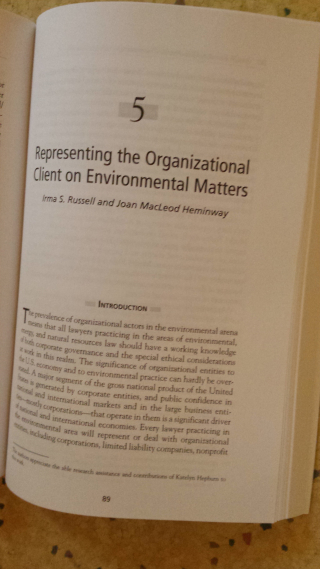
My good friend and long-time mentor Irma Russell and I wrote a chapter for the recently released ABA book, Ethics and the Environment: A Lawyer’s Guide.  Irma also is a co-editor of the book (with Vicki Wright).  In our joint contribution, the chapter entitled “Representing the Organizational Client on Environmental Matters,” Irma and I cover issues involving professional responsibility, corporate governance, and environmental compliance.  Guess which part was my primary responsibility . . . ?!)  Covering some 37 pages of the 242-page book, the rules we cover and the observations we make are fairly wide-ranging.  We hope, as we noted in our conclusion to the chapter, that we supply legal counsel representing corporations and other organizations with “foundational tools to assist them in providing advisory and advocacy-oriented services to organizational clients in the environmental law context.”  Irma and I received our copies last week.  The book soon will be available through the ABA and other outlets.


ABABookChapterPage

SaveSaveSaveSave

SaveSave

Prior to joining academia, I served as a compliance officer, deputy GC, and chief privacy officer for a Fortune 500 company. I had to learn everything on the job by attending webinars and conferences and reading client alerts. Back then, I would have paid a law school graduate a competitive salary to work in my compliance group, but I couldn’t find anyone who had any idea about what the field entailed.

The world has changed. Now many schools (including mine) offer relevant coursework for this JD-advantage position. I just finished teaching a summer skills course in compliance and corporate social responsibility, and I’m hoping that I have encouraged at least a few of the students to consider it as a viable career path. Compliance is one of the fastest growing corporate positions in the country, and the number of compliance personnel has doubled in the past 6 years. Still, many business-minded law students don’t consider it in the same vein as they consider jobs with Big Law.

This summer, my twelve students met twice a week for two hours at 7:30 pm. In the compressed six-week course, they did the following:

  • Heard from compliance officers and outside counsel for public

Yesterday, during a conversation with a law student about whether corporate social responsibility is a mere marketing ploy to fool consumers, the student described her conflict with using Uber. She didn’t like what she had read in the news about Uber’s workplace culture issues, sex harassment allegations, legal battles with its drivers, and leadership vacuum. The student, who is studying for the bar, probably didn’t even know that the company had even more PR nightmares just over the past ten days— the termination of twenty employees after a harassment investigation; the departure of a number of executives including the CEO’s right hand man; the CEO’s “indefinite” leave of absence to “mourn his mother” following a scathing investigative report by former Attorney General Eric Holder; and the resignation of a board member who made a sexist remark during a board meeting (ironically) about sexism at Uber. She clearly hadn’t read Ann Lipton’s excellent post on Uber on June 17th.

Around 1:00 am EST, the company announced that the CEO had resigned after five of the largest investors in the $70 billion company issued a memo entitled “Moving Uber Forward.” The memo was not available as

Last week, a reporter interviewed me regarding conflict minerals.The reporter specifically asked whether I believed there would be more litigation on conflict minerals and whether the SEC’s lack of enforcement would cause companies to stop doing due diligence. I am not sure which, if any, of my remarks will appear in print so I am posting some of my comments below:

I expect that if conflict minerals legislation survives, it will take a different form. The SEC asked for comments at the end of January, and I’ve read most of the comment letters. Many, including Trillium Asset Management, focus on the need to stay the course with the Rule, citing some success in making many mines conflict free. Others oppose the rule because of the expense. However, it appears that the costs haven’t been as high as most people expected, and indeed many of the tech companies such as Apple and Intel have voiced support for the rule. It’s likely that they have already operationalized the due diligence. The SEC has limits on what it can do, so I expect Congress to take action, unless there is an executive order from President Trump, which people have been expecting since February. 
 
The Senate

As a business lawyer in private practice, I found it very frustrating when the principals of business entity clients acted in contravention of my advice.  This didn’t happen too often in my 15 years of practice.  But when it did, I always wondered whether I could have stopped the madness by doing something differently in my representation of the client.

Thanks to friend and Wayne State University Law School law professor Peter Henning, who often writes on insider trading and other white collar crime issues for the New York Times DealBook (see, e.g., this recent piece), I had the opportunity to revisit this issue through my research and present that research at a symposium at Wayne Law back in the fall of 2015.  The law review recently published the resulting short article, which I have posted to SSRN.  The abstract is set forth below.

Sometimes, business entity clients and their principals do not seek, accept, or heed the advice of their lawyers. In fact, sometimes, they expressly disregard a lawyer’s instructions on how to proceed. In certain cases, the client expressly rejects the lawyer’s advice. However, some business constituents who take action contrary to the advice of legal counsel

Earlier this month, the EU announced plans to implement its version of conflict minerals legislation, which covers all “conflict-affected and high-risk areas” around the world. Once approved by the Council of the EU, the law will apply to all importers into the EU of minerals or metals containing or consisting of tin, tantalum, tungsten, or gold (with some exceptions). Compliance and reporting will begin in January 2021. Importers must use OECD due diligence standards, report on their progress to suppliers and the public, and use independent third-party auditors. President Trump has not yet issued an executive order on Dodd-Frank §1502, aka conflict minerals, but based on a leaked memo, observers believe that it’s just a matter of time before that law is repealed here in the U.S. So why is there a difference in approach?

In response to a request for comments from the SEC, the U.S Chamber of Commerce, which led the legal battle against §1502, claimed, “substantial evidence shows that the conflict minerals rule has exacerbated the humanitarian crisis on the ground in the Democratic Republic of the Congo…The reports public companies are mandated to file also contribute to ―information overload and create further disincentives

I’m too busy to blog today because I am preparing a training presentation on governance duties for nonprofits. The audience will consist of high level staff, not board members. I have served on many nonprofits and have advised others but I would be interested in your thoughts. Do you teach nonprofit law? Do you sit on nonprofits? What issues do you think nonprofit board members and staffer should know? Among other things, I plan to focus on fiduciary duties, maintaining 501(c)(3) exemption status, agency issues, the implications of Sarbanes-Oxley, conflicts of interest, document retention, code of ethics/whistleblower (to comport with 990),why nonprofits get sued, compensation issues, lobbying, insurance and indemnification, the role of different committees (particularly the audit committee), how to take good minutes, etc. I plan to use hypotheticals to help make the points stick. If you can think of other matters for my 3 hour module or some good case studies, please comment below or inbox me at mnarine@stu.edu. 

Businesses from small farmers to cruise lines are anxiously awaiting President Trump’s policy on Cuba and how/if he will rescind President Obama’s Executive Orders relaxing restrictions on doing business with the island.

If you’re in the South Florida area next Friday March 10th, please consider attending the timely conference on Doing Business in Cuba: Legal, Ethical, and Compliance Challenges from 8:00 am-4:30 pm at the Andreas School of Business, Barry University. The Florida Bar has granted 6.5 CLE credits, including for ethics and for certifications in Business Litigation and International Law. The Miami-Dade Commission on Ethics and Public Trust is organizing the event.

As a member of the Commission and an academic who has just completed my third article on Cuba, I’m excited to provide the opening address for the event. I’m even more excited about our speakers John Kavulich, President, U.S. Cuba Trade and Economic Council Inc;  the general counsel of Carnival Cruise Lines;  mayors of Miami Beach, Coral Gables, and Doral; director of the Miami International Airport; a number of academic experts from local universities; Commissioners Nelson Bellido and Judge Lawrence Schwartz; and outside counsel  from MDO Partners, Akerman LLP, Holland & Knight, Greenberg Traurig, Squire Patton Boggs