
I am a list maker.  I make daily to do lists, grocery lists, research plans, workout schedules (that quickly get jettisoned) and  complicated child care matrices necessary in two-career families.  How else am I supposed to remember and keep on my radar all of the things that I am supposed to be doing now, or doing when I have time, or things that I can’t forget to do in the future?  One area where I feel deficient is in planning my conference travel/attendance. It always feels either a little ad hoc (ohh I got an invitation and I never say no to those!) or a little out habit (once you have presented at a conference it is easier to be asked to participate in future panels). Rarely does it feel like a part of an intentional plan for the year where I set out to prioritize conference A or break into conference B.  

Realizing that this year there are 3 corporate law events within 10 days of each other is seriously making me reconsider my approach.  I need a conference list– a way to plan for the coming year, prioritize opportunities and frankly, schedule grandparent visits
Environmental groups and other opponents of high-volume hydraulic fracturing (also known as fracking) for oil and natural gas have roundly applauded Governor Cuomo’s decision to ban the process in the state of New York. The ban, which confirms New York’s more than five-year moratorium on the process, has been lauded as an environmental success and a model for other states.   The ban is neither. 

Oil and natural gas prices are at their lowest prices in years. Interest in expanding drilling in the Marcellus Shale, which is the geologic formation holding natural gas deposits under New York, Pennsylvania, and West Virginia, is correspondingly low.  That makes the fracking ban an easy decision because there is relatively limited interest in drilling in state.

There are those with interest in drilling in New York, of course, but as long as prices are low and there are other places to drill (like Pennsylvania and West Virginia), that interest will remain modest.  The ban also raises the value of Pennsylvania and West Virginia mineral rights by reducing competition, so companies with interests in the entire region have little reason to weigh in forcefully.

In this environment, then, an outright ban was easier to put in

In September, Myles Udland  wrote an article citing Burton G. Malkiel and his book, A Random Walk Down Wall Street, noting, “The past history of stock prices cannot be used to predict the future in any meaningful way.” This is a great point.

I also saw Udland’s article from today, which notes oil prices (and stock prices) have gone bonkers. Both prices have fluctuated wildly, and oil has been mostly trending mostly downward. As I have said before, I don’t expect prices to stay low (sub-$70 per barrel) for long, but time will tell.  

Low oil and gas prices are certainly having an impact on markets and economies. The big one right now is Russia, which is struggling, in major part because of low oil prices.  The ruble has taken a beating, and the nation’s central bank raised interest rates from 10.5 to 17 percent. Wow.  

The bulk of U.S. oil production appears safe well in the low- to mid-$40 per barrel price range, and I don’t think it will stay below $55 for long.  Then again, as much as I follow all of this, I am still a law professor, and not a financial analyst, so

Earlier this week, I watched Ivory Tower: Is College Worth the Cost? on CNN, which was a somewhat depressing documentary for someone who hopes to spend the next 30+ years in higher education.

One of the things the documentary decries is the construction of more and more extravagant buildings and amenities on college campuses.

While the extent and type of building that should occur can be reasonably debated – and my own institution has almost doubled the number of buildings on campus in the past decade – I want to make a relatively modest claim here: aesthetics matter in higher education.

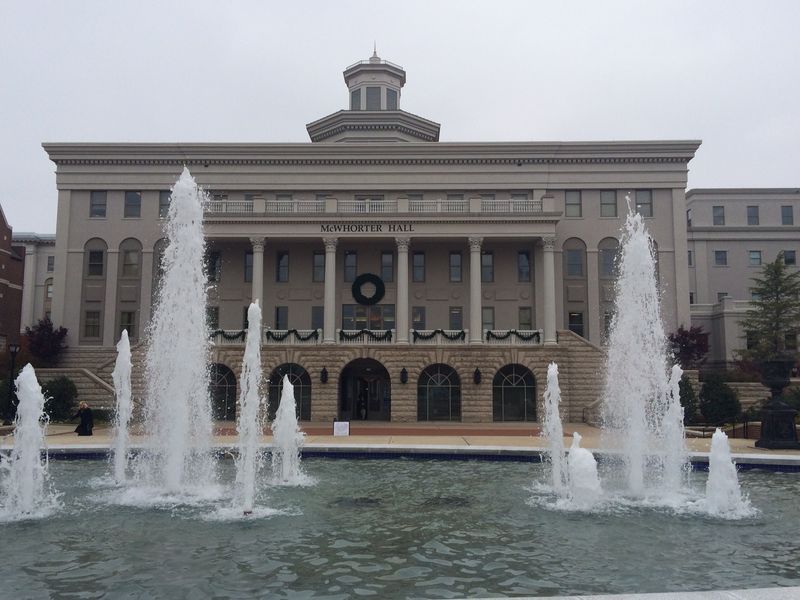
Belmont University

(Photo of a Belmont University building and fountain from my iPhone).

Perhaps some schools have gone overboard in creating beautiful campuses. However, at institutions that exist to illuminate for students something much more important than mere financial returns, I think it is fitting to invest in beautiful campuses, for their own sake.

Again, perhaps most schools do not need student recreation centers than costs hundreds of millions of dollars, but there is something inspiring about going to a school, and teaching at a school, that is breathtakingly beautiful. 

This post may surprise some people who know me because I

Note to all legislators and regulators: don’t do anything until you’ve thought through all the consequences.

One of the most important things I learned as a student of public policy was the difference between static and dynamic analysis. Static analysis looks only at the immediate consequences of a change. Dynamic analysis looks at the long-term consequences of a change, taking into account how people will adjust to that change.

If I tell my students they must write a 50-page paper by Friday or fail, most of them will at least try to write the 50-page paper. That’s the static effect. But no one will ever take my Business Associations class again. That’s the dynamic effect.

For some people today, including an increasing number of politicians on both sides of the aisle, neither static nor dynamic effects matter. It’s enough just to have good intentions. “Don’t you care?”, those people ask. “We need to do something.”

Even when policy makers do consider the effects of their policy choices, many of them consider only the immediate effects—static analysis—and don’t think about the long-term consequences. That’s unfortunate, because legislation and regulation often have unintended consequences.

That’s the point of Thomas E. Hall’s new

Many financial industry analysts are bearish on the oil industry right now. I’m not sure they’re right, as I note below, but I also think it’s important to recognize that financial market impact of oil price fluctuations is not the only impact U.S. oil production has on markets generally.

One thing I want to make clear at the outset, though, is that I am not a financial analyst, or an economist (as I have previously noted). My comments here are reactions to things analysts are saying based on my experience researching U.S. shale oil markets and activity, as well as the U.S. transportation sector in recent years.  My thoughts are related to my expectations for how I think the companies and people in the industry are likely to react, and reflect my hope that financial market changes don’t negatively impact other essential planning, in areas related to health, safety, and the environment, the industry desperately needs.

Back to the market predictions:  Goldman Sachs and some other analysts see the oil sector as over saturated and anticipate continued supply gluts to keep prices down.  According to a report from Goldman analysts, U.S. price indicator West Texas Intermediate (WTI) crude will fall

To be clear, I’m not an economist. I do, however, have an interest in economics, economic theory, and especially behavioral economics.  I incorporate basic concepts of economics into my courses, especially Business Organizations and Energy Law.   This week’s announcement of  Jean Tirole as the 2014 Nobel Laureate in economics thus caught my eye.  

I admit I did not much about Tirole before the announcement, and after just a little reading, it’s clear to me that I need to know more.  A nice summary of Tirole’s work (written by Tyler Cowen) can be found here. Cowen introduces the announcement and Tirole this way:

A theory prize!  A rigor prize!  I would say it is about principal-agent theory and the increasing mathematization of formal propositions as a way of understanding economics.  He has been a leading figure in formalizing propositions in many distinct areas of microeconomics, most of all industrial organization but also finance and financial regulation and behavioral economics and even some public choice too.  He is a broader economist than many of his fans realize.

Tirole is a Frenchman, he teaches at Toulouse, and his key papers start in the 1980s.  In industrial organization, you can think of him