
If you’re interested in securities law, there’s a new law review symposium issue worth reading. The SMU Law Review has posted an issue honoring the late securities law scholar Alan Bromberg. The symposium includes a number of interesting essays written by leading securities law scholars, including a piece by my co-blogger Joan Heminway. (I also have an article in the issue, so there’s also at least one non-interesting article by a non-leading scholar.). Here’s a copy of the cover, listing all of the articles:
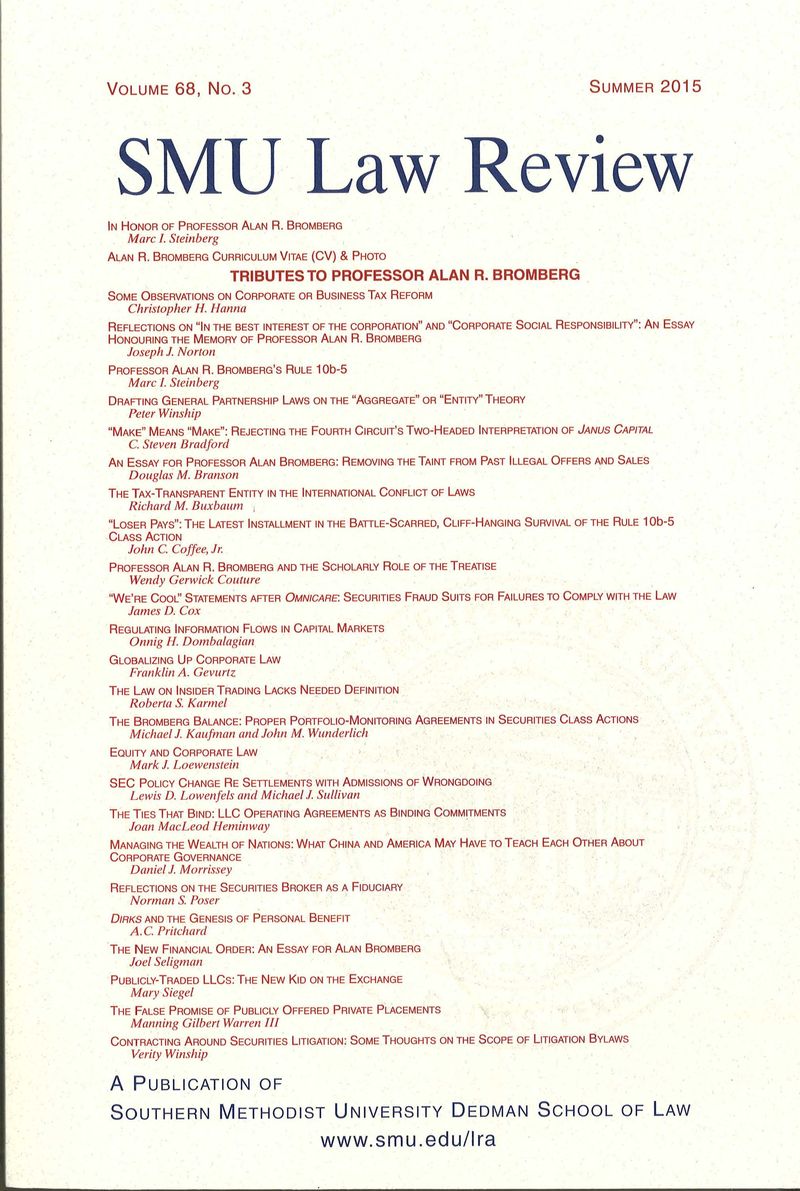
SMU Cover

Here’s  a PDF copy of the cover, if you can’t see the image.

You may have missed the most recent amendments to federal securities law. They were tucked into the Surface Transportation Reauthorization and Reform Act (H.R. 22), which President Obama signed into law on December 4.  Where else would you put securities law amendments?

The full Act, which includes a number of changes to securities law, is available here. I don’t recommend wading through it, unless you’re really into surface transportation. Today, I want to talk about one particular provision, a new exemption for the resale of securities.

As you may know, the Securities Act’s convoluted definition of “underwriter” makes it difficult to know when one may safely resell securities purchased in an unregistered offering (or when an affiliate of the issuer may safely resell any securities, registered or not). The SEC has enacted a couple of safe harbors, Rule 144 and Rule 144A. Rule 144A limits sales to large institutional buyers, so most ordinary resales are structured to meet the requirements of Rule 144. Sellers now have another option.

H.R. 22 adds a new section 4(a)(7) exemption to the Securities Act, as well as new subsections 4(d) and 4(e) to define that exemption.

Section 4(a)(7) exempts resales to accredited investors

Earlier this month, the DC Circuit denied a petition for rehearing on the conflict minerals disclosure, meaning the SEC needs to appeal to the Supreme Court or the case goes back to the District Court for further proceedings. At issue is whether the Dodd-Frank requirement that issuers who source minerals from the Democratic Republic of Congo label their products as “DRC-conflict free” (or not) violates the First Amendment. I have argued in various blog posts and an amicus brief that this corporate governance disclosure is problematic for other reasons, including the fact that it won’t work and that the requirement would hurt the miners that it’s meant to protect. Congress, thankfully, recently held hearings on the law.

I’ve written more extensively on conflict minerals and the failure of disclosures in general in two recent publications. The first is my chapter entitled, Living in a material world – from naming and shaming to knowing and showing: will new disclosure regimes finally drive corporate accountability for human rights? in a new book that we launched two weeks ago at the UN Forum on Business and Human Rights in Geneva. You’ll have to buy the book The Business and Human Rights Landscape: Moving

One final post on the SEC’s proposed changes to Rule 147 and I promise I’m finished—for now. Today’s topic is the effect the proposed changes will have on state crowdfunding exemptions. If the SEC adopts the proposed changes to Rule 147, many state legislatures will have to (or at least want to) amend their state crowdfunding legislation.

As I explained in my earlier posts here and here, the SEC has proposed amendments to Rule 147, currently a safe harbor for the intrastate offering exemption in section 3(a)(11) of the Securities Act. If the proposed amendments are adopted, Rule 147 would become a stand-alone exemption rather than a safe harbor for section 3(a)(11). There would no longer be a safe harbor for intrastate offerings.

That creates some issues for the states. Many states have adopted state registration exemptions for crowdfunded securities offerings that piggyback on the federal intrastate offering exemption. That makes sense, because, if the offering isn’t also exempted at the federal level, the state crowdfunding exemption is practically worthless. (An offering pursuant to the federal crowdfunding exemption is automatically exempted from state registration requirements, but these state crowdfunding exemptions provide an alternative way to sell securities through crowdfunding.)

Once the SEC has created a safe harbor for a statutory exemption, can it ever really get rid of it? That’s one of the issues raised by the SEC’s proposed changes to Rule 147, which I considered in detail last week.

Rule 147 is currently a safe harbor for the intrastate offering exemption in section 3(a)(11) of the Securities Act. Section 3(a)(11) exempts from the Securities Act registration requirement

“Any security which is a part of an issue offered and sold only to persons resident within a single State or Territory, where the issuer of such security is a person resident and doing business within or, if a corporation, incorporated by and doing business within, such State or Territory.”

Rule 147 currently provides that an offering

“made in accordance with all of the terms and conditions of this rule shall be deemed to be part of an issue offered and sold only to persons resident within a single state or territory where the issuer is a person resident and doing business within such state or territory, within the meaning of section 3(a)(11) of the Act.”

In other words, if you meet the requirements of Rule 147, you are within

The Department of Labor issued new interpretive guidelines for pension investments governed by ERISA.  A thorny issue has been to what extent can ERISA fiduciaries invest in environmental, social and governance-focused (ESG) investments?  The DOL previously issued several guiding statements on this topic, the most recent one in 2008, IB 2001-01, and the acceptance of such investment has been lukewarm. The DOL previously cautioned that such investments were permissible if all other things (like risk and return) are equal.  In other words, ESG factors could be a tiebreaker but couldn’t be a stand alone consideration. 

What was the consequence of this tepid reception for ESG investments?  Over $8.4 trillion in defined benefit and defined contribution plans covered by ERISA have been kept out of ESG investments, where non-ERISA investments in the space have exploded from “$202 billion in 2007 to $4.3 trillion in 2014.” 

In an effort to correct the misperceptions that have followed publication of IB 2008-01, the Department announced that it is withdrawing IB 2008-01 and is replacing it with IB 2015-01

The new guidance admits that previous interpretations may have

“unduly discouraged fiduciaries from considering ETIs and ESG factors. In particular, the Department is

Here’s something everyone who has ever taken Securities Regulation should know: Section 3(a)(11) of the Securities Act, the intrastate offering exemption, has a safe harbor, Securities Act Rule 147.

As Lee Corso would say, “Not so fast, my friend.”  The SEC is proposing to overturn that longstanding wisdom. If the SEC’s proposed changes to Rule 147 are adopted,Rule 147 would no longer be tied to section 3(a)(11) and section 3(a)(11) would no longer have a safe harbor. The intrastate nature of Rule 147 would be preserved, but the proposed changes would be adopted under the SEC’s general exemptive authority in section 28 of the Securities Act.

Here are the most significant changes that the SEC has proposed:

Tied to State Regulation

The premise of section 3(a)(11) and its Rule 147 safe harbor is to relegate purely intrastate offerings to state regulation. But there’s currently nothing in Rule 147 to enforce that premise; federal exemption does not depend on state regulation of the offering.

The SEC proposal would expressly tie the federal Rule 147 exemption to state regulation. An offering would qualify for the federal exemption only if it was (1) registered at the state level or (2) sold pursuant

I had the honor of being invited to speak at the annual symposium for the Wayne Law Review two weeks ago.  The event, which focused on Corporate Counsel as Gatekeepers, was well organized and attended–and also very stimulating.  Speakers included Tony West as a keynote, a few of us academics, and a bunch of current and former practitioners–prosecutors, in-house counsel, and outside counsel.

My presentation focused on a story that bugs me–a story built on an experience I had in practice.  In the story (which modifies the true facts), an executive flagrantly violates a securities trading compliance plan that I drafted in connection with a subsequent transaction that I worked on for the executive’s firm.  Specifically, the executive informs a friend about the transaction the day before it is announced, believing that the friend will never trade on the information.  The friend trades.  The incident results in a stock exchange and Securities and Exchange Commission (SEC) inquiries.  No enforcement is undertaken against the firm.  However, the executive signs a consent decree with–and pays a cash penalty to–the SEC and, together with the firm, suffers public humiliation via a front-page article in the local newspaper (since the SEC would not agree to forego a press release).  This fact pattern gnaws at me because I wonder whether there is anything more legal counsel can do to prevent an executive from violating a compliance policy to the detriment of himself and the firm . . . .

This hit my mailbox this morning.  If the report is correct, we’ll know in a few days whether we have a path to unregistered, broad-based securities crowdfunding in the United States.  More as news is reported . . . .

[Additional information:  Based on the link to the SEC’s notice of meeting in Steve Bradford’s comment to this post, it also appears that the SEC is considering amendments to Rules 147 (intrastate offerings) and 504 (limited offerings under Regulation D of up to $1,000,000).]

The Second Circuit decision in the Newman case has provoked much discussion of the Supreme Court’s opinion in Dirks and how to interpret the requirements it lays out for tippee liability. But it’s important to remember that Dirks was not writing on a clean slate. This year is the 35th anniversary of the case that preceded Dirks and laid the foundation for the Supreme Court’s insider-trading jurisprudence, Chiarella v. United States.

I realize that this was not the Supreme Court’s first look at insider trading. That honor, arguably, goes to Strong v. Repide, 213 U.S. 419 (1909). But Chiarella was the court’s first discussion of insider trading under Rule 10b-5.

The facts of the Chiarella case are relatively simple. Vincent Chiarella, the defendant in the case, was an employee of Pandick Press, a financial printer. His company was hired to print announcements of takeover bids. Although the identities of the target corporations were concealed in the announcements, Chiarella was able to figure out who they were. He bought stock in the target companies and made a profit of roughly $30,000. He was convicted of a criminal violation of Rule 10b-5, but the Supreme Court overturned his conviction.

It’s