
C6Glr.AuSt.79

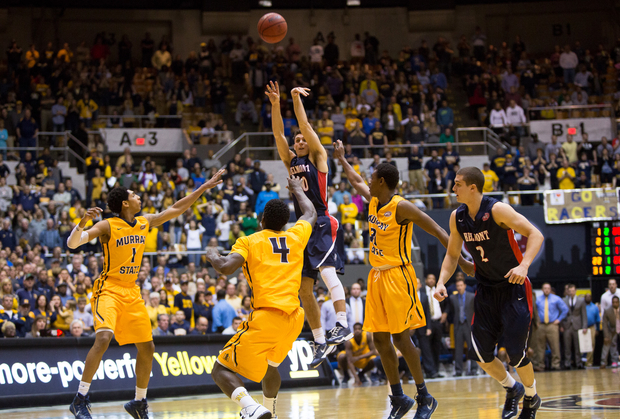
At Belmont, we have been basking in the glow of a dramatic win in the men’s basketball OVC championship game.

While I could not be prouder of all the members of our team, many of whom are majoring in business, I am most proud of the way they played and conducted themselves – with heart, effort, intelligence, humility, confidence, and class. Murray State, holder of a 25-game win-streak and ranked #25 in the country coming into the game, played just as hard and conducted themselves with class as well.

The OVC championship game was the best basketball game I have ever seen and it was a shame that either team had to lose. In the unlikely event that any selection committee members are reading this, I think Murray State deserves a spot in the NCAA tournament as well; how do you justify dropping a team from #25 to outside the top-68 teams after a well-played 1-point loss to another strong team?

Since that basketball game, I have been thinking a lot about “winning” as compared to “how you play the game.” Growing up, I was insanely competitive and was obsessed with winning. I loved the quote attributed to

This Sunday, the NCAA will announce the 68 basketball teams that are scheduled to participate in this year’s men’s basketball tournament.  Then, the true “madness” begins.  

At many schools, one or more professors will likely organize an NCAA Tournament pool.  The pool will likely include entry fees and prize money. The pool’s rules and standings will often appear on a public website.

All of this may sound like innocuous fun — especially during the anxiety-ridden days of waiting for ExpressO and Scholastica acceptances to arrive.  However, law professors playing in online, pay-to-enter NCAA Tournament pools technically are acting in violation of several federal laws — albeit, laws that are rarely enforced,

One federal law that seems to prohibit online, pay-to-enter NCAA Tournament pools is the Interstate Wire Act of 1961.  This act disallows individuals from “engaging in the business of betting or wagering [through the knowing use of] a wire communication for the transmission in interstate or foreign commerce.”  According to various recent court decisions, the Wire Act applies to contests hosted via the Internet, as well as those hosted over the phone.  And even though the act was originally passed to crack down on organized crime, even “upstanding” individuals

Ten days from now will mark the start of the 2015 NCAA men’s basketball tournament — one of the most watched sporting events of the year.   Recently, the NCAA sold 14 years worth of television broadcast rights to the NCAA Tournament for $10.8 Billion.  On an annual basis, that comes to an annual sum of  $770 Million per year.  

The athletes who play in these games, by contrast, do not receive any share of the derived revenues, nor are they allowed to endorse products or sign autographs for money.  In addition, the most successful teams in this tournament will have athletes that are required to miss upwards of nine class days based on a tournament schedule that is created to accommodate television broadcasts.

As a guest blogger for the month of March, I will be discussing the legal issues related to NCAA amateurism and the economic realities of the NCAA men’s basketball tournament.  Some of the topics I will discuss include why the NCAA is indeed an economic cartel, why the U.S. district court’s decision in O’Bannon v. NCAA does not go far enough to protect college athletes, why perhaps the National

Marc

The Business Law Prof Blog is pleased to announce that Professor Marc Edelman will be joining us as a guest blogger for the month of  March. Quoting from his online bio, “Marc Edelman is an Associate Professor of Law at the Zicklin School of Business, Baruch College, City University of New York. He specializes in sports law, antitrust, intellectual property, and gaming law.” During the summers, he also teaches at Fordham University School of Law.

I was previously familiar with Marc Edelman’s work through my interest in sports and through a bit of reading in the antitrust area. All of his areas of interest have significant intersections with business law and I look forward to reading his posts. Given that he is one of the most recognized experts in the area of law & sports, we are especially privileged to have him with us right before March Madness. 

Anyone who has followed me on Twitter knows that I am a pretty regular runner. I try to run at least four times a week, and depending on the time of year, my schedule, and other variables, I have run as much as six times a week.

It was not always this way. I have asthma, which didn’t help much as a kid, but that problem has been controlled by medication for years. And although I was a soccer player, I was not much of a runner. Goalkeepers often aren’t.  In my older years, I was known to say from time to time, “I only run when being chased.”

Sometime in 2011, that changed. I started running three miles, most days.  I got a pair of the Nike Free Run Shoes, which may or may not have helped, but I was less sore then I was with the old, stable, and heavy, running shoes I would previously tried to run.  Not long after that I got the Nike+ running app, which tracked my runs and served as a motivator and something of a personal accountability measure, as I shared my run with friends.   

In a little more than three

I was watching the Michigan State-Iowa basketball game a couple weeks ago, and commentator Jay Bilas noted his view (which he has stated previously) that the lane violation rule is wrong. I am teaching Sports Law and an Energy Law Seminar this semester, so (naturally) I linked his comments to a broader framework. 

So start, here’s the current rule.  Basketball for dummies explains

Lane violation: This rule applies to both offense and defense. When a player attempts a free throw, none of the players lined up along the free throw lane may enter the lane until the ball leaves the shooter’s hands. If a defensive player jumps into the lane early, the shooter receives another shot if his shot misses. An offensive player entering the lane too early nullifies the shot if it is made.

Bilas argues that a defensive lane violation should result in the ball being awarded to shooter’s team instead of another attempt at the free throw for the shooter.  His rationale is, “The advantage to be gained going in early is on the rebound, not the shot. Give the ball to the non-violating team.” This is probably right, though a player might enter the lane early

Many people have been talking about the four teams chosen for the inaugural college football playoff. I, good business law blogger that I am, have been thinking about conflicts of interest on the selection committee.

If you’re a football fan, you know that this year, for the first time, the national champion in NCAA major college football will be chosen through a four-team playoff. The four teams selected—Alabama, Oregon, Florida State, and Ohio State—will participate in two semifinal games, with the two winners to play for the championship. (Yes, Art Briles, Baylor should be one of the four, but, no, Ohio State is not the team that shouldn’t be there.)

The four participating schools are chosen by a thirteen-person selection committee, although one of the members, Archie Manning, has taken a leave of absence this year for health reasons. The committee includes several people with current relationships to schools that play major college football, including the following athletic directors:  Jeff Long, Arkansas; Barry Alvarez, Wisconsin; Pat Haden, USC; Oliver Luck, West Virginia; and Dan Radakovich, Clemson.

The selection committee adopted a recusal policy that requires committee members to recuse themselves if the committee member or an immediate

Many of you may have seen this already, but this past week’s news brought with it an update to JPMorgan Chase CEO Jamie Dimon’s health situation–positive news on his cancer treatment results, for which we all can be grateful. I posted here about Dimon’s earlier public disclosure that he was undergoing treatment for this cancer.  Based on publicly available information, I give Dimon my (very unofficial) “Power T for Transparency” cheer for 2014.  (The “Power T” is The University of Tennessee’s key–and now almost exclusive–branding symbol.  See my earlier posts on UT’s related branding decisions regarding the Lady Volunteers here and here.) 

As many of you know, I have written about  securities  law and corporate law disclosure issues relating to private facts about key executives (which include questions relating to the physical health of these important corporate officers).  I do not plan to rehash all that here. But I will note that I think friend and Glom blogger David Zaring gets it just right in his brief report on the recent Dimon announcement (with one small typo corrected and a hyperlink omitted):

Not to pile on, but there’s the slightly unsettling trend of CEOs talking, or not

Randall Thomas (Vanderbilt Law School) and Lawrence Van Horn (Owen Graduate School of Management, Vanderbilt University) have posted a new article entitled Are Football Coaches Overpaid? Evidence from Their Employment Contracts.

This is a rare article that appeals to both my academic interests and my interest in football. Rarely do these two set of interests overlap in my life, and the article has prompted me to think of ways I might incorporate my football knowledge into future academic articles. 

The article’s abstract reads:

The commentators and the media pay particular attention to the compensation of high profile individuals. Whether these are corporate CEOs, or college football coaches, many critics question whether their levels of remuneration are appropriate. In contrast, corporate governance scholarship has asserted that as long as the compensation is tied to shareholder interests, it is the employment contract and incentives therein which should be the source of scrutiny, not the absolute level of pay itself. We employ this logic to study the compensation contracts of Division I FBS college football coaches during the period 2005-2013. Our analysis finds many commonalities between the structure and incentives of the employment contracts of CEOs and these football coaches. These contracts’ features

NDSU

First Joshua Fershee visits North Dakota, now ESPN’s College GameDay

North Dakota State University, which is being featured on GameDay this morning, is also one of the schools looking for a business law professor (albeit a “lecturer”) on my updated list here.

While most of my co-bloggers teach at much bigger sports schools than I, as I mentioned previously, it is a lot of fun teaching at a school that gets at least occasional national attention for its sports teams.