BA(MasonJones-1)

I wanted to get there first, but friend, co-blogger, and Nova Southeastern Law colleague Jim Levy beat me to it.  In a blog post for Legal Skills Prof Blog, Jim wrote about the incredible similarities between the game show Hollywood Squares and Zoom teaching.  As I teach my last classes of the semester today–all online (thanks to our dean’s promotion of online teaching for the last two class days of the semester)–I continue to be stuck on  and struck by this similarity.  We are not the only ones to note this comparison, of course.  See, e.g., here and here and here.

I have called the Zoom squares the Hollywood Squares more than once during my class sessions this semester.   Unlike Jim, however, I have not yet endeavored to “play host” in a way that mimics the show.  He recalls (as do I) Peter Marshall’s lengthy stint as the show’s host.  But it does turn out there were others.

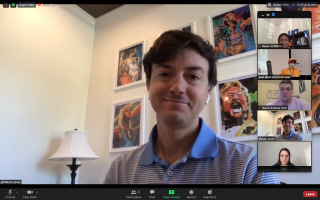
As I bid goodbye to the Fall 2020 semester, I leave you with a picture (above) of one of my class meetings earlier this fall.  UT Law alum and entrepreneur Mason Jones (founder of Volunteer Traditions, Inc.) visited
Some time ago, one of my students reached out to me about strategies for improving race relations at our law school. After some discussion, we arrived at the idea of starting an informal brown-bag lunch group that would discourse on race. The student invited 10 students, taking care that the group would be diverse as to race. He explained that the goals of the group would be to:

(1) Gain some new appreciation of racial diversity;

(2) Gain some new understanding of people with a different racial identity;

(3) Learn about ways of using diversity to the advantage of your legal practice/business/personal life/community;

(4) Change negative assumptions about race to positive assumptions; and

(5) Motivate every participant to leave his/her comfort zone and take some positive step towards change and reconciliation.

We developed a simple exercise for the first meeting. We put together a questionnaire (in Microsoft Word) and emailed it to all the participants in advance of the meeting. We asked them to complete the questionnaire in the word document (so no identifying handwriting), print it out, and bring it to the lunch. We explained that the questionnaires were to be anonymous, and we asked students to take care

Voting-1

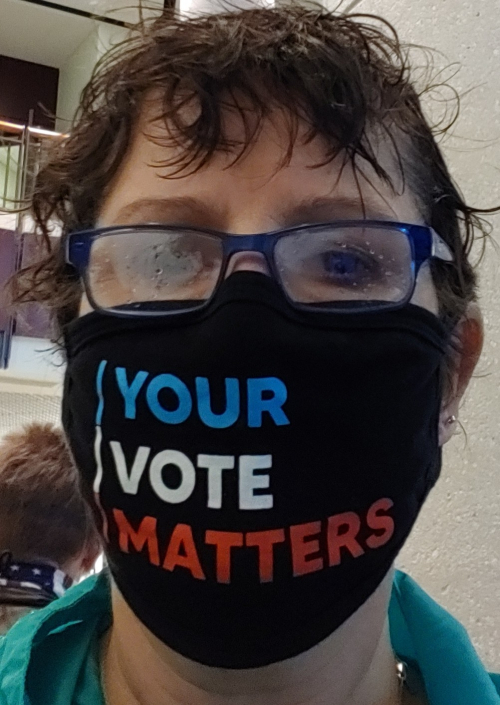
Since almost all of us are thinking about Election Day 2020 (tomorrow!), I am taking a moment here to reflect on conversations I recently have had with my students about parallels in political and corporate governance.  Although current conversations center around the fiduciary duties of those charged with governance (a topic that I will leave for another day), just a few weeks ago, we were focused on voting (both shareholder and director voting).  The above photo shows me–sporting wet hair and rain-spotted, fogged-up glasses–waiting in line to vote early last week.  I admit that while I routinely vote in political elections, I have only been to a shareholder meeting once, and then as an advisor to the corporation, not to actually vote any shares held.  Having said that, in my fifteen years of law practice, I did draft proxy materials, structure shareholder meetings, and address concerns associated with shareholder voting.

My students are always curious about shareholder voting and most intrigued by proxy voting.  Corporate governance activities are, of course, not very transparent in daily life for most folks.  A course covering corporate law introduces both new terms to a student’s lexicon and new concepts to a student’s base of

ABALogo(2020)
I have written about the American Bar Association Limited Liability Institute in this space before.  See, e.g., here, here, here, here, and here.  The 2020 LLC Institute is being hosted virtually and begins next Friday–something to look forward to at the end of election week!  This ABA program is always a premier event, and it is the only national annual program that focuses in exclusively on LLCs and unincorporated business associations.

Importantly, this year’s institute is free to law students.  I have recommended registration and attendance to mine.  Click here for more information, including the agenda, list of speakers (including yours truly!), and registration.

On Friday night, I finished five days of group oral midterm exam appointments with my Business Associations students.  (I wrote a law review article on these group oral midterms five years ago, in case you are interested in background and general information.)  It is an exhausting week: twenty-one 90-minute meetings with groups of three students based on a specific set of facts.  And this year, of course, the examinations were hosted on Zoom, like everything else.  Especially given social distancing, mask-wearing, and the overall hybrid instructional method for the course (about which I wrote here), I admit that I headed into the week a bit concerned about how it all would go . . . .

The examination is conducted as a simulated meeting of lawyers in the same law office–three junior lawyers assisting in preparing a senior colleague for a meeting with a new client.  The student teams are graded on their identification and use of the applicable substantive law. I was pleased to find that the teams scored at least as well overall and individually as they typically do.  That was a major relief.  I had truly wondered whether students would be less well prepared in

How are you doing? I’m exhausted between teaching, grading, consulting, writing, and living through a pandemic. I actually wasn’t planning to post today because I post every other Friday, as a way to maintain some balance. I may not post next Friday because I’ll be participating in  Connecting the Threads, IV, our business law professor blog annual conference. It’s virtual and you may get up to 8 CLE credits, including an ethics credit. If you love our posts, you’ll get to see us up close and personal, and you won’t even need a mask.

I decided to do this short post today because it may help some of you, whether you’re professors or practitioners. Several years ago, Haskell Murray wrote that he does a mid-semester survey. He asks his students what they like and don’t like. I love this idea … in theory. How many of us really want to know how we’re doing? I’ve done it a couple of times when I knew that the class was going great, but I don’t do it consistently. I decided to do it this year because we are piloting a new program modeled after Emory’s Transactional Law Program. I used

BLPB(CircusPhoto)Photo Credit: Pixabay

With almost six weeks of hybrid Business Associations classes now under my belt (and many more to go), I wanted to share a bit more about my experience teaching in the hybrid classroom.  This follows and builds on my post from the beginning of the semester offering initial impressions (based on my Professional MBA teaching experience).  As I noted in that post, technology can differ from classroom to classroom.  As a result, my observations here (which are based on a hybrid course with an in-class projection system featuring a camera  and document camera and an online component hosted on Zoom), may not hold in other teaching environments.  Hopefully, however, some of what I have to say here may be useful to some of you . . . .

Teaching a hybrid course is a bit like managing a three-ring circus.  Ring #1 is your in-class student population, #2 is your online students population, and #3 is your technology.  It is a lot to pay attention to.  I find it more than a bit exhausting.

I have 63 students in total in Business Associations this fall.  That is a bit low but within a normal range for that

As we continue to move through the Fall 2020 semester in “pandemic mode” (whatever that may be for you), the investments of colleagues in their teaching continues to amaze me.  The number of teaching webinars and conference panels has been truly awesome, starting in the spring and continuing through the present.  Social media posts on Facebook and Twitter offer individualized tips and the opportunity for innovators to build from them and post their responsive comments and additional advice.  My friend Jessica Erickson (Richmond Law) wrote an excellent series of Prawfsblog posts at the end of the summer, the last of which can be found here (with links to the earlier posts in the series).  Law faculties (including my own) are checking in with each other on challenges and victories on a regular basis.  Although the experiences of others may be different, I have felt supported (and very much like I am part of a team) the whole way along.

Among the more stimulating–and daunting–parts of pandemic teaching presentations and conversations are those relating to the introduction of new teaching technologies.  We have all dealt with this part of COVID-19 teaching in some respects and in our own ways.  Some of

I have written here in the past about laboring on Labor Day.  Most recently.  I wrote about the relationship between work and mindfulness in this space last year.  But it seems I also have picked up this theme here (in 2018) and here (at the end of my Labor Day post in 2017).  Being the routine “Monday blogger” for the BLPB does give me the opportunity to focus on our Monday holidays!

This year, however, Labor Day–like so many other days in 2020–is markedly different in one aspect: I am required to teach today.  When I logged in to the campus app on my phone this morning to do my routine daily health screening, I was greeted by this (in clicking through from the main event schedule page):

This is the first day in my 20 years of teaching, and maybe in my 35 years of post-law school work, that I have been required to work on Labor Day.  My daughter, a Starbucks night shift manager, is required to work every year on Labor Day.  But this is new to me . . . .

Of course, the ongoing pandemic is the reason for this change.  By compacting the semester

On Saturday, I taught Business Planning to the Class of 2020 Professional MBA (ProMBA) Students in the Haslam College of Business at The University of Tennessee, Knoxville.  I have taught business law topics in this program for a number of years now and thoroughly enjoy it as a change-up to teaching law students.  This class is no exception.  And two of the students from this cohort plan to go to law school at some point in the next few years.

The class sessions on Saturday–four hours worth–were taught in a hybrid format, with some of the students in the classroom and some participating in the class remotely through Zoom.  Starting Wednesday, I will be teaching my Business Associations class sessions in a synchronous hybrid flex format with half of the students rotating in and out of the classroom in accordance with a predefined schedule.  The ProMBA program uses classrooms with technology different from that available at the College of Law, did not afford me Zoom hosting privileges that I have at the College of Law, and allows eating and drinking in the classroom.  Nevertheless, parts of the teaching I did on Saturday are analogous to what I will be doing