IMG_8728(1)

A few months ago, I mentioned taking the free Yale University online course The Science of Well Being taught by Professor Laurie Santos.

Before jumping into the substance of the course, I wanted to talk a bit about the format. The course was likely filmed with better equipment than most of us will have in the fall. The videos were mostly under 15 minutes each, and the videos usually had quiz questions to keep you engaged. Then there were longer quizzes at the end of sections and discussion boards.

Even though this was a Yale course, on an interesting subject, with a gifted professor, I probably would not have paid even $1 for this course. The material was surely worth more than $1, but there is simply too much good free information online, in this format, for me to pay anything for it. This fact is sobering to me as a professor, given that at least some of my students will be online-only this fall. The real value, I think, springs from interaction – between professor and student, and between the students themselves. As such, I need to plan my courses with a fair bit of this interaction.

Moving
In a reflection on the meaning of career success, a majority of my business ethics students mentioned happiness as a barometer. 

“Happiness,” however, is an incredibly imprecise term. For example, here is over seventy-five minutes of Jennifer Frey (University of South Carolina, Philosophy) and Jonathan Masur (University of Chicago, Law) discussing happiness under two different definitions. 

Frey, in the tradition of Aristotle and Aquinas, considers happiness not as a private good, but rather as the highest common good. Happiness is enjoyed in community. True happiness according to Frey, is bound up in the cultivation of virtue and human excellence. Under Frey’s definition, happiness makes room for sacrifice and suffering as beautiful and awe-inspiring. 

Masur, a self-described hedonist, seems to have a more psychological, subjective view of happiness. Masur defines happiness as positive feelings, and unhappiness as negative feelings. Masur acknowledges that happiness–maybe even the deepest happiness–can arise from relationships and altruistic behavior. Unlike Frey, however, Masur includes positive feelings that are artificially produced or arising from unvirtuous behavior as part of “happiness.” Masur sees happiness and living a good, moral life as often overlapping, but as not necessarily intertwined. 

These are two different conceptions of happiness. I think we need

Strava

The Social Enterprise Alliance (SEA) previously defined “social enterprise” as businesses that (1) Directly address social need; (2) Commercial activity [not donations] drives revenue; and (3) Common good is the primary purpose. SEA’s definition has evolved to be more inclusive, now recognizing three different models based on — (1) opportunity employment, (2) transformative products/services, or (3) donations. While the first definition could be criticized for being too narrow (Ben & Jerry’s would not qualify because their product does not directly address a “social need”), SEA’s new definition is likely too broad because it seems to cover all donating businesses. 

Personally, I am most fond of social enterprises that produce products/services that lead directly to human flourishing. 

For Lent, I gave up Facebook/Twitter/Instagram. While these products have their uses, on the whole they tend distract me from what is truly important. Perhaps social media has improved since the advent of Covid-19, and I admit to feeling somewhat out of the loop. But I also feel much more at peace, and may not return to those forms of social media after Easter, or, if I do, I hope it will be on a much more limited basis. 

In contrast, Strava

I am taking a free online course from Coursera and Yale University on the Science of Well-Being. The course is taught by Professor Laurie Santos.

Join me.

I may blog about the course at a later date. I am taking the course both for the content and for online teaching strategies.

Update (1/2/21): While I found some suggestions in this course helpful, I think philosopher Jennifer Frey makes a thoughtful critique of this course and the happiness hacking it promotes. In relevant part, Professor Frey writes:

“Happiness, pagan and Christian philosophers agreed, requires something more than technique or self-help; it requires the transformation of the person that comes with the acquisition of virtue: wisdom, prudence, justice, courage, and temperance. Wisdom gives us a clear vision of what is truly good, prudence allows us to deliberate well so as to attain and maintain that vision, justice to realize it in our actions, and courage and temperance to preserve it in the face of fears and temptations. Acquiring virtue is not about hacking oneself or engaging in other forms of self-manipulation; it is about the proper habituation of one’s thoughts, feelings, and desires so that one becomes existentially ready to

Image result for olympic trials in the marathon

Last year, in a post about personal finance, I mentioned my friend Joey Elaskr, who is completing a PHD/MD program at Vanderbilt University. In late 2019, Joey qualified for the Olympic Trials at the Monumental Marathon in an impressive 2:18:57 (5:18 per mile for 26.2 miles). On February 29th this year, just a couple weeks after successfully defending his dissertation, he competed in the Olympic Trials in Atlanta. You can read a bit about Joey’s running on Lets Run and on Money & Megabytes. While the tie to “business law” is admittedly stretched, I do think our readers can learn a good bit about juggling demanding responsibilities from Joey, and I am glad he agreed to answer a few questions below the break.

After spending the entire day grading undergraduate business law exams, I drove to my son’s elementary school for our first parent-teacher conference. On my wife’s advice, I mostly just listened. My legal and academic training have given me “a very particular set of skills” that I can use to construct and deconstruct arguments in a way some people find combative, so my wife’s advice was probably wise.

The parent-teacher conference for our kindergarten-aged son went well. Most important to me, it was clear that our son’s teacher already appeared to love him and seemed committed to helping him develop. But I worry about what our education system may do to my son. Only two months into formal school, my sweet son, who has been in speech therapy since age two, is already receiving grades. Granted, the grades are pretty soft at this point – 3 for mastery, 2 for on track to complete this year, 1 for behind schedule. I hope he will not get overly discouraged. I also know he will not receive nearly as much affirmation in school for his impressive, budding artistic skills as he would for a photographic memory. 

This parent-teacher conference, coupled with

In college, I majored in business administration with a concentration in finance, but I learned next to nothing about personal finance. Thankfully, my father provided some advice, and I did a bit of reading on the subject before I graduated law school. But I am still learning, and have dug deeper this summer.

More universities should instruct their students on matters of personal finance. As I mentioned a few months ago, I spoke on personal finance for a group of students at my university last school year,  and I hope to bring Joey Elsakr to speak at my university this school year. Joey is a graduate student and is the co-founder of the blog Money and Megabytes.

Last week, Joey graciously invited me to guest post on his blog. As I mention in the post, I don’t think I have that much to add to his many useful and detailed posts on personal finance, but I do think personal finance gets a lot more difficult after you have a family (namely because there are so many more non-financial factors to weigh in most financial decisions). I pose some of those difficult questions in the linked post below, and

0429191454

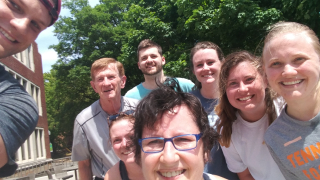
This picture brings me joy.  It captures the mood among all of us (me, my UT Law emeritus colleague John Sobieski, and a group of UT Law students) after my last UT Law yoga session this past spring.  I need to begin to wrestle with how I will be able to teach yoga at the College of Law this coming semester, since I will be full-time back in the classroom teaching two demanding business law courses (Business Associations and Corporate Finance).  All ideas are welcomed . . . .

My law school yoga teaching came to mind this week not because I am already deep into planning the fall semester (although that comes soon) but because of two independent health/wellness items that hit my radar screen this week.  First, I was reminded that the Knoxville Bar Association (of which I am a member) is offering a full-day continuing legal education program in September entitled “Balancing the Scales of Work and Wellness – Finding Joy through Self-Care Practical Advice & Wellness Strategies”.  Second, I learned today that my UT Law colleague Paula Schaefer penned a nifty post yesterday on the Best Practices for Legal Education blog: Examples of How Law Schools

Image result for olivia jade college

The college admissions scandal has been on my mind a good bit since the story broke. (Listen to the podcast “Gangster Capitalism” if you need to catch up on the details of the scandal.)

One student, more than any other in the scandal, has been in the media’s crosshairs: Olivia Jade Giannulli. Olivia Jade – a social media influencer (whatever that means) – seems to be getting so much attention because of her famous parents (actress Lori Loughlin and fashion designer Mossimo Giannulli), and because of some unfortunate comments she made about college on YouTube. Olivia Jade said: “I don’t know how much of school I’m going to attend but I’m going to go in and talk to my deans and everyone and hope I can try and balance it all. But I do want the experience of game day and partying, I don’t really care about school. As you guys all know. ” I don’t know much about Olivia Jade, but she comes across as spoiled, arrogant, selfish, entitled, obnoxious, and lacking self-awareness. In many ways, I hope my children and my students grow up to be her opposite. 

In contrast, three runners who I

Joey Elsakr, a PHD/MD student at Vanderbilt University, has teamed up with his roommate for a blog called Money & Megabytes. The blog covers personal finance and technology topics, which I think may be of interest to many of our readers and their students.

Last year, convinced that students need more guidance on personal finance, I gave a talk at Belmont University on the topic. Given the very limited advertising of the talk, I was surprised by the strong turnout. The students were quite engaged, and some simple personal finance topics seemed to be news to many of them. I plan on asking Joey to join me in giving a similar talk next year.

One post that I would like to draw our readers’ attention to is Joey’s recent post on his monthly income/expenses. You can read the entire post here, but here are a few takeaways: 

  • Know Where Your Money Goes. How many students (or professors!) actually have a firm grasp on where they are spending money? While creating a spreadsheet like Joey’s could be time consuming, the information gained can be really helpful (and just recording the information — down to your nail clippers purchase!