
Environmental groups and other opponents of high-volume hydraulic fracturing (also known as fracking) for oil and natural gas have roundly applauded Governor Cuomo’s decision to ban the process in the state of New York. The ban, which confirms New York’s more than five-year moratorium on the process, has been lauded as an environmental success and a model for other states.   The ban is neither. 

Oil and natural gas prices are at their lowest prices in years. Interest in expanding drilling in the Marcellus Shale, which is the geologic formation holding natural gas deposits under New York, Pennsylvania, and West Virginia, is correspondingly low.  That makes the fracking ban an easy decision because there is relatively limited interest in drilling in state.

There are those with interest in drilling in New York, of course, but as long as prices are low and there are other places to drill (like Pennsylvania and West Virginia), that interest will remain modest.  The ban also raises the value of Pennsylvania and West Virginia mineral rights by reducing competition, so companies with interests in the entire region have little reason to weigh in forcefully.

In this environment, then, an outright ban was easier to put in
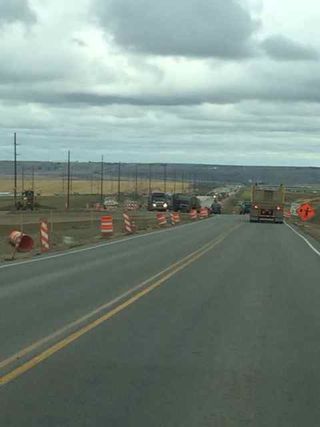
We covered a lot of ground today, driving up from Medora, ND, to Williston, ND, through Watford City.  The traffic was not terrible for us, though the truck traffic and the road construction was slow going for a while.  We’re told we missed the worst of the traffic because our timing was good. It still felt like big city traffic in what is not a big city.  Traffic

Watford City has been a prime example of a place where the oil boom has caused significant growing pains. A recent article in The Atlantic asked, What If Your Small Town Suddenly Got Huge?, and explained: 

The Bakken oil boom has brought rapid growth to many towns and cities in western North Dakota, including Williston, north of the Missouri River, and Dickinson, alongside Interstate 94. But Watford City, where the population has jumped from just 1,400 people six years ago to more than 10,000 today, has experienced a particularly dramatic shift in character. 

There is dirt being moved everywhere: for roads, for housing, and, of course, for oil.  Driving this region you see very few homes, rolling hills, a few small buttes, and some abandoned farm homes. Oil wells blend in surprisingly well

I’m currently flying at about 30,000 feet on my way to Dickinson, North Dakota.  Regular readers know I do much of my research in the energy sector and that the impacts of horizontal drilling and hydraulic fracturing have had on the local, regional, national, and global economies are an interest of mine.  This trip marks my first return to North Dakota since I left the University of North Dakota School of Law in the summer of 2012, and it will be my most extended trip to the Bakken oil patch in the western part of the state. 

I have the benefit of traveling with a group from West Virginia University, and we’re gathering information for a variety of applications, all of which I hope will help us plan for a more sustainable economic and environmentally viable energy future.  The trip is scheduled to include meetings with government officials (state and local), industry representatives, landowners, farmers, educators, and others.  I’m looking forward to this rare opportunity to hear so many different perspectives from people living in the heart of the U.S. oil boom. 

Over the last few years, I have written about the challenges and opportunities related to the shale oil and

Last week, I had the pleasure of being part of the Second Annual Searle Center Conference on Federalism and Energy in the United States.  (I had the good fortune to be part of the first one, too.)  The conference covered a wide range of energy issues from electricity transmission siting to hydraulic fracturing to natural gas markets.  One paper/presentation struck me as particularly interesting for markets generally (I am told an update version will be available soon at the same site: “The Evolution of the Market for Wholesale Power” by Daniel F. Spulber, Kellogg School of Management, Elinor Hobbs Distinguished Professor of International Business and Professor of Management Strategy & R. Andrew Butters, Kellogg School of Management, Northwestern University.

Here is the conclusion: 

A national market for wholesale electric power in the US has emerged following industry restructuring in 2000. Tests for correlation and Granger Causality between trading hubs support the presence of a national market. Going beyond pairwise analysis, we introduce an array of multivariate techniques capable of addressing the national market hypothesis, including the common trend test. Although there is strong evidence of integration between the series, the analysis suggests a division between the eastern and western parts of the