July 2019

Like co-blogger Joan Heminway, I felt it a great honor and pleasure to attend the second annual Women’s Leadership in Legal Academia Conference last week (thanks, Joan, for bringing it to my attention via the BLPB!).  It was a fabulous two days – an opportunity to reconnect with colleagues from around the country, meet new ones, learn a ton, and participate in many highly-engaging discussions.  And as a UVA JD/MBA, it was also a wonderful chance to return to C’ville, catch up with a few former professors, and buy a much needed new pair of running shoes (Nike outlet new since my time!).

I loved Joan’s “mini-workshop.”  It really challenged teams of attendees to grapple with difficult scenarios (see yesterday’s post), provided valuable leadership insights, and reminded me of summer reading I want to do!  During the workshop, Joan mentioned the book Emotional Intelligence.  It’s been on my “must read” list for years.  Overall, the scenarios brought to life the emotional savvy (and regulation) essential to great leadership, and left me with two overarching thoughts.  First, in any situation, doing one’s best to understand the persons (including oneself!) and complexities involved is foundational to effective leadership.  It

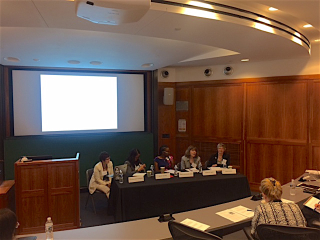
WomensLeadership2019(IMG_1193)

Last Thursday and Friday, I had the honor and pleasure of joining a large group of women interested in law school leadership at the second annual Women’s Leadership in Legal Academia conference.  The two days provided many opportunities for education and inspiration. Four of my UT Law colleagues started off the conference with a workshop focused on microaggressions.  My mini-workshop entitled “Leading from Where We Are” (picture above taken by fellow BLPB blogger Colleen Baker, who attended the session) followed.

The workshop extended my thoughts on leadership as a concept distinct from titles–thoughts I had touched on in an earlier blog post for the Leading as Lawyers blog. It also offered me the chance to describe an optimal organizational structure, with leaders at every key juncture.  In introducing my panelists, I noted leadership attributes that I had observed in each and told a related/relevant story about our relationship.  Then, we offered for discussion two hypothetical situations in which a faculty member is challenged to lead.  In each case, we started with small group work and followed through with a report-out to the “committee of the whole.”  One of the hypotheticals involved a (potential) misunderstanding between the dean and the

I’ve previously blogged in this space about Shari Redstone and her conflicts with the CBS board.  Last week, New York Magazine published this fascinating article about Shari Redstone’s corporate battles and her relationship with her father, Sumner Redstone.  Shari Redstone refused to participate and thus much of it appears to have been drawn from other sources, but it was all new to me, and the anecdotes make for a fascinating – and eyebrow raising – read.  Here’s a taste:

In retrospect, it took some chutzpah for Moonves to take Redstone to court, when as reporting would later show, he was busily covering up the sexual-assault allegations against him. Less than six months later, he was gone. So were Gifford and most of the other elder men on the board who’d backed Moonves. …. CBS and Viacom are once again talking about merging, though Redstone cannot be officially involved until negotiations are further along. If the merger goes through, as it well may this summer, she will have cemented her control of a $30 billion media kingdom.

And Moonves’s stunning downfall has given Redstone, for all her wealth, something she’s never had before: a narrative that justifies her own rise.

When was the last time you sat in a classroom for 6 hours a day learning material that you weren’t sure that you would use on a daily basis for your job? I’m not talking about attending a CLE or an academic conference where you pick what you want to learn and from whom. I’m talking about taking notes, doing homework everyday, and being called on— you know, like we do with our students. 


Well I’ve just finished this experience and it will change how I teach from now on. Since mid June, I’ve taken 90 hours of immersive Spanish classes—30 hours through weekend work at the University of Miami and 60 hours through Habla Ya in Panama for two weeks. I did this while teaching a transactional drafting course online (asynchronously), which required me to hold individual video conferences with my 16 students and markup and review drafts. I also worked on a time consuming project for a client. This was no vacation. At times, it was pure hell. 

Here’s what I learned. 

  1. The teacher really does matter. I often hear my students saying “I just can’t learn from Professor X.” I always thought it was a lame

A new paper from a powerhouse trio just hit SSRN.  Steve Choi, Adam Pritchard, and Jessica Erickson teamed up to take a look at attorneys’ fees in securities class actions.  Erickson announced it earlier today with some quick summary tweets:

They collected data on over 1,700 settlements to examine how high and low value settlements differ from each other and whether judges treat the high-value cases differently than the low value ones.   Interestingly, they found some evidence that attorneys may engage in some make-work in high-value cases in order to justify collecting big fees. With all of the data they collected, we’ll likely see many more papers coming out of this set. 

Hopefully, the data will help courts make better decisions when scrutinizing fee requests in mega-settlements.  One challenge will be getting the information before courts reviewing settlements.  The attorneys representing parties generally have little incentive to police

I have been a dean for two days.  So, obviously, I have it all figured out.  (That’s very much a joke). 

My sample size is small, but it seemed like a good time for me to take a shot at comparing what it’s like to be a new dean versus what it’s like to be a new professor. Admittedly, I am working hard to remember what it was like to be a professor in his first two days. I have the benefit of hindsight with that, while my life as dean is very much real time.  But hey, it’s a blog, so I will give it a try. 

  • As a new professor, I was worried (very worried) that I did not know everything about the subject matter and that it would be obvious. As a new dean, I expect that others don’t expect me to know everything, and if they do, I know they’re wrong.    
  • As a new professor, I wanted everyone to like me.  As a new dean, I’d still appreciate that.  But I don’t need it, and I don’t expect it, and I know it is impossible. (It’s impossible as a professor, too, by the way,

In Tennessee Wine and Spirits Retailers Assn. v. Thomas, the SCOTUS affirmed decisions of the Sixth Circuit and Federal District Court of Middle Tennessee finding Tennessee’s 2-year residency requirement applicable for retail liquor store license applicants unconstitutional as a violation of the Commerce Clause that is not saved by the 21st Amendment.  Specifically, in an opinion dated June 26, 2019, Justice Alito concluded that “Tennessee’s 2-year durational-residency requirement plainly favors Tennesseans over nonresidents” and, addressing the claim that Tennessee’s regulation nevertheless is valid under Section 2 of the 21st Amendment, found that “the record is devoid of any ‘concrete evidence’ showing that the 2-year residency requirement actually promotes public health or safety; nor is there evidence that nondiscriminatory alternatives would be insufficient to further those interests.”  This is a huge win for the alcoholic beverage retail industry nationwide, even of it is a deemed loss for smaller local liquor retailers in Tennessee who were protected by the stringent residency requirements (although the Tennessee Alcoholic Beverage Commission had stopped enforcing the requirements against new applicants).

[Note: BLPB reader Tom N. predicted this result in his comment to this Josh Fershee post earlier in the year.]

A number of things about

On Thursday, the Commodity Futures Trading Commission (CFTC) held an open meeting to consider:

Supplemental Proposal on Exemption from Derivatives Clearing Organization Registration

Proposed Rule on Registration with Alternative Compliance for Non-U.S. Derivatives Clearing Organizations

Proposed Rule on Customer Margin Rules relating to Security Futures

In Special Report: CFTC advances two proposals amending oversight of non-U.S. clearinghouses, the FIA noted:

…the five members of the U.S. Commodity Futures Trading Commission voted unanimously to release a proposed rulemaking designed to create a less burdensome regulatory regime for foreign clearinghouses that clear swaps for U.S. customers…

A related proposal fared less well, however.  The agency’s two Democratic commissioners strongly objected to a supplemental proposal to exempt foreign clearinghouses from U.S. regulation if they are subject to regulation in their home countries that is comparable to the U.S….Despite the objections, the supplemental proposal passed by a vote of three to two and will be published for public comment. 

As I’ve noted, the regulation of derivatives clearing has been a source of conflict between international policymakers, particularly since the financial crises of 2007-08 and the subsequent global clearing mandates.  An article in the FT, CFTC agrees to rein in rules for