
Photo of Ann Lipton

Ann M. Lipton is a Professor of Law and Laurence W. DeMuth Chair of Business Law at the University of Colorado Law School.  An experienced securities and corporate litigator who has handled class actions involving some of the world’s largest companies, she joined the Tulane Law faculty in 2015 after two years as a visiting assistant professor at Duke University School of Law.

As a scholar, Lipton explores corporate governance, the relationships between corporations and investors, and the role of corporations in society.  Read more.

Recently, Walmart shifted its listing from the New York Stock Exchange to the NASDAQ.  The move, apparently, had nothing to do with the formal policies of the exchanges, and everything to do with the fact that the NASDAQ is associated with tech stocks.  Walmart is trying to sell itself as a tech company, and part of that effort involves actually shifting exchanges.

To some extent, the benefits of this move rely on an assumption of market inefficiency, i.e., the well known phenomenon where stocks trade differently depending on index inclusion; Walmart is betting that if it’s added to the NASDAQ 100, it will trade like the rest of the index.

But it’s also an exercise in branding.  Walmart, I gather, hopes for an image revitalization; it’s signaling a business model, and a commitment to a digital business strategy, and it hopes investors will share that vision.

I’ve been thinking that, in the wake of the chartering wars, state of incorporation may serve a similar function.  I’ve previously posted that Texas has adopted an anti-woke approach to corporate governance, and I think for most firms, that’s not a particularly desirable stance; they’d much rather, at least, choose Nevada
Well, restoring Elon Musk’s 2018 pay package and awarding $1 in nominal damages instead is, I suppose, one way of distracting from the Epstein files.

No one needs a recap of where we were on Elon Musk’s 2018 pay package, but just in case: in 2024, Chancellor McCormick concluded after a trial that Elon Musk was a controlling shareholder of Tesla, and that the pay package was a conflicted transaction that was not entirely fair to the stockholders. In particular, she found that Musk himself controlled the process by which the compensation committee set his pay, and largely made up his own contract with the comp committee serving as a rubber stamp. As a remedy, she ordered that the pay package be rescinded.

Today, the Delaware Supreme Court did not question any of Chancellor McCormick’s actual findings regarding how Musk’s 2018 pay package was negotiated, the control and interference that Musk exercised over the process, or even the unfairness of the award itself. Instead, the sole basis for the holding is a kind of Rumpelstiltskin argument: the plaintiffs used the word “rescission” when requesting a remedy, but this case does not meet the technical requirements for rescission

The White House Executive Order is out, and it largely tracks what I previously expected based on prior reporting. It isn’t self executing, but it directs the FTC, the SEC, and the DoL to review rules pertaining to proxy advisors and revise them, and/or take enforcement action.

The FTC is ordered to investigate potential antitrust violations.

The Department of Labor is ordered to consider revising rules pertaining to ERISA funds’ reliance on proxy voting advice (i.e., impose paperwork burdens that will inhibit funds’ ability to rely on proxy advisors).

The SEC is directed to ensure that proxy advisors register as investment advisors (too late!), and then use that status to incapacitate them with paperwork (I’m reading between the lines), and to somehow treat voting recommendations as the equivalent of coordinating a 13d group. It’s also directed to ascertain whether the recommendations themselves are misleading (the Business Roundtable has previously argued that it is proxy fraud for a proxy advisor to characterize a director as not independent when the company designates them as independent for exchange listing purposes).

Also included is a direction to the SEC to revise and rescind guidance surrounding Rule 14a-8.

Anyway, these

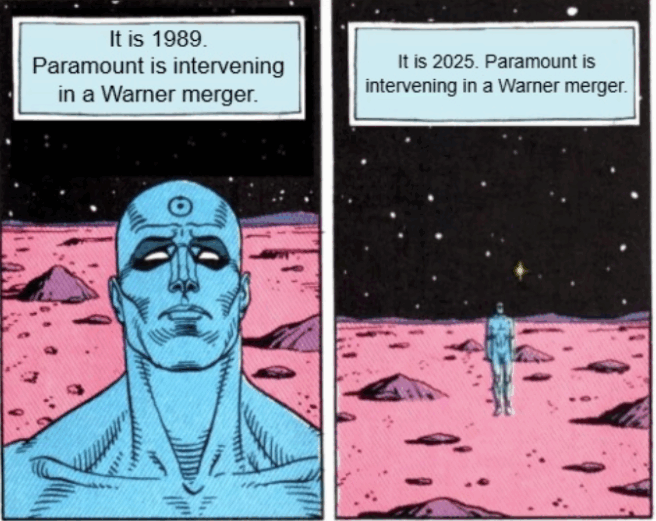
Obviously, the big business news today is the Netflix/Warner merger agreement, coupled with party-crasher Paramount.

This is not, of course, the first time that Paramount has interrupted a Warner merger deal. As probably everyone reading this post already knows, back in the late 80s, Time signed a merger agreement with Warner, and Paramount parachuted in with an offer to take over Time instead. When Time locked up the merger agreement too tightly for Paramount to get a foothold, it sued in Delaware, and lost before the Delaware Supreme Court in Paramount v. Time.

A lot of the mainstream news reporting is presenting Paramount’s topping bid for Netflix as a “hostile” tender offer, echoing Paramount’s claim that it is taking its bid directly to the shareholders. That is … not exactly accurate.

No one does hostile tender offers anymore, in the sense of an actual for-real offer to buy shares without approval of the target board. That’s because, after cases like Paramount v. Time, boards have fairly broad powers to prevent unapproved acquisitions – like, poison pills, and DGCL 203. So, this Paramount offer is actually a proposal for a friendly 251(h) merger, conditioned explicitly on the approval

With regard to proxy voting, practices that directly or indirectly result in coordinated voting should be evaluated with respect to compliance with reporting requirements under the Securities Exchange Act. Shareholders form a group if they act together for the purpose of voting the equity securities of an issuer. Depending on the facts and circumstances, funds and asset managers using PVABs for voting decisions may have formed a group for purposes of Section 13(d)(3) or Section 13(g)(3) of the Securities Exchange Act.  Indeed, the Commission itself raised this issue in 2020 when it stated that “[u]se of a proxy voting advice business by investors as a vehicle for the purpose of coordinating their voting decisions regarding an issuers’ securities” would raise issues under the SEC’s beneficial ownership rules. Of course, a group is not formed simply because a shareholder independently determined how it wants to vote

In this week’s Shareholder Primacy podcast (here at Apple, here at Spotify, here at YouTube), Mike Levin and I talk about the all-of-government war on proxy advisors.

Which was timely, because – as we didn’t know when we recorded – ISS just created a new website, www.protectshareholders.com, apparently aimed at making the case for proxy advisors and fighting back against all of the political attacks.

My initial social media reaction was, “OMG,” which apparently was inscrutable to many, so I’ll elaborate here.

To me, ISS’s website does not appear to be a targeted lobbying approach aimed at asset managers or politicians; it appears to be directed at largely a general audience, like public-facing PR. Certainly not geared toward low-information voters, but maybe toward reporters who will communicate to a general audience, or other general audiences who may have sway with politicians. And it is surprising – shocking – to me when a technical matter of corporate governance reaches that level of political salience. Which happened, for example, in the context of SB 21, when I posted that this kind of controversy was unequivocally bad for Delaware.

Now, back in the day – the “day”

I’ve blogged several times about the unduly narrow concept of “standing” and the “purchaser-seller” rule that courts have been applying in the context of Section 10(b).  (Most recent post discussing it is here; there is a link to earlier posts).

We have a new case that adds to the mix.

Toronto Dominion Bank signed an agreement to purchase the stock of First Horizon, which of course caused First Horizon’s price to trade upward.  Eventually, TD got into regulatory trouble and the merger fell through, which caused First Horizon’s stock to fall.  Purchasers of First Horizon stock sued First Horizon, but they also sued TD Bank, alleging that its false representations of regulatory compliance made the merger seem more plausible and inflated First Horizon’s stock price.

Careful readers will recognize that this is, more or less, exactly what happened in Semerenko v. Cendant Corp., 223 F.3d 165 (3d Cir. 2000).  There, the defendants argued that statements about the acquirer (in this case, the acquirer’s audit opinion) were not made “in connection with” the purchase or sale of the target’s securities, as Section 10(b) requires.  The Third Circuit held that that statements about the would-be acquirer were made “in connection

I just had the privilege of participating in Columbia Law School’s M&A conference, on a panel with Ed Rock of NYU, Eduardo Gallardo of Paul Hastings, and John Mark Zeberkiewicz of RLF, moderated by Dorothy Lund of Columbia, to discuss SB 21 and its likely impact going forward.

In this post, I’ll elaborate on some stuff I said at the panel.

After SB 313 passed authorizing shareholder agreements – ostensibly to conform the law with “market practice” – Gladriel Shobe, Jarrod Shobe, and William Clayton found that the law in fact went much further than actual market practice to authorize a broad array of contracts that are somewhere between uncommon and nonexistent.

That kind of thing is what gives rise to the suspicion that when the Delaware Corporation Law Council recommends legislative amendments, it does so not as neutral arbiters, but as representatives specific clients who desire particular legislative outcomes. And while there is nothing new or surprising about lobbyists advocating for legal changes that benefit their clients, the CLC is not supposed to be acting as a lobbyist when it participates in the legislative process. In some ways, then, SB 313 always read to me as the

It’s been recently reported that the White House is looking to wage a full scale war on proxy advisors.  Not only are they being singled out for antitrust probes, but apparently they’re being investigated by CFIUS over their foreign ownership.

Additionally, the White House is looking for ways to issue some kind of securities-law based executive order to curb their influence.

Now, just to state the obvious about why this is all happening, I refer back to a prior blog post:

one cannot help but suspect that companies’ reasons for objecting to proxy advisors is the same as their objection to unions – it’s not conflicts or corruption, it’s that they overcome transactions costs of a disaggregated constituency and facilitate coordination so as to create a countervailing power center.  Managers, in other words, just don’t want to be challenged – by anyone.

But anyway. I keep getting questions about what the White House could actually do.  And I can’t answer that from an antitrust or national security perspective, but I can spitball some ideas from a securities law perspective, though I’m sure the forces gunning for proxy advisors are probably far more creative than I

I tried posting about something else this week, but there’s a gravitational force, so here’s bonus Tesla content.

Honestly, this is what I find interesting and unexpected:

Schwab Asset Management earlier this week pledged to back the pay proposal after a number of prominent retail shareholders said on social media that they would move funds out of brokerages that voted in opposition.

With the caveat that I am not exactly clear on what assets were involved, this is an interesting conundrum of fiduciary obligation and mutual fund voting.

On the one hand, shouldn’t funds vote the way the investors want? On the other, Tesla stans are not the only investors in the fund, and if Schwab believes the pay package is bad for the fund overall, shouldn’t those other investors be protected?

To wit: when adopting its voting choice program, BlackRock explicitly said it wouldn’t just delegate voting decisions to investors; instead, it had a fiduciary obligation to review the range of choices to decide they were all suitable, which is its justification for giving investors only a limited slate of pass through voting options.

But also – and, again, I’m not sure I’m clear on