Photo of Ann Lipton

Ann M. Lipton is a Professor of Law and Laurence W. DeMuth Chair of Business Law at the University of Colorado Law School.  An experienced securities and corporate litigator who has handled class actions involving some of the world’s largest companies, she joined the Tulane Law faculty in 2015 after two years as a visiting assistant professor at Duke University School of Law.

As a scholar, Lipton explores corporate governance, the relationships between corporations and investors, and the role of corporations in society.  Read more.

Yesterday, I had the pleasure of participating in Case Western Reserve Law Review Conference and Leet Symposium, Fiduciary Duty, Corporate Goals, and Shareholder Activism.  It was a fun and lively set of discussions with some interesting themes that hit right in my sweet spot of interests, so I had a wonderful time.  I’ll give a brief synopsis of the topics under the cut, but the entire thing will soon be available as a webcast online at the above link, and next year the law review will publish a special symposium issue.

Also, I just apologize in advance if I misdescribe anyone’s remarks – if you see this post and want to correct me, feel free to send an email.

[More under the jump]

Daniel Greenwood coined the term “fictional shareholders” to refer to courts’ tendency to base corporate law decisions on the preferences of a set of hypothetical investors, untethered to the real-world priorities of the actual shareholders who hold a company’s stock.  See Daniel J.H. Greenwood, Fictional Shareholders: “For Whom Are Corporate Managers Trustees,” Revisited, 69 S. Cal. L. Rev. 1021 (1996).  If ever there were an illustration of Greenwood’s point, it comes in VC Laster’s recent post-trial decision in In re PLX Stockholders Litigation.

And hey, this got really long, so more under the jump

If you follow this blog regularly, you’ve probably seen me rant about the myriad errors courts make when evaluating market and investor behavior in the context of securities litigation.  I finally did what I’d been threatening to do and compiled my complaints into a single Essay on the subject, which I presented at the Connecting the Threads symposim hosted by the University of Tennessee at Knoxville in September.  (The symposium featured all of the Business Law Prof bloggers, and Marcia posted a description of the full program here)

My Essay, along with pieces by my co-bloggers, will be published in Transactions: The Tennessee Journal of Business Law.  I’ve just posted a draft to SSRN, and – anyway, here’s Wonderwall:

Fact or Fiction: Flawed Approaches to Evaluating Market Behavior in Securities Litigation

Abstract: Courts entertaining class actions brought under Section 10(b) of the Securities Exchange Act are required to make numerous factual judgments about the economic effects of the alleged misconduct.  For example, they must determine whether and for how long publicly-available information has exerted an influence on security prices, and whether an alleged fraud caused economic harm to investors.  Judgments on these matters dictate whether

This week, the Delaware Supreme Court decided Flood v. Synutra, and began to clear up some of the questions left open after its earlier decision in Kahn v. M&F Worldwide Corp., 88 A.3d 635 (Del. 2014) (“MFW”).  Flood itself is relatively straightforward but, for me, it inevitably calls to mind some larger issues regarding the relationship between independent directors and controlling shareholders under Delaware law.

For many years, the regime in Delaware was that a controlling shareholder squeeze-out transaction would be reviewed for entire fairness, but the burden to prove lack of fairness would be placed on plaintiffs if the deal was approved by either a majority of the minority shareholders, or by a committee of independent directors who acted freely, without coercion, had the power to say no, etc. See Kahn v. Lynch Communication Systems, Inc., 638 A.2d 1110 (Del. 1994).

In MFW, the Delaware Supreme Court held that if a controlling shareholder employs both protections, and makes clear from the outset that any deal will be conditioned on their satisfaction, and there is no reason to think the protections were circumvented (i.e., the committee acted with care, was fully empowered, and so forth)

All I’ve got this week is a drive-by of interesting things (which is necessary because of how the news was so. exceptionally. boring)

1)  You’ve probably at least heard about the New York Times’s massive expose on Donald Trump’s inherited wealth and the tax fraud that enabled it.  If you’re not a tax person, the length may be a little intimidating, but trust me it’s very accessible and worth the read.  Among other highlights are some specific descriptions of the use of a shell company called All County Building Supply & Maintenance that served a dastardly dual purpose: to spin cash gifts from Fred Trump to his children into ordinary income (thus avoiding gift tax liability), and to justify rent increases for rent-stabilized apartments.  Fred Trump accomplished this by making his children owners of All County, and then using All County as a purchasing agent for his buildings.  For every purchase, All County added a large markup – pure profit for All County (and thus the kids), paid by Fred Trump.  Then, Fred Trump used the inflated bills as proof of property improvements to justify his rent increases.  The scheme was sheer elegance in its simplicity.

For the securities

By now, I’m sure everyone’s seen the eyebrow-raising SEC complaint filed against Elon Musk for his fateful tweet announcing “funding secured” for his plan to take Tesla private at $420/share – while keeping all the old shareholders.  There are a lot of juicy details here, including an allegation that the $420 price was – as many suspected – a reference to marijuana; he ballparked a 20% premium, which would bring the price to $419, and then rounded up to impress his girlfriend.

Well, as we all know by now, funding was not secure, there was no plan, and – as I previously posted – there was no way the plan was ever going to work in the first place, because you can’t go private while keeping a massive retail shareholder base.

That said, the thing I keep wondering is, if anyone but the SEC had brought this case, would there be a serious question of materiality?

For starters, there has been a private complaint.  A short-seller, apparently injured when Tesla’s price shot up in the wake of Musk’s initial tweet, filed a class action complaint alleging securities fraud.  Now, this case is in the early stages so there’s no

Back when the CBS Board first decided to revolt against its controlling shareholder, Shari Redstone, I posted a collection of immediate thoughts.  My final one was:

[T]here’s a subtext in all of this, and it’s that Shari Redstone in particular is an untutored interloper, interfering in a business that she knows little about having finally managed to wrest control from her ailing – and often-estranged – father….It’s hard not to wonder about something of a gendered undercurrent in this kind of commentary, and that, in turn, taints CBS’s general depiction of Shari Redstone as a gossipy – and they don’t use that word but that is the implication when they allege that Redstone basically is saying mean things about people – busybody in corporate affairs.

In light of what transpired and came to light since then, I’m going to emphasize that point again.  Because there’s even more evidence today that the Board’s hostility to Redstone – and its support of Moonves – was tainted by (what I assume was unconscious) bias.  And now, after an expensive and pointless legal battle, terrible publicity, and a general waste of corporate resources, we have a cautionary tale about how sexism distorts and inhibits business judgment.

[More under the jump]

Corporate managers have long complained about proxy advisory services, such as ISS, Egan-Jones, and Glass Lewis.  They argue that proxy advisors provide governance advice to companies – for a fee – and then make influential voting recommendations to client shareholders, functionally creating a kind of shakedown service (“Pay us and we’ll be able to recommend that shareholders vote in your favor; don’t, and who knows what we’ll do?”).  Corporations argue that shareholders don’t conduct their own analysis of issues anymore, and blindly vote with however proxy services recommend – giving them far too much power.

There is plenty of reason to be skeptical of their complaints.  At least one study shows that most institutional investors take recommendations into account but ultimately make their own decisions.  And as John Coates recently testified before Congress on the issue, there is no evidence of a market failure necessitating congressional regulation, and regulation might make the industry more concentrated and less competitive, which is the exact opposite of what we should strive for.

I won’t deny that to the extent proxy advisory services potentially have conflicts, these should be known and their policies for cleansing should be clear.  But one cannot help but suspect that companies’ reasons for objecting to proxy advisors is the same as their objection to unions – it’s not conflicts or corruption, it’s that they overcome transactions costs of  a disaggregated constituency and facilitate coordination so as to create a countervailing power center.  Managers, in other words, just don’t want to be challenged – by anyone.

That said, corporate complaints have found a sympathetic ear among Republicans in Congress and now, apparently, in Jay Clayton at the SEC.  The SEC just announced that it was withdrawing two no-action letters from 2004 that have become the bete noire of corporate managers, in preparation for an upcoming Roundtable on the Proxy Process.  Clayton even went out of his way to issue a separate statement clarifying that staff guidance is non-binding, if we hadn’t gotten the message that anything done under previous administrations is now suspect.

You can’t read the letters online, because apparently withdrawing them means making them inaccessible unless you have access to a legal database – and that, by the way, is just terrible practice from a transparency point of view; I’d rather they just be clearly marked as withdrawn.

That said, I will summarize (and embed the letters in this post, if I can get the tech to cooperate).  But first, some background – and this is going to get long, so I’m putting the rest behind a cut.

[More under the jump]

I’ve been absolutely riveted by Nike’s decision to make Colin Kaepernick the face of its new ad campaign.  (I assume most readers are aware of the basics but here’s an article to catch you up if you need it.)  It’s a daring move, not just because of the controversy over Kaepernick himself, but also because of Nike’s relationship with the NFL: Nike is the official supplier of uniforms and sideline gear (a deal that was just extended through 2028), and presumably, in that capacity, Nike wants to keep the NFL popular and football fans happy.

So, there’s so much to chew over here.

We start with the ongoing tension between the fact that it is good marketing for companies to look like they care about various social causes – whatever those causes may be – and their fiduciary duty not to actually care about those things. (Assuming you buy into a shareholder primacy model, etc etc). 

My favorite example for my students is, well, this FT Alphaville blog post in reaction to Jamie Dimon’s ostentatious announcement that he was giving his employees a raise.  And then there’s Tax Exempt Lobbying, a new paper by Marianne Bertrand, Matilde Bombardini, Raymond J. Fisman, and Francesco Trebbi, finding that companies strategically direct charitable giving so as to please politicians that have control over their fates.

So on the one hand, it may be good business to promote Kaepernick, but Nike has to absolutely pretend that’s not really its motivation.

(More under the jump)

It’s not that there isn’t other news, it’s just that this is swimming in warm water.  A few days ago, SurveyMonkey filed an S-1 for its forthcoming IPO, and there are a few things that jumped out at me.

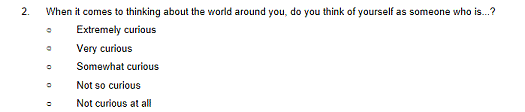
First, there’s a survey!

Survey3

Survey4

(Okay, I’m feeling a little attacked right now.)

Second, there’s a warning!  I previously warned about warnings; poorly drafted ones can warn the registrant right out of a truth on the market/materiality defense if there’s a subsequent securities fraud claim.  SurveyMonkey seems to get it right, though:

Warning1

So, unlike warnings that have gotten issuers into trouble in the past, this one doesn’t explicitly tell anyone not to rely on external information.  It’s just warning you that external information isn’t attributable to SurveyMonkey.

(Which, incidentally, highlights the artificiality of the entire exercise; does anyone seriously believe that from an investor/market perspective, there’s any real difference between “you should only rely on us” language and “we have not authorized anyone else” language?)

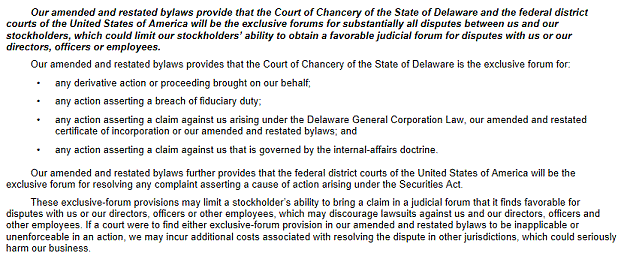
And finally, as I promised in my subject line, there’s the litigation limit:

Forum1

Okay, so much to talk about here.  First, if you’ve been following along, you know that I’ve repeatedly posted about – and written