
Photo of Colleen Baker

PhD (Wharton) Professor Baker is an expert in banking and financial institutions law and regulation, with extensive knowledge of over-the-counter derivatives, clearing, the Dodd-Frank Act, and bankruptcy, in addition to being a mediator and arbitrator.

Previously, she spent time at the U. of Illinois Urbana-Champaign College of Business, the U. of Notre Dame Law School, and Villanova University Law School. She has consulted for the Federal Reserve Bank of Chicago, and for The Volcker Alliance.  Prior to academia, Professor Baker worked as a legal professional and as an information technology associate. She is a member of the State Bars of NY and TX. Read More

Dear BLPB readers:

The Wharton School of the University of Pennsylvania will host its annual Wharton Financial Regulation Conference on April 16, 2021, virtually. The conference will include keynote addresses from Greg Ip, Chief Economics Commentator, The Wall Street Journal, and an as-yet confirmed senior policymaker in financial regulation.

We issue a call for papers to any scholars from any discipline—law, economics, political science, history, business, and beyond—to submit papers on any topic related to financial regulation, broadly construed. Special attention will be paid to junior scholars and those new to the financial regulation community, but we welcome all submissions, including from those who have presented before. Here’s the complete announcement: Download 2021 FinReg Call for Papers
Have you heard about the idea of central bank digital currencies (CBDCs) and stablecoins?  Are you interested in learning more… but maybe just the basics, briefly and quickly (because you’re not focused on banking like some of us)?  I’ve got a great solution for you!  Today I read Clifford Chance’s thought leadership piece, Central Bank Digital Currencies and Stablecoins – How Might They Work in Practice?  It’s a mere 7 pages of text, incredibly accessible, and provides a great introduction to these topics and even includes some banking and payment systems history.  It will take you 15 minutes to read.  You’ll be glad that you did!  Here’s the abstract:

Payment media, from gold coins to stablecoins, exist to be used, and in practice their use requires payment systems. In my paper ‘Central Bank Digital Currencies And Stablecoins – How Might They Work In Practice?’ I consider the way in which existing payment infrastructures and particularly payment banks — might reconfigure their services to accommodate Central Bank Digital Currencies (CBDCs) and stablecoins.

For this purpose, it is probably irrelevant whether the ‘coins’ concerned are created by central banks

BLPB readers:

Wow, a great resource is now available: Digital and Digitized Assets: Federal and State Jurisdictional Issues: Download ABA Digital Assets White Paper Updates (December 2020 Final)

The paper was prepared by the Innovative Digital Products and Processes Subcommittee Jurisdiction Working Group of the Derivatives and Futures Law Committee of the American Bar Association.  It’s an update of a March 2019 version and is organized into 7 sections:

Section 1: Background on Digital Assets and Blockchain Technology

Section 2: Commodity Exchange Act and CFTC Regulation

Section 3: Federal Securities Regulation: Securities Act and Exchange Act

Section 4: Federal Securities Regulation: Investment Company Act and Investment Advisers Act

Section 5: The Need for a Better CFTC and SEC Regulatory Scheme for Digital Assets

Section 6: FINCEN Regulation

Section 7: International Regulation of Digital Assets and Blockchain Technology

Section 8: State Law Considerations

Lastly, the Derivatives and Futures Law Committee is (virtually) having their Winter Meeting next week.  I’m really looking forward to the event and would love for other BLPB readers to join! 

Dear BLPB readers,

I wanted to share about great opportunity that I learned about from Professor Laurie Lucas at Oklahoma State University, a Member of the Governing Committee of the Conference on Consumer Finance Law (thanks, Laurie!!):

Those of you who may have interest in consumer finance, FinTech, antitrust issues, or the use of nonfinancial alternative data in this space are invited to attend this free program sponsored by the Conference on Consumer Finance Law and George Mason University Scalia Law School. During this program, three members of the CFPB’s Taskforce on Federal Consumer Financial Law will discuss the report and its key recommendations.  
 
This program, “New Directions for Consumer Finance Law.  An Insider’s Look at the Report of the CFPB’s Taskforce,” is scheduled for Feb. 11, 2021, 12:00 – 1:30 p.m. EST. Registration is free, but closes February 8, 2021. (No CLE is available for this event.) Flyer is here: Download Ccfl_feb_webinar
 

BLPB Readers:

The University of Oklahoma (OU) invites nominations and applications for the next Dean of the College of Law. Building upon the successful tenures of the last two deans over 26 years, OU seeks an inspiring leader who can help craft and execute an innovative and inspiring vision for legal education at OU. The Dean of the College of Law is the chief executive officer of the College of Law and reports directly to the Senior Vice President and Provost of The University of Oklahoma. 

The complete announcement can be viewed here.

BLPB readers, I hope that everyone is enjoying the holiday season and the semester break!  I also want to get an early start on wishing everyone a HAPPY NEW YEAR!!! 

Before we leave 2020, I wanted to share that if you missed Bank Supervision: Past, Present, and Future, a stellar virtual conference hosted by the Federal Reserve Board of Governors, Harvard Law School, and the Wharton School on December 11, you can still access the conference materials here.  There’s lots of great stuff, including four literature reviews (below) that banking law profs researching in this area are certain to find helpful.  Enjoy!  And a big shout-out to the hosts for such a successful event!

Literature Review on Economics: Beverly Hirtle, Banking Supervision: The Perspective from Economics

Literature Review on Law: Julie Andersen Hill, Bank Supervision: A Legal Scholarship Review

Literature Review on History: Sean H. Vanatta, Histories of Bank Supervision

Literature Review of Supervisory Practices: Jonathan Fiechter and Aditya Narain, Enhancing Supervisory Effectiveness –Findings from IMF Assessments

Dear BLPB Readers:

The University of Oklahoma College of Law

Associate Professor of Law  

The University of Oklahoma College of Law seeks outstanding applicants, either entry level or pre-tenure lateral, to fill a full-time tenure-track position to begin fall semester 2021. Successful applicants must have a J.D. or equivalent academic degree, strong academic credentials, a commitment to excellence in teaching, and demonstrably outstanding potential for scholarship. We welcome candidates in all subject matter areas, with particular interest in filling curricular needs that include criminal law, family law, constitutional law, wills and trusts, bankruptcy, and real estate transactions.  Complete announcement is here: Download OULaw_TenureTrackHiringAnnouncement

Dear BLPB Readers:

The Edmond J. SafraCenter for Ethics at TelAviv University is accepting applications for its 2021-22 post-doctorate fellowship program. The Center offers grants to outstanding researchers who study the ethical, moral and political aspects of markets, local or global, real or virtual. The Center encourages applications from all disciplines and fields, including economics, social sciences, business, the humanities, and the law.  Complete call for applications here: Download Call for Post-Doc 2021-22

Earlier this year, the North American Securities Administrators Association released a draft Model Whistleblower Act.  As I wrote when the draft act emerged, the draft model legislation seemed to closely track the federal whistleblower-bounty program enacted as a part of Dodd-Frank.  In cribbing from Dodd-Frank, the initial draft picked up one of the problems with Dodd-Frank in that it contained language which had been interpreted to only protect whistleblowers who went to the regulator–not whistleblowers who reported internally.

To help states avoid the problem, Andrew Jennings led a comment letter effort, which I joined along with Andrew Baker and Samantha Prince.  Our comment letter (one of only seven submitted) explained that the draft language could be improved to address two concerns: (i) explicitly protecting internal reporting; and (ii) making clear that whistleblowers may anonymously report via counsel.

NASAA amended the draft model legislation to address these concerns.   The final model legislation now explicitly protects internal whistleblowers and contemplates anonymous whistleblowing through counsel.

I’m enormously grateful to Andrew Jennings for taking on drafting the letter at a time when he could have otherwise been pursuing purely academic scholarship.  This kind of involvement matters and has a real impact.  In the

In doing my weekly SSRN search, I was absolutely delighted to see Professor Ron Berndsen’s Five Fundamental Questions on Central Counterparties (here) (note: these institutions are sometimes also referred to as CCPs or clearinghouses).  Berndsen has produced an extensive and invaluable review of the “booming literature on CCPs, of which about 60% is published in the last five years.”  As he notes, this area “can be considered as the most important niche of financial economics.” 

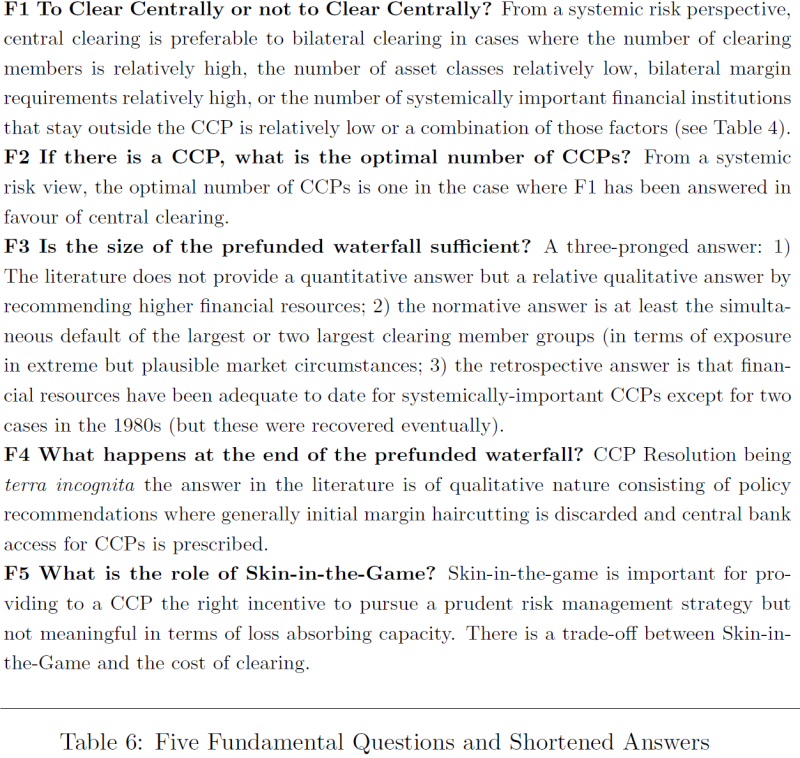
Berndsen organizes the review through “asking five fundamental questions about CCPs.”  Table 6 on p.30 (copied below) provides these questions and shortened answers.

Berndsen_Table6


I am grateful to Berndsen for writing this article, proposing future research topics based on his extensive review of the literature, and providing a comprehensive bibliography (even if it has increased my “to read” list!).  An abstract of the article is below:           

Central counterparties (CCPs) are designed to reduce aggregate counterparty credit risk and function as market infrastructures for capital markets in securities and derivatives. Although CCPs, also known as clearing houses, exist for well over a century, they have gained prominence since they became the main international public policy response to the