
Photo of Colleen Baker

PhD (Wharton) Professor Baker is an expert in banking and financial institutions law and regulation, with extensive knowledge of over-the-counter derivatives, clearing, the Dodd-Frank Act, and bankruptcy, in addition to being a mediator and arbitrator.

Previously, she spent time at the U. of Illinois Urbana-Champaign College of Business, the U. of Notre Dame Law School, and Villanova University Law School. She has consulted for the Federal Reserve Bank of Chicago, and for The Volcker Alliance.  Prior to academia, Professor Baker worked as a legal professional and as an information technology associate. She is a member of the State Bars of NY and TX. Read More

Over the summer, I had the good fortune of hearing Professor Christina Parajon Skinner present her important and timely work on Central Banks and Climate Change.  I was thrilled to see that this article was recently posted to SSRN (here) and I’m reading it now!  Here’s the abstract:

Central banks are increasingly called upon to address climate change. Proposals for central bank action on climate change range from programs of “green” quantitative easing, to increases in risk-based capital requirements to deter banks from lending to climate-unfriendly business. Politicians and academics alike have urged climate risk as both macroeconomic and financial stability risk. Nevertheless, in the U.S., the Federal Reserve has been measured in its response to climate change.

This article considers the scope of the Fed’s policy and legal authority to address climate change. Drawing on insights from corporate finance and macroeconomics, the article first considers how climate risk presents risks that are policy problems for the Fed. From that policy basis, the article constructs a legal framework — stitching together a variety of Fed laws, regulations, and precedents of practice — to discern where the Fed can legitimately move forward on climate change and the areas
Dear BLPB Readers:

The Department of Finance, Insurance, Real Estate and Law, at the University of North
Texas G. Brint Ryan College of Business, invites applications for the appointment of Lecturer
in Business Law starting in the spring 2021 semester or possibly fall 2021. The lecturer will
teach four business law courses per semester, advise students and provide service to the
department, college and university. Teaching will be at the Denton main campus and Frisco
branch campus (face-to-face and/or online/remote) and will include courses such as the
Legal Environment of Business, International Business Law, Real Estate Law, Corporation
Law, and Law for Accountants and Managers.  Complete announcement is here: Download UNT lecturer job ad

Carlos Berdejó recently posted a fascinating new article to SSRN, entitled Financing Minority Entrepreneurship.  In it, he examines the reasons why minorities struggle to access capital when starting businesses and takes a close look at how existing programs have not succeeded at increasing access to capital.  He argues that a successful program will increase equity and hybrid investment while also addressing informational asymmetry issues.  

He proposes that a new type of Small Business Investment Company (SBIC) — a Local Impact Small Investment Company (LISBIC) might offer a way to address many of the barriers faced by minority-owned businesses.  A LISBIC would do much of what a SBIC does, but with a more localized focus.  This local focus would allow the LISBIC to better evaluate soft-information about investment opportunities while its structure and design would generate credibility with investors.

The article also explores many practical and technical challenges to implementing such a program.  It left me with the sense that this sort of program would be achievable and might even pass through a divided Congress.  Hopefully, policymakers and legislators will consider this approach to increase access to capital.

Yesterday, the Financial Stability Board (FSB) released a report: Holistic Review of the March Market Turmoil (Report).  It contains lots of really interesting information and is well worth a read (for a quick overview, there’s an Executive Summary and a two minute YouTube video of Randal K. Quarles, FSB Chair and a Governor of the Federal Reserve System, discussing the Report). 

I thought its emphasis on the increasingly central role of market liquidity to financial market resilience particularly important.  Today, both the traditional, highly regulated banking system and the market-based credit system provide credit to the economy.  These systems are interconnected and roughly equivalent in size.  Although the market-based credit system – non-bank financial intermediation (NBFI) – looks, smells, and acts like banking, it is not similarly regulated nor does it have access to deposit insurance or the Federal Reserve’s lender of last resort liquidity facility.  Nevertheless, in the financial crisis of 2007-09 and this past March, the Federal Reserve provided extraordinary liquidity and other support to the NBFI to promote financial stability and address bank-like runs.

On p.2, the Report notes that “The need to intervene in such a substantial way has meant that central banks had to take

BLPB Readers, below are hiring announcements of the Kelley School of Business at Indiana University:

Tenure Track Posting

The Kelley School of Business at Indiana University seeks applications for a tenured/tenure-track position in the Department of Business Law and Ethics, effective fall 2021. The candidate selected will join a well-established department of 26 full-time faculty members who teach a variety of courses on legal topics, business ethics, and critical thinking at the undergraduate and graduate levels. It is anticipated that the position will be at the assistant professor rank, though appointment at a higher rank could occur if a selected candidate’s record so warrants. Complete posting here: Download BLE tenure-track ad (to start fall 2021)

Lecture (non tenure track) Posting

The Kelley School of Business at Indiana University seeks applications for a full-time, non-tenure-track lecturer position in the Department of Business Law and Ethics, effective fall 2021. The candidate selected will join a well-established department of 26 full-time faculty members who teach a variety of residential and online courses on legal topics, business ethics, and critical thinking at the undergraduate and graduate levels. Lecturers have teaching and service responsibilities, but are not expected to engage in research activities. Complete posting

In today’s post, I thought I’d share with BLPB readers a few tidbits of information that caught my eye this morning:

1) Today, the Financial Stability Board (FSB) released the “2020 list of global systemically important banks (G-SIBs).”  Topping the list of 30 are Citigroup, HSBC, and JP Morgan Chase.

2) The FSB also recently released a discussion paper for public consultation: Regulatory and Supervisory Issues Relating to Outsourcing and Third Party Relationships.  Reading it has now been added to my “do to list” as it addresses issues such as banks’ reliance on cloud computing, a topic I wrote about in Banking on the Cloud (w/David Fratto and Lee Reiners), an article for last year’s BLPB symposium.

3) Bill Ackman, CEO of the hedge fund Pershing Square, is “hedging the pandemic again.” 

4) Ok, so this one didn’t really catch my eye so much as I went looking for it!  I’m working on finishing this year’s BLPB symposium article… Huang and Takát’s The CCP-bank nexus in the time of Covid-19 shares the happy news that despite the intense market volatility of March 2020, clearinghouses performed well.  However, procyclical margin calls by clearinghouses did create liquidity

Michigan Law School 2021 Junior Scholars Conference

April 16-17, 2021

Call for Papers

Deadline for Submission: January 4, 2021

The University of Michigan Law School is pleased to invite junior scholars to attend the 7th Annual Junior Scholars Conference which will take place virtually on April 16-17, 2021. The conference provides junior scholars with a platform to present and discuss their work with peers and receive feedback from prominent members of the Michigan Law faculty. The Conference aims to promote fruitful collaboration between participants and to encourage their integration into a community of legal scholars. The Junior Scholars Conference is intended for academics in both law and related disciplines. Applications from graduate students, SJD/PhD candidates, postdoctoral researchers, lecturers, teaching fellows, and assistant professors (pre-tenure) who have not held an academic position for more than four years, are welcomed.

Complete call for papers Download Cfp Michigan Law School 2021 Junior Scholars Conference.

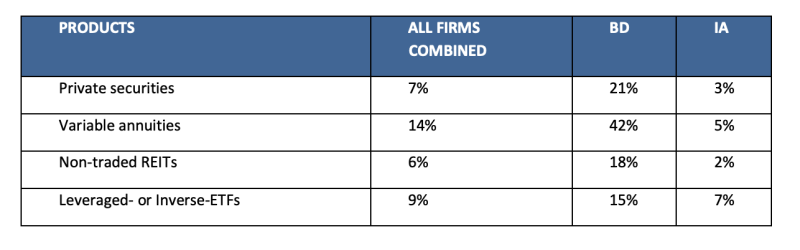
The North American Securities Administrators Association (NASAA) recently released a new report aimed at “identify a baseline of broker-dealer (“BD”) and investment adviser (“IA”) firm policies, procedures, and practices involving sales to retail investors, as those policies, procedures, and practices existed in 2018 prior to adoption and release of the final rule by the SEC (the “pre-BI period”).”  NASAA will do a second look later to see how Regulation Best Interest changes sales patterns.  My early prediction:  not much.

As it stands, some of the differences between the BD channel and the IA channel are shocking.  You’re nine times as likely to get sold a non-traded REIT by a BD than by an IA.  Across the board, BDs load investors up with riskier, complex products:

Screen Shot 2020-10-29 at 11.42.11 AM

This doesn’t surprise me.  Many of these complex products pay massive commissions to the brokers who sell them.  Unsurprisingly, they tend to get sold more often through that channel.  The IA channel compensates advisers differently and they lack the same incentive to get their clients into variable annuities and other complex, illiquid products.

Looking forward, if Regulation Best Interest has some meaningful effect, we would expect these numbers to change in some significant way.  I

The University of Wisconsin Law School is looking to hire in the areas of Business/Corporate Law, among other closely related areas. We invite applications for faculty position at the rank of Assistant, Associate or Full Professor of Law beginning academic year 2021-2022. We seek entry-level and lateral candidates who show scholarly promise, as evidenced by publications, works in progress, or a research agenda. Applicants should have relevant experience such as teaching, legal practice, or a judicial clerkship. Hiring rank will be commensurate with years of relevant experience. All candidates must have proven success in conducting research or publishing papers in high-impact journals, and teaching appropriate to their stage of career. The University of Wisconsin is an Equal Opportunity and Affirmative Action Employer. We promote excellence through diversity and encourage all qualified individuals to apply. 


The complete PVL is available here: https://jobs.hr.wisc.edu/en-us/job/505740/assistant-associate-or-full-professor-of-law

With the comment period closing today, the SEC will consider a FINRA proposal to make some relatively minor changes to how the current process for expunging public records works.  In my comment letter, I explained that changes simply don’t do anywhere near enough to address the core problem underlying the current, fundamentally broken expungement process. In essence, the Proposal’s expungement process improperly relies on an adversarial system to surface information relevant to whether customer dispute information should be expunged.  This adversarial system fails to function in any reliable way because expungement hearings generally proceed as one-sided affairs which are functionally ex parte proceedings.  In these functionally ex parte proceedings, arguments and evidence submitted by brokers seeking expungement never receive any real scrutiny by anyone well-situated to carefully consider these expungement requests.  When arbitrators recommend expungement, courts—which are generally precluded from closely reviewing the underlying arbitration absent the rarest of circumstances—then confirm the arbitration awards.  Judicial review under these circumstances provides no meaningful check on this process and only serves as a dubious veneer. 

To help the Commission see that these expungement hearings often have little resemblance to the sort of adversarial proceeding one would expect in arbitration, I