Photo of Colleen Baker

PhD (Wharton) Professor Baker is an expert in banking and financial institutions law and regulation, with extensive knowledge of over-the-counter derivatives, clearing, the Dodd-Frank Act, and bankruptcy, in addition to being a mediator and arbitrator.

Previously, she spent time at the U. of Illinois Urbana-Champaign College of Business, the U. of Notre Dame Law School, and Villanova University Law School. She has consulted for the Federal Reserve Bank of Chicago, and for The Volcker Alliance.  Prior to academia, Professor Baker worked as a legal professional and as an information technology associate. She is a member of the State Bars of NY and TX. Read More

A bunch of us sensed that it was coming.  I raised the question in an October 8, 2018 post here.  Now, it has actually happened.

Tesla Chief Executive Officer Elon Musk has finally caught the negative attention of the U.S. Securities and Exchange Commission (SEC) with yet another of his reckless tweets.  The WaPo reported earlier tonight that “[t]he Securities and Exchange Commission . . . asked a federal judge to hold Tesla CEO Elon Musk in contempt for violating the terms of a recent settlement agreement . . . .”  That settlement agreement, as readers will recall, relates to SEC allegations that Musk lied to investors when he posted on Twitter that he had secured the funding needed to take Tesla private.  The settlement agreement provides for the review and pre-approval of Musk’s market-moving public statements.

Ann Lipton and I, as BLPB’s resident fraud mongers, have been following the Musk affaire de Twitter for a number of months now.  (See, e.g., here, here, and here.)  Based on our prior posts, it seems clear the world was destined for this moment–a moment in which the SEC not only catches Musk in a tweeted misstatement but also

BLPBPlatedTacos

Couples Cooking with Plated: Curried Lamb Tacos
with Cabbage Slaw and Cilantro-Lime Yogurt

Since I last wrote about meal kits–those boxes of goodness (recipes and ingredients, all shipped to your door)–they have continued to be in the news.  There’s been some consolidation in the industry (referenced here), continued speculation about whether the industry is sustainable (for a negative view, see here), and ongoing interest in what meal kits are all about (here).  Now, there even is an industry information page dedicated to meal kits (here).

A central concern in much of what is being written is competition.  But I have my own perspective on competition in this industry: if enough of these firms can find a financially sustainable, cost-effective business model (and I certainly hope they do), I have a good feeling about the continued survival of a few of these firms.  Why?  Because each of the three firms I have ordered from–Blue Apron, Hello Fresh, and Plated–has evolved toward each other a bit as time has gone on, converging toward better service norms.  Among the areas of convergence: segregated ingredients (put in a separate bag or mini-box)

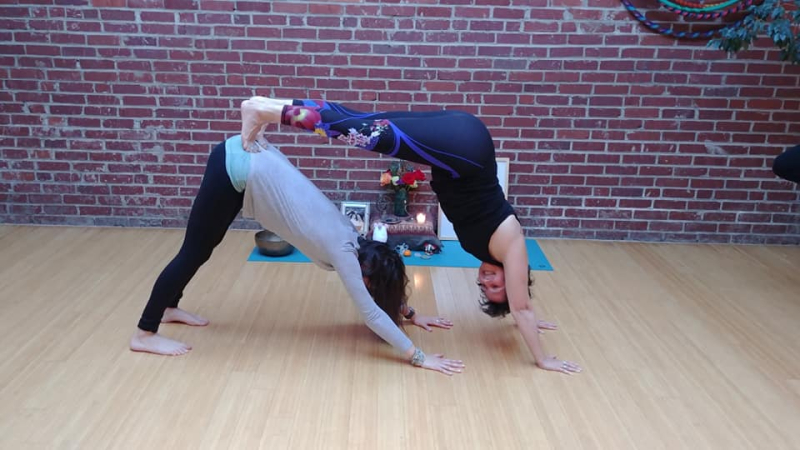
Yoga(Me&Jordan)

A bit over three years ago, I publicly noted in this space that I am an active yoga practitioner.  In a post on “Mindfulness and Legal Drafting for Business Lawyers (A Yoga Analogy),” I wrote about common touchpoints in an asana practice (what many folks just call “yoga”) and contract drafting, sharing thoughts that had first come to me after a yoga class one weekend.  In my three-part 2017 series of “Traveling Business Law Prof” posts on packing for business travel, I also mentioned my asana practice here and here.

Today, I set out to start posting a bit more on the intersections of yoga and business law teaching and practice.  I will have help from BLPB co-blogger Colleen Baker, a fellow yogi.  In fact, it is Colleen who has spurred this on.  We have shared a bunch of ideas on things to write about.

I begin with the news that I now am a Registered Yoga Teacher with a 200-hour certification.  I set out to achieve that goal about 18 months ago, after a discussion (at the wedding of a former student) with the life partner of a UT Law alum who is about 30 years

Our friend and colleague Dan Kleinberger sent the following request along to me a few days ago on behalf of the LLCs, Partnerships and Unincorporated Entities Committee of the Business Law Section of the American Bar Association:

At the Spring meeting of the ABA Business Law Section in Vancouver, on Thursday, March 28, 2019 from 2:30pm – 4:30pm, the LLCPUE Committee is sponsoring a panel entitled, “Lessons from the Trenches for Transactional Lawyers.” Here is a brief description:

Avoiding errors in transactional documents — insights from attorneys who have seen errors play out in litigation: two litigators (including one who defends attorney malpractice claims), a transactional lawyer who often plays clean up, and an expert witness who frequently testifies in cases arising from problematic language in deal documents.

If you have some examples of problematic language, favorite (or disfavored) cases, or “occasions of sin” to share in, the panel would be grateful. The presentation will not be merely war stories. Instead, the panelists will present various categories of errors and occasions for error, as well as practical suggestions for avoiding error. However, the more examples the panel has from which to work, the more useful the categorizations will be.

Redact

This from our friend Heather Johnson at Hofstra Law:

This May and June, Hofstra Law will offer a three-credit or five-credit study abroad program on International Financial Crimes and Global Data Regulation. Both programs will begin Sunday, May 19; the three-credit program will conclude on June 1, 2019 and the five-credit program will conclude on June 13, 2019. The courses will be taught by Hofstra University School of Law Professor Scott Colesanti and Professor Giovanni Comande from the Scuola Superiore Sant’Anna.

It will be held in Pisa, Italy, and is co-sponsored by the Scuola Superiore Sant’Anna. This year, we have added a dinner with the Dean of our Law School, Gail Prudenti and an excursion to Milan to visit the Borsa headquarters!

The deadline is Friday, March 29, 2019 — those interested should apply as soon as possible!

The course is open to law students around the country; students must have completed their full-time 1L course work by the start of this program. Attached to this e-mail you’ll find the up-to-date application, a poster about the program as well as the tentative schedule. Interested students should apply by AS SOON AS POSSIBLE.

Students joining us from other universities

Boston University School of Law is seeking to hire a full-time attorney in its Startup Law Clinic (the “Clinic”). The Clinic is part of BU Law’s Entrepreneurship, Intellectual Property, and Cyberlaw Program, which is a unique collaboration between BU Law and the Massachusetts Institute of Technology.

The Clinic represents current students at MIT and BU on matters related to a wide range of legal issues faced by early-stage business ventures. The attorney would be expected to help law students counsel clients and represent students in transactional settings. Clients often present questions of law involving for-profit and nonprofit entity formation, allocations of equity, startup financing, employment and independent contractor issues, ownership of intellectual property, privacy policies, terms of service and other third-party contractual relationships, and trademark and copyright matters. Experience representing startup ventures is considered a plus.

The attorney’s primary responsibility will be to supervise and assist students with direct client representation matters. The attorney will also assist the Clinic Director and Assistant Director in preparing and teaching a year-long seminar for students enrolled in the Clinic, including developing materials, performing research, and coordinating classroom activities and guest presentations. The position is a year-round position and the attorney also would work

Miraval2019-1

Back in November, my sister invited me to join her for the second time for a three-day break at Miraval, a resort in Tucson, Arizona.  I accepted her invitation with the understanding that I needed to recharge a bit after a rough 2018.  A visit to Miraval, I thought, would be a great way to do that and jumpstart my research this spring. I signed on.  Then, my sister had to back out on the trip late-in-the-game for professional reasons.  My dilemma: to cancel/reschedule the trip . . . or just go by myself?  I decided to go anyway.

Miraval’s distinctive claim to fame as a resort is mindfulness.  Among other things, it promotes “Life in Balance.”  Mindfulness has been a hot topic for the legal profession, law schools (see, e.g., the University of Miami’s Mindfulness in Law Program), and the American Bar Association (the “ABA”) in recent years.  Among other things, mindfulness may help attorneys process difficult situations in a healthier manner, acting as an antidote (in some circumstances) for lawyer mental health issues I wrote about a few weeks ago. (See also Marcia Narine Weldon’s follow-on post.)  Berkeley Law has

ComplianceNet2 Conference Invitation Announcement: Early Bird Registration Deadline is THIS FRIDAY, January 25th!

The second-annual ComplianceNet conference will take place on June 3-4, 2019. Villanova University Charles Widger School of Law and its Girard-diCarlo Center for Ethics, Integrity and Compliance will host the conference. Like the highly successful inaugural conference at UC Irvine in 2018, this conference will allow scholars from across disciplines and different legal and regulatory topics to exchange research and explore connections for collaboration.

The timing of this year’s conference is designed to follow on the heels of the Law & Society meeting in nearby Washington, D.C. If you are already headed to Law & Society, Villanova is a short train-ride away and easily accessible by public transportation. Regardless of whether you will be attending Law & Society, Villanova is in a beautiful location right outside Philadelphia, easily serviced by major international airports (Philadelphia (PHL), Newark (EWR), Baltimore (BWI), two more in NYC, and two more in DC); 90 minutes from NYC; and two hours from D.C.

The theme of this year’s conference is “Business Ethics”, although we welcome additional papers discussing compliance across diverse settings. This year’s theme seeks to engage the question of how to

image from pixabay.com

As we celebrate Martin Luther King Day today, I am moved to write a bit about him as a teacher.  Preachers (along with coaches and others who interact with us in various capacities in our lives) are teachers, of course.  They struggle, as educators, with similar challenges in their teaching to those that we face in curricular, co-curricular, and extracurricular teaching in law schools.

So many parallels are obvious.  But I want to focus on one small (and perhaps less obvious) thread in this post: love.  The choice of this focus derives from a David Brooks op-ed that I read a few days ago in The New York Times.  The column included a number of helpful facts and ideas relating to the connection between emotions and intelligence.  Perhaps one of the most poignant messages it conveyed was this one: “children learn from people they love, and . . . love in this context means willing the good of another, and offering active care for the whole person.”  That rang true to me.  How, then, might love unite Dr. King with teaching and learning?

Of course, as many may recall, Dr. King (like other Christian clerics) preached about loving one’s

My frequent academic partner and friend John Anderson and I organized and moderated a discussion session on insider trading in the blockchain transactional environment at this year’s AALS annual meeting. The session, entitled “Insider Trading and Cryptoassests: The Future of Regulation in the Blockchain Era,” featured teacher-scholar participants from academic backgrounds in white collar crime, corporate law, securities regulation, intellectual property, cyberlaw, and ethics/compliance. The program description is as follows:

As the cryptoasset ecosystem shows signs of emerging from its “Wild West” phase, insider trading has become a principal concern for trading platforms, investors, and regulators. Insider trading cases concerning cryptoassets present challenges, however, because the legal understanding of both cryptoassets and the markets in which they are generated, bought, and sold has been significantly outpaced by their development, expansion, and innovation. In the United States, market professionals, the Securities and Exchange Commission (SEC), the Commodities Futures Trading Commission (CFTC), and others debate whether virtual currencies are securities, contracts, currencies, commodities, or something else. Both the SEC and CFTC assert jurisdiction over cryptoassets, but (at this writing) neither has precisely defined the scope or nature of its purported regulatory oversight. This commercial and regulatory uncertainty leaves a number of