Photo of Colleen Baker

PhD (Wharton) Professor Baker is an expert in banking and financial institutions law and regulation, with extensive knowledge of over-the-counter derivatives, clearing, the Dodd-Frank Act, and bankruptcy, in addition to being a mediator and arbitrator.

Previously, she spent time at the U. of Illinois Urbana-Champaign College of Business, the U. of Notre Dame Law School, and Villanova University Law School. She has consulted for the Federal Reserve Bank of Chicago, and for The Volcker Alliance.  Prior to academia, Professor Baker worked as a legal professional and as an information technology associate. She is a member of the State Bars of NY and TX. Read More

ILT&LHeader

CALL FOR PRESENTATION PROPOSALS

Institute for Law Teaching and Learning Summer Conference
“Teaching Today’s Law Students”
June 3-5, 2019
Washburn University School of Law
Topeka, Kansas

The Institute for Law Teaching and Learning invites proposals for conference workshops addressing the many ways that law professors and administrators are reaching today’s law students.   With the ever-changing and heterogeneous nature of law students, this topic has taken on increased urgency for professors thinking about effective teaching strategies. 

The conference theme is intentionally broad and is designed to encompass a wide variety of topics – neuroscientific approaches to effective teaching; generational research about current law students; effective use of technology in the classroom; teaching first-generation college students; classroom behavior in the current political climate; academic approaches to less prepared students; fostering qualities such as growth mindset, resilience, and emotional intelligence in students; or techniques for providing effective formative feedback to students.

Accordingly, the Institute invites proposals for 60-minute workshops consistent with a broad interpretation of the conference theme. Each workshop should include materials that participants can use during the workshop and when they return to their campuses. Presenters should model effective teaching methods by actively engaging the workshop participants.  The Institute Co-Directors are glad
The following comes from our friend Saule Omarova at Cornell Law.  I hope that many can arrange to attend one or both events to honor Lynn’s life and work.

*          *          * 

Please join us on February 1-2, 2019, in New York City, for a special two-part event celebrating the life and work of our colleague and friend, Professor Lynn Stout.

On February 1, 2019, Cornell University Law School will hold the Lynn Stout Memorial Conference, honoring Professor Stout’s scholarly work and significant impact in corporate governance. The conference will feature a series of cutting-edge paper presentations and discussion panels; the conference celebrates Professor Stout’s scholarship and highlights the lasting impact of her ideas and writings on the present and future trajectory of legal research in corporate law, securities and derivatives regulation, law and economics, and law and ethics. 

The conference will take place at the Cornell Club in New York City (6 East 44th Street, New York, NY 10017).

On February 2, 2019, at 10 a.m., an informal memorial service will be held at St. Paul’s Chapel of Trinity Church Wall Street (209 Broadway, New York, NY 10007).

The agenda

I am finishing up the last of my grading (grades are due on Wednesday).  Nevertheless (or maybe for the purpose of grading avoidance), I have been determined all day to take a pause to reflect on 2018 and look forward to 2019.  For me (and perhaps for us all), 2018 was a year with both joys and sorrows; achievements and failures; ups and downs.  I admit that 2018’s sorrows were more abundant than usual–or than I would have liked.  And so, I am primed to kick 2018 to the curb.  Ready or not, 2019 will be here in a few short hours.  I have much to look forward to in the coming year–a research leave, my son’s wedding, and lots more that I know I am forgetting or do not even know about yet!

Among my more serious reflections and (dare I say it) resolutions heading into 2019 is self-care.  I am particularly mindful of the need for lawyers and lawyers-in-waiting (our students) to be aware of an attendant to their mental health.  A few days ago, The American Lawyer published an article entitled After a Year Marked by Tragedy, Attorney Mental Health Takes the Spotlight.  The article highlights

A few weeks ago, I posted on the SEC Roundtable on the Proxy Process (here).  I noted in a postscript to that post that friend-of-the-BLPB Bernie Sharfman had an additional comment letter (his fourth) relating to this regulatory project up his sleeve (so to speak).  That comment letter, dated December 17, 2018, was recently filed (see here) and focuses on voting recommendations.  The nub?

Investment advisers should not be in fear of breaching their fiduciary duties if they use board voting recommendations. . . . The SEC needs to go further than just approving the use of board voting recommendations as long as the investment adviser has an agreement with the client to use them. . . . [T]he SEC needs to explicitly state in some way that an investment adviser will not be in breach of its fiduciary duties under the Advisers Act if it uses board voting recommendations when voting its proxies.

To implement such a policy, this comment letter requests the SEC to provide investment advisers with a liability safe harbor under the Advisers Act when using board voting recommendations in voting their proxies as long as their clients do not prohibit their use

image from images.westacademic.com

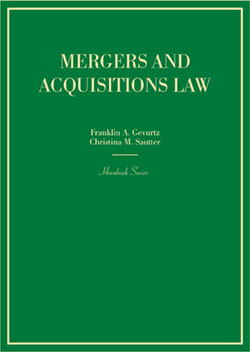
West Academic Publishing has just released a new mergers and acquisitions hornbook co-authored by dear friends and business law prof colleagues Frank Gevurtz and Christina Sautter.  I had known that the book was in the offing, but I just got a note from Frank on Saturday confirming its publication and availability.  Here is the synopsis from West:

Gevurtz & Sautter’s Hornbook on Mergers and Acquisitions provides a comprehensive exploration of this important topic. Written in a casual style designed to engage the reader, the book clarifies and critiques critical doctrine. In addition to covering corporate laws governing mergers and acquisitions, the book explores securities, tax, and antitrust laws, as well as addressing the business, financial, and practical lawyering aspects of mergers and acquisitions.

I know these two to be folks with solid backgrounds and interesting insights in this area.  I have requested my online review copy.  Perhaps some of you will want to do that, too.  And for those without that privilege who want this in their libraries, you can get it by clicking on the West Academic Publishing link at the beginning of this post or purchase it on Amazon here.

Haskell Murray, this one’s for you (and many others who work with B corporations and benefit corporations)!

Friend of the BLPB Tamara Belinfanti recently sent me a link to an article in which she was quoted.  The premise of the article is clear from its title: To B or not to B? That’s the question for companies who seek to “balance profit and purpose.”  Familiar proposition; great article title.  It’s certainly worth a quick read, even if it says nothing new.  (Although it does seem to imply that Justice Strine is no longer the Chief Justice of the Delaware Supreme Court . . . .)

In the article, various folks (including Justice Strine) comment about whether B corporation certification and/or benefit corporations are “needed” for social enterprise firms.  This is a question that I love to think about (especially if it can keep me from grading papers for a bit . . . ).  Some of you may remember my post on this topic from a few years ago.  It also is an issue that I have approached at times in pieces of my academic writing, including in the article featured in this post.

Next summer, at the

A number of years ago, I attended the Biennial Conference on Applied Legal Storytelling.  It was a super event.  I came out of the conference with amazing ideas for teaching and scholarship.  I am thinking of taking my spring research project (on friends and family insider trading) to the conference in 2019.  Will you come join me?

Typically, the conference principally attracts legal writing instructors and clinicians. But more of us should be jumping on this bandwagon.   Storytelling and narrative more generally—which are (of course) a part of all advocacy and dispute resolution—also are used in transaction-building and negotiation.  Accordingly, I am hoping that some of you will consider attending the conference with me this coming summer.  Here are the details from the call for proposals.

*          *          *

Call for Proposals

Seventh Biennial Conference on Applied Legal Storytelling

Boulder, Colorado, July 9–11 2019

Hosted by the University of Colorado School of Law,
University of Denver Sturm College of Law, and University of Wyoming School of Law, and coordinated by the Rocky Mountain Legal Writing Scholarship Group

This is the call for proposals for the seventh biennial conference on Applied Legal Storytelling. We are offering two deadlines for submitting proposals: January 21, 2019 (priority deadline) and March 11, 2019 (extended deadline).

About the Conference

The Applied Legal Storytelling Conference brings together academics, judges, andpractitioners. The conference has previously convened in 2007 (London), 2009 (Portland),2011 (Denver), 2013 (London), Seattle (2015), and Washington D.C. (2017). We are veryexcited to bring it back to the Mountain West (Boulder) in July 2019.

Applied Legal Storytelling (AppLS) examines the use of stories—and of storytelling or narrative elements—in law practice, legal education, and the law.

This definition is intentionally broad in order to allow people creativity in the way theythink and present on the topic. Such topics may include: the ways in which fiction-writing techniques or narrative theory can inform legal storytelling; stories in the law, or law as stories; legal storytelling and metaphor; client story advocacy; legal storytelling and cognitive science; and ethical considerations in legal storytelling.

In an effort to continue the storytelling conversation for this seventh conference, and to welcome new attendees, we are providing resources for those interested in submitting a proposal and who wish to generate ideas or respond to others’. The first is a list of topicsfrom past conferences, available athttps://www.lwionline.org/sites/default/files/TopicsfrompastAppLSconferences.pdf. The second is a link to a bibliography on AppLS, including articles that have emerged from previous storytelling conferences, available at http://www.alwd.org/wp-contentuploads20151108-rideout_article2015-pdf/. We are also happy to answer questions and offer you suggestions—if you are a newcomer and interested in becoming involved, please reach out.

It seems like it’s “Call for Papers Week” for me.  Here’s one near and dear to my heart, as you all must know . . . .

*     *     *     *     *

National Business Law Scholars Conference (NBLSC)
June 20-21, 2019
Call for Papers

The National Business Law Scholars Conference (NBLSC) will be held on Thursday and Friday, June 20-21, 2019, at the University of California, Berkeley School of Law.

This is the tenth meeting of the NBLSC, an annual conference that draws legal scholars from across the United States and around the world. We welcome all scholarly submissions relating to business law. Junior scholars and those considering entering the academy are especially encouraged to participate. If you are thinking about entering the academy and would like to receive informal mentoring and learn more about job market dynamics, please let us know when you make your submission.

To submit a presentation, email Professor Eric C. Chaffee at eric.chaffee@utoledo.edu with an abstract or paper by February 15, 2019. Please title the email “NBLSC Submission – {Your Name}.” If you would like to attend, but not present, email Professor Chaffee with an email entitled

From our friend and colleague, Djamchid Assadi at the Burgundy School of Business in Dijon, France:

Lisbon2019_EURAM-banner_1100

SIG 03 – ENT – Entrepreneurship

With our theme Exploring the Future of Management: Facts, Fashion and Fado, we invite you to participate in the debate about how to explore the future of management.

We look forward to receiving your submissions.

T03_08 – Entrepreneurship in the sharing economy: P2P strategies, models, and innovation paradigms

Proponents:

Djamchid Assadi, Burgundy School of Business BSB; Asmae DIANI, Sidi Mohamed Ben Abdellah University, Fez, Morocco; Urvashi Makkar, G.L. Bajaj Institute of Management and Research (GLBIMR), Greater Noida; Julienne Brabet, Université Paris-Est Créteil (UPEC); Arvind ASHTA, Arvind, CEREN, EA 7477, Burgundy School of Business – Université Bourgogne Franche-Comté, France

Short description:

Sharing of funds, files, accommodations, and other utilities and properties has become a vital part of the emerging social life and economy.

The traditional dyadic firm-to-customer transactions has given place to the depositional triadic of P2P platforms game changers which facilitate exchange between peer providers and peer recipients. As these P2P platforms disrupt conventional transactions, for example, P2P home exchange platforms like Airbnb thoroughly disorder the hotel industry, it is crucial that researchers consider conceptual refinement and empirical grounding for providing insights.

This track aims to bring together

Even after 19 years or so of teaching Business Associations courses, I still marvel at how hard it is to teach corporate fiduciary duty doctrine to my students.  A lot of my frustration comes from the amount of (perhaps not-so-useful) judicially instigated labeling involved under Delaware law, as the leading state in the area.  In particular, there is the narrowing of the duty of care to exclude both substantive duty of care claims and Caremark claims.  And then there is the matter of how to best describe the nature of the business judgment rule and how to describe the interaction of disclosure (candor) with the fiduciary duties of care and loyalty. And finally there is a lingering doctrinal question as to whether, in other jurisdictions, good faith, classified as a subsidiary component of the duty of loyalty in Delaware, may be a free-standing fiduciary duty or, in the alternative, foundational, penumbral, etc. to the fiduciary duties of loyalty and care  . . . .  Tough stuff.

Is anyone else out there suffering in the same way I do in teaching fiduciary duties in a Business Associations or Corporations class?  How do you handle the legal complexity/labeling questions?  I continue to