Photo of Colleen Baker

PhD (Wharton) Professor Baker is an expert in banking and financial institutions law and regulation, with extensive knowledge of over-the-counter derivatives, clearing, the Dodd-Frank Act, and bankruptcy, in addition to being a mediator and arbitrator.

Previously, she spent time at the U. of Illinois Urbana-Champaign College of Business, the U. of Notre Dame Law School, and Villanova University Law School. She has consulted for the Federal Reserve Bank of Chicago, and for The Volcker Alliance.  Prior to academia, Professor Baker worked as a legal professional and as an information technology associate. She is a member of the State Bars of NY and TX. Read More

As many of you know, I have had the honor and privilege of being the Interim Director of the Institute for Professional Leadership (IPL) at The University of Tennessee College of Law for the past three academic years.  The IPL is a special part of UT Law.  As the home of an academic program that ties various parts of the traditional law curriculum together, the IPL benefits students with a wide variety of post-graduation goals–helping them to prepare themselves for the inevitable leadership spaces they will occupy in their professional and personal lives.

I have served as Interim Director at the IPL while continuing with a full teaching schedule, scholarship agenda, and service load.  It now is time for me to step back and allow someone else to lead the IPL–someone who will devote full time to carrying out its mission.  Accordingly, we are looking for a permanent Director for the IPL.  The position announcement can be found here.  

As you can see from the position announcement, the permanent Director will be a member of the law faculty, either tenure-track or non-tenure-track.  The qualifications section of the announcement is copied in below, for your ease of reference.

Qualifications
In 2021 and again in 2022, I blogged about Well-Being Week in Law.  The first week in May bears this title, offering a chance for all of us to focus on how to best ensure that those involved in legal service work can flourish in our work and in the rest of our lives.  As the website notes:

When our professional and organizational cultures support our well-being, we are better able to make good choices that allow us to thrive and be our best for our clients, colleagues, organizations, families, and communities. It is up to all of us to cultivate new professional norms and cultures that enable and encourage well-being.

I agree with all of that.  And as an instructor and researcher and public servant who dedicates significant time to lawyer leadership, I focus a lot of attention on the legal profession and developing the whole lawyer.  So, count me in as a fan.

But this year, I did not post on Well-Being Week in Law, which was last week.  I carry a small amount of guilt for that (and for not getting this post up yesterday, too, when I had originally planned to publish it), since

A great joy in my law practice over the years has been to work on a pro bono basis with creative and social enterprises.  For the 2021 Business Law Prof Blog symposium, Connecting the Threads, I offered some wisdom from my work with creatives in legally organizing and funding their projects.  I wrote briefly about that presentation here.

I recently posted the article that I presented back then, Choice of Entity: The Fiscal Sponsorship Alternative to Nonprofit Incorporation, 23 Transactions: Tenn. J. Bus. L. 526 (2022), on SSRN.  The associated abstract follows.

For many small business ventures that qualify for federal income tax treatment under Section 501(a) of the U.S. Internal Revenue Code of 1986, as amended, the time and expense of organizing, qualifying, managing, and maintaining a tax-exempt nonprofit corporation under state law may be daunting (or even prohibitive). Moreover, the formal legal structures imposed by business entity law may not be needed or wanted by the founders or promoters of the venture. Yet, there may be distinct advantages to entity formation and federal tax qualification that are not available (or not as easily available) to unincorporated not-for-profit business projects. These advantages may include, for example, exculpation

As I recently announced, tomorrow is the last day that we will be accepting submissions for the National Business Law Scholars Conference, June 15-16 at The University of Tennessee College of Law.  We need to start scheduling the sessions for the conference next week.  The substantive requirements for submission include a paper title, a brief abstract, and a few key words.

Information about the conference, including related notes on transportation and accommodations and more information about submissions, can be found here.  We look forward to seeing many of you in Knoxville in June!  Please contact me or Eric Chaffee with questions.

Friend-of-the-BLPB Tom Rutledge alerted me earlier today to a Thomson Reuters piece on the TripAdvisor reincorporation litigation that quotes not one but two of our blogger colleagues: Ann Lipton and Ben Edwards (in that order).  Ann is quoted (after a mention and quotation of one of her recent, more entertaining tweets) on the Delaware judicial aspects of the case.  Ben is quoted on the Nevada corporate law piece.  So great to see these two offering their legal wisdom on this interesting claim.

Ann’s tweet (perhaps predictably) offers a different “take” on Nevada law than Ben’s press statements.

Ann: “I tell my students, Nevada is where you incorporate if you want to do frauds . . . .” 

Ben: “The folks here are people acting in good faith, trying to do what’s right – not cynically racing to the bottom . . . .”

And then Ben gets the last word: “Nevada . . . has become a home for billionaires leaving Delaware in a huff.”

Beautiful.

I am looking forward to welcoming many of you to Knoxville for the National Business Law Scholars Conference on June 15th and 16th!  We have a great group already registered for the conference.  The papers being presented span a wide range of interesting business law topics, as has been the custom.

Several folks indicated they were a bit jammed for time to make the April 7 deadline for submissions.  After consulting with our master scheduler, Eric Chaffee, we have determined to leave submissions open until April 28th.  We are in the process of changing the conference website to update the submission deadline, but the submission link (which generates an email to Eric) is still open.

In the coming weeks, the conference website will be updated to include information on lodging (we have arrangements with several local hotels) and transportation.  In addition to Knoxville’s local airport, McGee-Tyson (TYS), flights are available to a number of local airports (Nashville, Chattanooga, and Tri-Cities) at which one can rent a car and from which one can drive to Knoxville.  The State of Tennessee is beautiful and fun.  I would be delighted to offer touring advice to anyone who would like to take some

The DePaul Law Review will devote the third issue of its 73rd volume (slated for publication in Spring 2024) to a symposium addressing the Emmy-winning scripted drama Succession from a legal and pedagogical point of view. The aim of this special issue is to collect in one place the insights of a variety of faculty members with different legal subject-matter expertise, as a resource for all who are interested in the use of this award-winning work for the teaching, practice, and study of law. The DePaul Law Review has already secured the participation of a number of distinguished scholars.

The DePaul Law Review invites proposals from others for two to four additional contributions to be included in this special issue. Proposals for a contribution of between 5,000 and 10,000 words are welcome from all who teach any area of law. (The print symposium will be accompanied by simultaneous online publication with live hyperlinks, allowing readers to access video links if the author desires.)

Potential contributions to the special issue might take a variety of forms. For example, these essays might:

• explore the legal implications of various plotlines through a variety of doctrinal lenses (e.g., mergers and acquisitions, wills and

This just in from Mary Fan at the University of Washington School of Law:

The University of Washington School of Law invites applications for a visiting lecturer to teach courses in business law and entrepreneurship.  The University of Washington is a major research university in the dynamic hub of Seattle with numerous connections to innovative business and entrepreneurial activity.  Courses that the lecturer may teach include Business Organizations, Entrepreneurial Law, Law and Technology, Intellectual Property Survey, and Nonprofit Organizations. The successful candidate will have a track record of teaching and practical experience in these areas.  Please apply soon because applications are reviewed on a rolling basis.

More information and the application upload site is here:

https://apply.interfolio.com/122716.

Thanks to Mary for sharing this opportunity.

Henning(Rakoff)

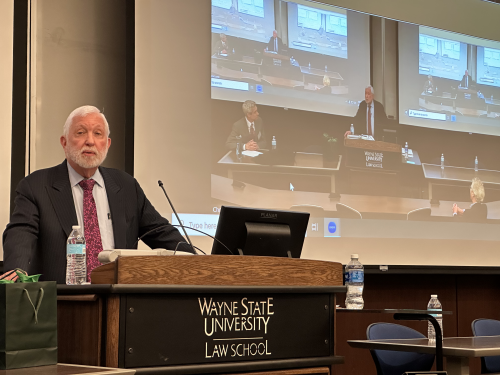
As I wrote last week, I attended the inaugural Petter J. Henning lecture today at Wayne State University Law School.  The Honorable Jed S. Rakoff offered insightful remarks on the sustainability of fraud: why fraud continues to occur unabated and why fraudsters get away with it.  In short, after citing to data on decreasing rates of crime of other kinds, Judge Rakoff noted that fraud rates have been holding steady.  He posited a number of reasons why fraud persists, as set forth below:

  • Deterrence requires speed and certainty of punishment, and fraud enforcement actions are slow and uncertain.
  • The Anglo-American common law of fraud makes it hard to prosecute.
  • Public enforcement is underfunded.
  • Pressure to generate short-term profits is strong.

Judge Rakoff also offered–relevant to some of the work that I have done and am doing on friends-and-family insider trading cases–that based on his personal experience, fraud and other white collar criminal misconduct may be motivated by greed, a desire for power or status, psychological issues, etc.  But he noted overall that those who commit business fraud have a well-founded belief that they can get away with their misconduct–and they actually do.  These fraudsters get off the hook, he

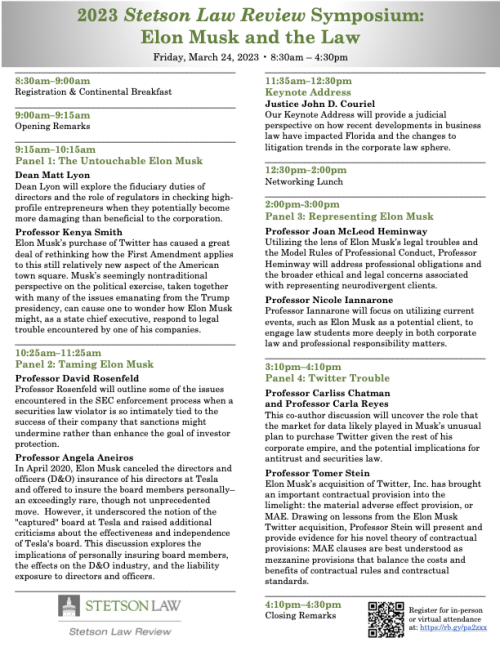
Last Friday, I had the privilege of speaking, with other colleagues, at the 2023 Stetson Law Review Symposium on “Elon Musk and the Law.”  (See the flyer on the program, below.)  This symposium grew out of a discussion group I organized at the 2022 Southeastern Association of Law Schools Conference.  I posted about it here back in May of last year.

I could not have been happier with the way the symposium worked out.  The Stetson Law students, faculty, and administration were well organized, kind, and fun–a total pleasure to work with.  And I got excellent questions and feedback on my early draft paper, Representing Elon Musk, which focuses attention on the lawyer-client relationship under the American Bar Association’s Model Rules of Professional Conduct.  I look forward to seeing the final published proceedings in two forthcoming books of the Stetson Law Review.

*               *               *

Stetson2023(flyer)