
Photo of Benjamin P. Edwards

Benjamin Edwards joined the faculty of the William S. Boyd School of Law in 2017. He researches and writes about business and securities law, corporate governance, arbitration, and consumer protection.

Prior to teaching, Professor Edwards practiced as a securities litigator in the New York office of Skadden, Arps, Slate, Meagher & Flom LLP. At Skadden, he represented clients in complex civil litigation, including securities class actions arising out of the Madoff Ponzi scheme and litigation arising out of the 2008 financial crisis. Read More

California Western School of Law (CWSL) is seeking lateral candidates for a full-time faculty position teaching Professional Responsibility and serving as a Director of CWSL’s STEPPS Program.  STEPPS is a key component of CWSL’s innovative sequential experiential curriculum, bridging the gap between the first-year legal skills program and third-year clinical and externship programs.  STEPPS integrates the teaching of professional responsibility with an experiential small “law firm” component. 

The role combines the doctrinal teaching of professional responsibility and an administrative component managing the STEPPS Program.  The majority of the time spent in the role will be dedicated to the teaching component, however, the Director will also work closely with the STEPPS staff coordinator to supervise the adjunct professors who teach the experiential component of the program.  We welcome lateral candidates with an established record of scholarship who are seeking tenured/tenure-track positions.  We also welcome clinical faculty seeking a clinical position with security of appointment under ABA Accreditation Standard 405(c).  The timing of this job opening corresponds to a periodic review of the STEPPS curriculum, and so the new Director will both be directing a mature program, but also be part of the process of ensuring the program remains innovative moving forward.  
Earlier today the Supreme Court released its opinion in Slack Technologies LLC v. Pirani.  It ruled that a plaintiff seeking to bring a Section 11 claim must trace their stock to a registration statement.  Of course, companies today now go public through direct listings or other methods where the pool of publicly traded stock includes some issued pursuant to registration statement and some from other prior holders.  Functionally, this often makes it impossible to for anyone buying shares in the open market to trace whether their shares were issued pursuant to a registration statement or simply sold by someone else.

The unanimous decision follows the vast majority of circuit courts to consider the issue.  It pointed out that the issue was previously addressed by Judge Friendly in Barnes v. Osofsky, 373 F. 2d 269, 272 (CA2 1967).  

If you regularly read speeches given by SEC Commissioners and staff, you may have noticed a change in the standard opening.  For most of my career, the remarks always began with something to this effect:

Before I begin, I must give the customary disclaimer that the views I express today are my own and do not necessarily reflect the views of my fellow commissioners or the staff.

That standard disclaimer came from Commissioner Crenshaw on March 30, 2023 in the opening to her remarks to the Fixed Income Forum.  And about a month ago, Chair Gensler’s standard disclaimer on April 24, 2023 to the Annual Small Business Forum came out as:

As is customary, I would like to note that my views are my own, and I’m not speaking on behalf of the Commission or SEC staff.

But something has changed.  Chair Gensler gave the disclaimer this way on May 10, 2023 in remarks to the Municipal Securities Disclosure Conference:

My views are my own as Chair of the SEC, and I am not speaking on behalf of my fellow Commissioners or the staff (emphasis added)

This change continues forward to Chair Gensler’s remarks today to to the Investment

As Joan already flagged, Delaware litigation has broken out over whether TripAdviser can reincorporate to Nevada.  The Complaint in that action argues that Delaware courts should enjoin the move and prevent the corporation from moving to Nevada.  The New York Post has also picked up on the reincorporation trend.  In my view, the conditions under which a corporation may exit a jurisdiction and reincorporate elsewhere is a valid question of its current state’s corporate law.  While Delaware may want to impose appropriate conditions on some departures, I doubt it wants to become the Hotel California of corporate law–where you can check in any time you want, but you can never leave.

There are undoubtedly material differences between Delaware and Nevada law.  As I covered here at the time, Nevada’s statutory business judgment rule imposes more limits on liability that Delaware law.  Nevada’s Supreme Court has explained that establishing liability under Nevada law “plainly requires the plaintiff to both rebut the business judgment rule’s presumption of good faith and show a breach of fiduciary duty involving intentional misconduct, fraud, or a knowing violation of the law.”  

Nevada’s law may be better for some corporations than Delaware’s law.  Duke’s Ofer Eldar

As regular readers of this blog will know, you can’t go touting crypto-securities without disclosing how much you’ve been paid to push those products.  I first wrote about this issue in 2018 after Evander Hollyfield attracted attention for promoting the fraudulent AriseBank coin. The same issue showed up again with Kim Kardashian last year.  Now, we’ve got the SEC taking action against eight more:

  • Lindsay Lohan

  • Jake Paul

  • DeAndre Cortez Way (Soulja Boy)

  • Austin Mahone 

  • Michele Mason (Kendra Lust)

  • Miles Parks McCollum (Lil Yachty)

  • Shaffer Smith (Ne-Yo)

  • Aliaune Thiam (Akon)

They all allegedly touted TRX and BTT without disclosing that they were paid to do so or the amount they were paid.  The enforcement actions arise out of the SEC’s pursuit of Justin Sun for allegedly fraudulently manipulating the secondary market for TRX through wash trades.  

I remain skeptical about much of the asset valuation in the crypto and NFT space.  I’d expect that the SEC will continue to pursue these kinds of actions when it has evidence that much of the market for a particular cryptocurrency or type of NFT is largely illusory wash trading designed to generate the appearance of value to suck in money.

Soulja Boy and

A full court press to lower the gates to private markets has emerged.  Last month, Duke’s Gina-Gail Fletcher testified before the House Committee on Financial Services, Subcommittee on Capital Markets.  The Committee titled the hearing: “Sophistication or Discrimination? How the Accredited Investor Definition Unfairly Limits Investment Access for the Non-wealthy and the Need for Reform.”  It considered a range of bills which would eat away at the accredited investor standard and allow broader access to private markets.

The U.S. Congress isn’t the only legislative body considering whether to allow ordinary retail investors to buy private offerings.  Nevada has introduced legislation which would create an intrastate offering exemption which would allow Nevadans making about $65,000 a year (Nevada’s median income) to be sold illiquid, private placements.  The Nevada proposal would create “Nevada certified investors” as an intrastate offering category.  The proposal describes it this way:

“Nevada certified investor” means a natural person who is, or a married couple who each are, a resident of this State  and who, at the time an offer to sell or sale of a security is made to the person or couple: 1. Holds an ownership interest of more than 50 percent in a 

As reported by America First Legal (here), Texas Governor Greg Abbott’s office recently issued a memo reminding state agencies and universities that “federal and state law forbid discrimination against a current or prospective employee because of that person’s race, color, religion, sex, national origin, age, disability or military service.” As stated in the letter (here): “Rebranding this employment discrimination as ‘DEI’ doesn’t make the practice any less illegal.” Of course, the extent to which diversity may be deemed a compelling interest justifying at least some forms of racial discrimination is an issue currently before the Supreme Court (see here).

Many BLPB readers are likely aware that Stephen Bainbridge recently published a new book, The Profit Motive: Defending Shareholder Value Maximization. I must admit that I’m a fan of the Introduction:

There are a lot of books on the market praising stakeholder capitalism. They proclaim a new age in which big corporations should embrace—and, in fact, are embracing—environmental, social, and governance (ESG) goals. Whether putatively objective academic tomes filled with statistics or mass market books filled with bullet points, the bottom line is the same; namely, that stakeholder capitalism is the right thing to do both morally and financially. This is not one of those books.

For those of you on the fence, there is an hour-long overview on YouTube (here), but if that’s too long you might consider a recent guest post by Prof. Bainbridge on the Corporate Finance Lab discussing the book (here). Below is a brief excerpt from that post.

Three major themes animate the project. First, any conception of corporate purpose that embraces goals other than creating value for shareholders is inconsistent with the mainstream of U.S. corporate law. Second, directors do—and should—have wide and substantially unfettered discretion as to how

The following excerpt is from the introduction to a recent publication that may be of interest to BLPB readers. The publication is: Emilie Kao, 303 Creative v. Elenis: Can Stand-Alone Dignitary Harm Create A Right to Endorsement and Duty to Endorse?, 2023 Harv. J.L. & Pub. Pol’y Per Curiam 5, 2–5 (2023). Emilie Kao is Senior Counsel and Vice-President for Advocacy Strategy at Alliance Defending Freedom (ADF), which represents Lorie Smith.

All people have inherent dignity and should be treated with respect. However, whether and how courts should address legal claims surrounding dignity are notoriously complicated. Does the government have an interest in protecting citizens from “dignitary harm”–subjective feelings of emotional distress or stigma? If so, does the government’s interest require it to compel or silence the expression of certain views? If so, does the dignity of the person compelled to speak or remain silent matter? Dignitary harm has played important roles in conflicts between religious freedom and anti-discrimination laws in Masterpiece Cakeshop v. Colorado Civil Rights Commission and Fulton v. Philadelphia. And they are at issue again in 303 Creative v. Elenis, a free-speech case that was recently argued at the U.S. Supreme Court.

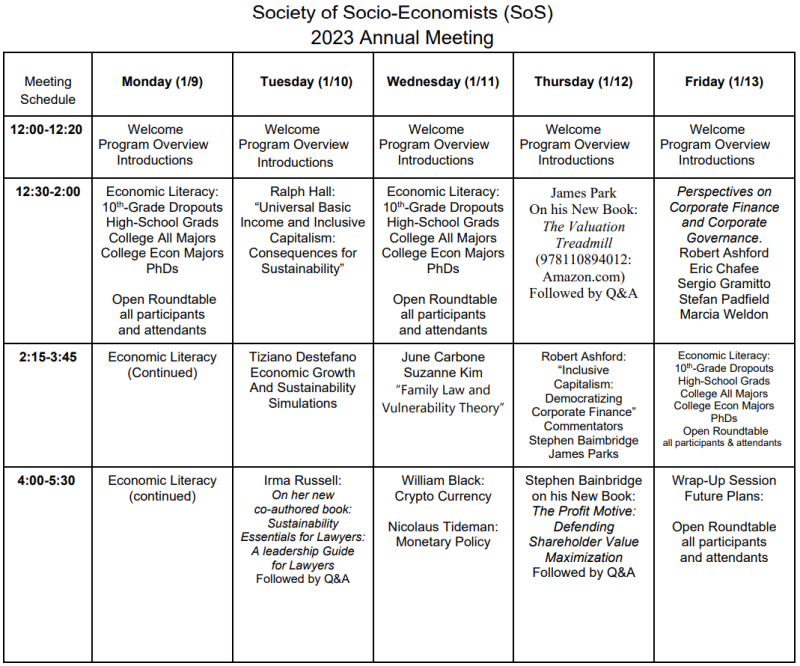
Below are the upcoming events taking place online as part of the Society of Socio-Economists Annual Meeting (all times EST). All events are accessible via a single link, which will be sent to you after registering here (registration is free). Readers of this blog will likely recognize a number of the presenters. I hope to see you there.

SOS 2023

UPDATE: You can find the paper Robert Ashford will be discussing Thursday at 2:15 here: https://scholarlycommons.pacific.edu/cgi/viewcontent.cgi?article=1372&context=uoplawreview

UPDATE 2: Two videos from economists discussing Professor Ashford’s Inclusive Capitalism: (1) https://youtu.be/lL1gEEj0tCU; (2) https://video.syr.edu/media/t/1_nnt9e504 .