Photo of Haskell Murray

Professor Murray teaches business law, business ethics, and alternative dispute resolution courses to undergraduate and graduate students. Currently, his research focuses on corporate governance, mergers & acquisitions, sports law, and social entrepreneurship law issues.

Professor Murray is the 2018-19 President of the Southeastern Academy of Legal Studies in Business (“SEALSB”) and is a co-editor of the Business Law Professor Blog. His articles have been published in a variety of journals, including the American Business Law Journal, the Delaware Journal of Corporate Law, the Harvard Business Law Review, and the Maryland Law Review. Read More

Last Thursday, Jay Brown filed an amicus brief with the U.S. Supreme Court coauthored by him, me, Jim Cox, and Lyman Johnson.  The brief was filed in Leidos, Inc., fka SAIC, Inc., Petitioners, v. Indiana Public Retirement System, Indiana State Teachers’ Retirement Fund, and Indiana Public Employees’ Retirement Fund, an omission case brought under Section 10(b) of and Rule 10b-5 under the Securities Exchange Act of 1934, as amended.   An abstract of the brief follows.

This Amicus Brief was filed with the U.S. Supreme Court on behalf of nearly 50 law and business faculty in the United States and Canada who have a common interest in ensuring a proper interpretation of the statutory securities regulation framework put in place by the U.S. Congress. Specifically, all amici agree that Item 303 of the Securities and Exchange Commission’s Regulation S-K creates a duty to disclose for purposes of Rule 10b-5(b) under the Securities Exchange Act of 1934.

The Court’s affirmation of a duty to disclose would have little effect on existing practice. Under the current state of the law, investors can and do bring fraud claims for nondisclosure of required information by public companies. Thus, affirming the existence of

My family has been touched by terrorism.  My cousin, Scott Marsh Cory, died on Pan Am Flight 103–the Lockerbie flight–on December 21, 1988.  He was a Syracuse University student coming home from a semester abroad in England.  Every December 21, with Christmas and grading on my mind, I stop for a moment to remember him.  I think of him at various other times, too.  My son Scott is named after him.

The events of September 11, 2001 are irrevocably connected in my mind to all that.  I taught that morning after both World Trade Center towers had been hit.  I gave students permission to come and go in my class that day.  But I felt that I had to teach that class.  I vowed that I was not going to let terrorists have power over me and rule my life–which is, after all, what they want to do.  I did not teach my afternoon class.  I had learned after my morning class that my brother was scheduled to be down near the World Trade Center towers that morning–and we could not reach him.  I was too emotional to be able to teach, and almost everyone had cancelled their classes

I am excited and proud to make the following announcement about a cool (!) upcoming program being held on Saturday, September 16 at UT Law in Knoxville:

The University of Tennessee College of Law will host a conference and CLE program that will focus on trends in business law. Discussions will take place throughout the day featuring panel discussions that center upon business law scholarship, teaching and law practice.

Topics will include business transaction diagramming; risks posed by social enterprise enabling statutes; fiduciary obligations and mutual fund voting; judicial dissolution in LLCs; Tennessee for-profit benefit corporation law and reporting; corporate personality theory in determining the shareholder wealth maximization norm; and professional responsibility issues for business lawyers in the current, evolving business environment.

The presenters for the program panels are . . . well . . . us!  All of the BLPB editors and contributing editors, except Anne Tucker (we’ll miss you, Anne!), are coming to Knoxville to share current work with each other and conference attendees.  Each editor will anchor a panel that also will include a faculty and student discussant.  The BLPB blogger papers and the discussants’ written commentaries will all be published in a future issue of our


From Friend-of-the-BLPB Andrea Boyack:

WASHBURN UNIVERSITY SCHOOL OF LAW invites applications for one or possibly two tenure-track faculty positions commencing in the 2018-19 academic year.  We are particularly interested in secured transactions, payment systems, and other commercial law courses.  We would also be interested in candidates who could also expand our tax law offerings, in addition to those commercial law courses.The Washburn campus is located in the heart of Topeka, Kansas, blocks from the state capitol.  Topeka has been named a Top Ten City in Kiplinger’s magazine.  Topeka features affordable housing with beautiful, historic neighborhoods filled with well-maintained parks, and is the home of the Brown v. Board of Education historical site.

Washburn Law School is committed to diversity in its faculty and encourages applicants whose backgrounds will enrich the law school. Candidates should possess a JD degree from an ABA accredited law school; a distinguished academic record; and, a record of, or demonstrated potential for, scholarly production.

Review of applications will begin immediately, continuing until the position is filled.  (All faculty appointments are contingent upon funding.)  Interested candidates should send a resume, listing three references, and a cover letter.  Contact: Professor Mary Ramirez, Chair, Faculty Recruitment Committee, Washburn

From Friend-of-the-BLPB Minor Myers (blue font emphasis added by me!):

BROOKLYN LAW SCHOOL seeks one or more full-time, tenure-track or tenured faculty members. We are interested in outstanding candidates in all fields, including, in particular, securities law and regulation and corporate law. Other areas of potential interest are civil procedure, constitutional law, labor law, antitrust, and torts. Applicants should have a strong academic record and demonstrated commitment to scholarly activity and publication. We are interested in both entry-level and lateral candidates, and we are especially interested in candidates who will enhance the diversity of our faculty. In addition, Brooklyn Law School plans to hire a proven, innovative leader for our academic success program. Entry-level candidates, and candidates who have been teaching in a tenure-track position for no more than two years, should apply via the Faculty Appointments Register or by email to Professor Minor Myers, Chair, Faculty Appointments Subcommittee (minor.myers@brooklaw.edu). Candidates who have been teaching in a tenure-track position for more than two years and candidates for the academic success position should apply via email to Professor Alex Stein, Chair, Lateral Faculty Appointments Subcommittee (alex.stein@brooklaw.edu).

Eclipse2017(totality)

So, it happened.  A total eclipse of the sun.  (And how many of you are still singing one of these songs in honor of the occasion?)  Where were you?  What did you see and do?  My best Android phone photo of totality is above.

I spent the day enjoying both the event and the charm of Charleston, South Carolina with my hubby, sister-in-law, brother-in-law, and nephew (a student at the College of Charleston)–as well as many others.  The photo below shows how dark it got on the ground for us during the total eclipse.  The street lights came on!

Eclipse2017(totalityground)

A lot of people left the park we settled in for the eclipse soon after totality.  My husband and I stayed to watch the moon move away.  It all was so amazing.  Check out the little sliver of sun emerging from under the moon in the spot between the clouds in the photo below.  Yowza!  Here comes the sun!

Eclipse2017(post)

I am sure the business and business law stories from the total eclipse of 2017 will take some time to resolve themselves.  But I did note this WaPo article from earlier today reporting that the run-up to the eclipse, at

The Executive Committee of the AALS Section on Business Associations seeks to recognize Section members who demonstrate exemplary mentoring qualities.  We seek nomination letters on behalf of a deserving colleague (please no self-nominations) on or before November 1, 2017, sent to Professor Anne Tucker at amtucker@gsu.edu.

Nominations should address personal experience with the mentor, and any additional information illustrative of the nominee’s dedication to mentoring including qualities such as:

  • Is eager to discuss others’ early ideas and contributes to the development and improvement of others’ work;
  • Promotes and encourages the success of junior scholars by reading and providing meaningful and useful feedback on drafts;
  • Promotes a supportive and rigorous environment for conference presentations;
  • Speaks frankly, provides useful professional and personal advice when asked;
  • Actively participates in a network of scholars;
  • Facilitates professional opportunities for junior scholars such as providing introductions to others in the field, and encouraging participation in the scholarly community through writing and speaking; 
  • Mentors those from underrepresented communities in academics and the study of law;
  • Actively/willingly participates in the promotion process for others by advising on tenure process, writing review letters, and providing useful guidance on career advancement.

Who May Nominate: Any member of the

Former BLPB editor Steve Bradford has posted a new paper adding to his wonderful series of articles on crowdfunding (on which I and so many others rely in our crowdfunding work).  This article, entitled “Online Arbitration as a Remedy for Crowdfunding Fraud” (and forthcoming in the Florida State University Law Review), focuses on a hot topic in many areas of lawyering–online dispute resolution, or ODR.  Steve brings the discussion to bear on his crowdfunding work.  Specifically, he suggests online arbitration as an efficacious way of resolving allegations of fraud in crowdfunding.  Here’s the abstract:

It is now legal to see securities to the general public in unregistered, crowdfunded offerings. But offerings pursuant to the new federal crowdfunding exemption pose a serious risk of fraud. The buyers will be mostly small, unsophisticated investors, the issuers will be mostly small startups about whom little is known, and crowdfunded offerings lack some of the protections available in registered offerings. Some of the requirements of the exemption may reduce the incidence of fraud, but there will undoubtedly be fraudulent offerings.

An effective antifraud remedy is needed to compensate investors and help deter wrongdoers. But, because of the small dollar amounts

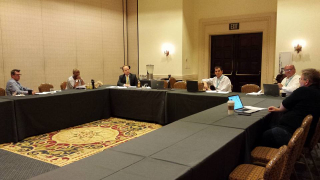
Yesterday, on the last morning of the 2017 Southeastern Association of Law Schools (SEALS) conference, Matt Lyon, the Associate Dean at Lincoln Memorial University – Duncan School of Law (UT Law’s Knoxville neighbor) convened a discussion group on “Corporate and Financial Reform in the Trump Administration.” I was grateful to be asked to participate.  In addition to me, BLPB co-bloggers Josh Fershee and Marcia Narine Weldon, my UT Law coworker Brian Krumm, Securities Law Prof Blog editor Eric Chaffee, and University of Houston Law Center colleague Darren Bush were among the discussants.

SEALS2017(RegReformDiscGrp-1)

Each of us came with issues and questions for discussion.  Each of us offered reflections.  Recently made, currently proposed, and possible future changes to business regulation were all on the table.  I wish this session had been held earlier in the program, since many had left before the Sunday morning sessions (and we were competing with, among other enticing alternatives, a discussion session on marijuana regulation). However, we honestly had more than enough to discuss as among the seven of us, in any case.

I had to leave the session early to attend the SEALS board meeting.  But before I left, I took some notes on topics relating to my interest in and potential future work on regulatory reform.  I continue, for example, to be interested in the best approaches to reducing and streamlining regulation.  (See my posts here and here.)  A few additional outtakes follow.

I have been at the Southeastern Association of Law Schools (SEALS) conference all week.  As usual, there have been too many program offerings important to my scholarship and teaching.  I have participated in and attended so many things.  I am exhausted.

But I know that all of this activity also energizes me.  Once I am back at home tomorrow night and get a good night’s sleep, I will be ready to rock and roll into the new academic year (which starts for us at UT Law in a few weeks).  I use the SEALS conference as this bridge to the new year every summer.

One of my favorite discussion groups at the conference was the White Collar Crime discussion group that John Anderson and I organized.  A number of us focused on insider trading law this year.  John, for example, shared his preliminary draft of an insider trading statute.  I asked folks to ponder the result under U.S. insider trading law of a tipping case with the following general facts:

  • A person with a fiduciary duty of trust and confidence to a principal conveys material nonpublic information obtained through the fiduciary relationship to a third person;
  • The recipient of the