
Photo of Marcia Narine Weldon

Professor Narine Weldon is the director of the Transactional Skills Program, Faculty Coordinator of the Business Compliance & Sustainability Concentration, Transactional Law Concentration, and a Lecturer in Law.

She earned her law degree, cum laude, from Harvard Law School, and her undergraduate degree, cum laude, in political science and psychology from Columbia University. After graduating, she worked as a law clerk to former Justice Marie Garibaldi of the Supreme Court of New Jersey, a commercial litigator with Cleary, Gottlieb, Steen and Hamilton in New York, an employment lawyer with Morgan, Lewis and Bockius in Miami, and as a Deputy General Counsel, VP of Global Compliance and Business Standards, and Chief Privacy Officer of Ryder, a Fortune 500 Company. In addition to her academic position, she serves as the general counsel of a startup and a nonprofit.  Read More

The Pep Boys – Manny, Moe & Jack (NYSE:  PBY) merger triangle with Bridgestone Retail Operations LLC and Icahn Enterprises LP is proving to be an exciting bidding war.  The price and the pace of competing bids has been escalating since the proposed Pep Boys/Bridgestone agreement was announced on October 16, 2015.  Pep Boys stock had been trading around $12/share. Pursuant to the agreement, Bridgestone commenced a tender offer in November for all outstanding shares at $15.  

Icahn Enterprises controls Auto Plus, a competitor of Pep Boys, the nation’s leading automotive aftermarket service and retail chain.  Icahn disclosed an approximately 12% stake in Pep Boys earlier in December and entered into a bidding war with Bridgestone over Pep Boys.  The price climbed to $15.50 on December 11th, then $17.00 on December 24th. Icahn Enterprises holds the current winning bid at $18.50/share, which the Pep Boys Board of Directors determined is a superior offer.  In the SEC filings, Icahn Enterprises indicated a willingness to increase the bid, but not if Pep Boys agreed to Bridgestone’s increased termination fee (from $35M to 39.5M) triggered by actions such as perior proposals by third parties.  Icahn challenged such a fee as a serious threat to
A year ago today, President Obama shocked the world and enraged many in Congress by announcing normalization of relations with Cuba. A lot of the rest of the United States didn’t see this as much of a big deal, but here in Miami, ground zero for the Cuban exile community, this was a cataclysmic event. Now Miami is one of the biggest sources of microfinance for the island.

Regular readers of this blog know that I have been writing about the ethical and governance issues of doing business with the island since my 10-day visit last summer. I return to Cuba today on a second research trip to validate some of my findings for my second article on governance and compliance risks and to begin work on my third article related to rule of law issues, the realities of foreign direct investment and arbitration, what a potential bilateral or multilateral investment agreement might look like, and the role that human rights requirements in these agreements could play.

This is an interesting time to be visiting Cuba. The Venezuelan government, a large source of income for Cuba has suffered a humiliating defeat. Will this lead to another “special period” for the

CALL FOR PRESENTATION PROPOSALS 

 Institute for Law Teaching and Learning—Summer 2016 Conference

“Real-World Readiness”

June 10-11, 2016

Washburn University School of Law—Topeka, Kansas

 The Institute for Law Teaching and Learning invites proposals for conference workshops addressing the many ways that law schools are preparing students to enter the real world of law practice.  With the rising demands for “practice-ready” lawyers, this topic has taken on increased urgency in recent years.  How are law schools and law professors taking on the challenge of graduating students who are ready to join the real world of practicing attorneys?  Can we be doing more?

The Institute takes a broad view of educational practices that promote real-world readiness.  Accordingly, we welcome proposals for workshops on incorporating such teaching techniques in doctrinal, clinical, externship, writing, seminar, hybrid, and interdisciplinary courses.  Workshops can address real-world readiness in first-year courses, upper-level courses, required courses, electives, or academic support teaching.  Workshops can present innovative teaching materials, course designs, curricular or program designs, etc.  Each workshop should include materials that participants can use during the workshop and also when they return to their campuses.  Presenters should model best practices in teaching methods by actively engaging the workshop participants. 

I’m knee deep in grading my business associations exams and so far, I’m pretty pleased. Maybe it’s my in-house background, but I spend a lot of time with my students getting them to focus on providing strategic advice to their fictional clients because that’s what my former clients demanded. My operations and executive colleagues complained that lawyers didn’t understand business or their pressure points and offered legal advice without thinking of the big picture or strategic considerations. With that in mind, my students work in law firms and do a variety of exercises from Michelle Harner’s skills book. When they answer questions in class based on cases or drafting exercises, I force them to think like a client rather than just the lawyer. I drill into them the importance of speaking to their clients in plain English, and I tell them if they can’t break the concepts down in their own words, then they don’t really understand them. Their final exam required them to advise a number of different clients based on the same fact pattern, and I am enjoying reading the different strategies that my 69 students devised based upon the same set of facts.

I get a

Divestment campaigns have been a popular form of corporate activism.  With divestment pensions, institutions, endowments and funds withdraw investments from companies to encourage and promote certain social/political behaviors and policies. 

Erik Hendey in his article Does Divestment Work (in the Harvard Political Review) recounted recent divestment campaigns including: 

“sweatshop labor, use of landmines, and tobacco advertising. But undoubtedly the best known example of divestment occurred in the 1970s and ’80s in response to the apartheid regime of South Africa. Retirement funds, mutual funds, and investment institutions across the country sold off the stocks of companies that did business in South Africa.”

A current divestment campaign is focused on guns.  In the wake of the San Bernardino, California mass shooting, this issue is poised to gain momentum.  The widespread investment in gun manufacturers will also make this campaign relevant to many investors. Andrew Ross Sorkin at the NYT DealBook writes in Guns in Your 401(k)? The Push to Divest Grows:

“If you own any of the broad index funds or even a target-date retirement fund, you’ve got a stake in the gun industry. Investments in gun makers, at least over the past five years, have performed well. Shares of Smith & Wesson

Earlier this month, the DC Circuit denied a petition for rehearing on the conflict minerals disclosure, meaning the SEC needs to appeal to the Supreme Court or the case goes back to the District Court for further proceedings. At issue is whether the Dodd-Frank requirement that issuers who source minerals from the Democratic Republic of Congo label their products as “DRC-conflict free” (or not) violates the First Amendment. I have argued in various blog posts and an amicus brief that this corporate governance disclosure is problematic for other reasons, including the fact that it won’t work and that the requirement would hurt the miners that it’s meant to protect. Congress, thankfully, recently held hearings on the law.

I’ve written more extensively on conflict minerals and the failure of disclosures in general in two recent publications. The first is my chapter entitled, Living in a material world – from naming and shaming to knowing and showing: will new disclosure regimes finally drive corporate accountability for human rights? in a new book that we launched two weeks ago at the UN Forum on Business and Human Rights in Geneva. You’ll have to buy the book The Business and Human Rights Landscape: Moving

I am about 10, if not 15 years late to this party.  This is not a new question:  have investment time horizons shrunk, and if so, in a way that extracts company value at the expense of long-term growth and sustainability?

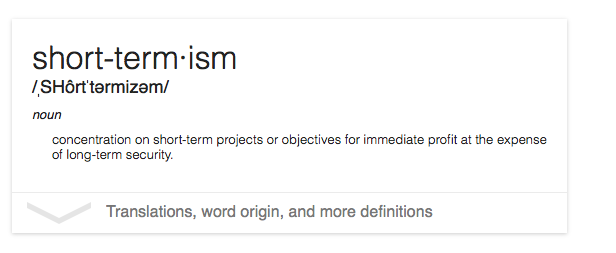
Short termism definition image

Since this isn’t a new question, there is a considerable amount of literature available in law and finance (and a definition available on investopedia).  This may seem like great news, if like me, you are interested in acquiring a solid understanding of short termism.  By solid understanding,  I mean internalization of knowledge, not mere familiarity where I can be prompted to recall something when someone else talks/writes about it.  I have some basic questions that I want answers to:   What is short-termism?,  What empirical evidence best proves or disproves short-termism?  Which investors, if any, are short-term?  What are the consequences (good and bad) of a short-term investment horizon?  If there is short-termism, what are the solutions?  I’ll briefly discuss each below, and my utter failure to answer these questions with any real certainty thus far.

What is the definition of short-termism and does it change depending upon context or user?  There appears to be consensus on the conceptual definition

This post concludes the Contract Is King, But Can It Govern Its Realm? Micro-symposium.  The symposium was hosted as part of the AALS section on Agency, Partnership, LLCs and Unincorporated Associations in advance of the section meeting on January 7th at 1:30 where the conversation will be continued.

I summarized the conversation and provided links to all of the individual posts.  Bookmark this page– there is great commentary at your finger tips on a range of topics.  Please keep reading (and commenting) on these great contributions by our insightful participants to whom we are very grateful.

Jeffrey Lipshaw kicked off the symposium conversation with his post (available here) questioning, in practice, how different LLCs are from traditional corporations.  He used a great map analogy to talk about the role of formation documents and default rules as gap fillers. 

“The contractual, corporate, and uncorporate models are always reductions in the bits and bytes of information from the complex reality, and that’s what makes them useful, just as a map of Cambridge, Massachusetts that was as complex as the real Cambridge would be useless.” 

After asserting that LLCs differ from corporations only in matters of degrees, Jeff went on to

Guest Post by Daniel Kleinberger

Part IV– Delaware’s Implied Contractual Covenant of Good Faith and Fair Dealing

Delaware case law applying the implied contractual covenant of good faith and fair dealing to a limited partnership dates back to at least 1993,[i] and Delaware’s limited partnership and limited liability company acts have expressly recognized the covenant since 2004.[ii] However, the contents of the implied covenant have not always been crystal clear.[iii]

     A passage from a 2000 Chancery Court decision is illustrative:

The implied covenant of good faith requires a party in a contractual relationship to refrain from arbitrary or unreasonable conduct which has the effect of preventing the other party to the contract from receiving the fruits of the contract.  This doctrine emphasizes faithfulness to an agreed common purpose and consistency with the justified expectations of the other party.  The parties’ reasonable expectations at the time of contract formation determine the reasonableness of the challenged conduct.  [C]ases invoking the implied covenant of good faith and fair dealing should be rare and fact-intensive.  Only where issues of compelling fairness arise will this Court embrace good faith and fair dealing and imply terms in an agreement.[iv]

     This

The micro-symposium has generated interest in a broad range of topics, so we are adding the following post by Peter Molk & Verity Winship discussing their recent scholarship on dispute resolution in LLC operating agreements and its intersection with the “contract is king” discussion this week.

Guest post by Peter Molk & Verity Winship:

This post highlights a particular area of private ordering within the LLC and other alternative entities: contractual provisions within the operating agreement that set the rules for resolving internal disputes.  These terms determine how disputes are resolved, such as by specifying when claims must be submitted to arbitration, where disputes can be heard, and whether parties waive the jury right or impose fee-shifting of litigation costs.  They apply to internal disputes, meaning they govern the dispute process among the LLCs’ members, managers, and the LLC itself.

How do these provisions fit with the debate over whether contract should be king?  The broadest connection is straightforward.  Dispute resolution provisions allocate rights and duties within LLCs, so the debate about the proper bounds of freedom of contract in the LLC space has implications for them as well.  But how firms set the rules for internal disputes is also