
A while back, I wrote about CVS’s choice to eliminate tobacco products from its stores.  I noted that it seemed clear to me that CVS could make that choice, even thought it would mean lower short-term profits, because it was a decision that is clearly protected (or should be) by the business judgment rule. 

Today, according to an LA Times piece, 

[CVS] stood up for its principles.

The pharmacy giant announced it was quitting the U.S. Chamber of Commerce after reports that the influential business organization was lobbying against anti-smoking laws around the world.

CVS bolted because of the Chamber’s views on tobacco sales.  In 2009, Apple and Nike made waves with the Chamber of its policy position on climate change. I find this interesting, and I have no reason to doubt that all of these companies are following their corporate values, though I also think they see public relations value in the noisy withdrawal.  

That some big companies have stepped away from the Chamber is less surprising to me than the fact that the Chamber has maintained such strength with small business owners, while advocating for many big business positions that don’t help, and may hurt, small businesses. 
UPDATE: The deadline for submissions has been extended to July 21.

[The following is a copy of the official workshop announcement.  I have moved the “Guiding Questions” to the top to highlight the business law aspects.  Registration and submission details can be found after the break.]

A Vulnerability and the Human Condition Initiative Workshop at Emory Law

Guiding Questions:

This workshop will use vulnerability theory to explore the implications of the changing structure of employment and business organizations in the new information age. In considering these changes, we ask:

• What kind of legal subject is the business organization?
• Are there relevant distinctions among business and corporate forms in regard to understanding both vulnerability and resilience?
• What, if any, should be the role of international and transnational organizations in a neoliberal era? What is their role in building both human and institutional resilience?
• Is corporate philanthropy an adequate response to the retraction of state regulation? What forms of resilience should be regulated and which should be left to the ‘free market’?
• How might a conception of the vulnerable subject help our analysis of the changing nature of the firm? What relationships does it bring into relief?
• How have discussions about market vulnerability shifted over time?
• What forms of resilience are available for institutions to respond to new economic realities?
• How are business organizations vulnerable? How does this differ from the family?
• How does the changing structure of employment and business organization affect possibilities for transformation and reform of the family?
• What role should the responsive state take in directing shifting flows of capital and care?
• How does the changing relationship between employment and the family, and particularly the disappearance of the “sole breadwinner,” affect our understanding of the family and its role in caretaking and dependency?
• How does the Supreme Court’s willingness to assign rights to corporate persons (Citizen’s United, Hobby Lobby), affect workers, customers and communities? The relationship between public and private arenas?
• Will Airbnb and Uber be the new model for the employment relationships of the future?

I’ve always been eager to do pro bono work. I went to law school with the intent of helping the indigent upon graduation, but then with a six-figure debt load, I went to BigLaw in New York and Miami, and then corporate America so that I could pay that debt off. But even as an associate and as in house counsel, I dutifully accepted pro bono cases. As a relatively new academic, I paid my way out of pro bono for the first couple of years as Florida allows and assuaged my guilt with the knowledge that my payments were going to fund the local legal aid office.

This year, as a condition of attending a family law CLE for free, I volunteered to take a case. I’ve devoted over 70 hours to it thus far, and we still aren’t finished even after today’s marathon 6.5 hour hearing dealing with a motion for contempt and enforcement, modification of alimony and child support, a QDRO (qualified domestic relations order), and a house in foreclosure. The case was complicated even according to my seasoned family law practitioner friends.

As a former litigator and current BA professor, I found that my skills helped

For those of you who teach agency (and the related concept of independent contractors) the following recent case example will make for a fun and culturally relevant example for many of your students.  

In March, 2015, the California Labor Commissioner’s Office issued an opinion finding that a  driver for the ride-hailing service mobile app company, Uber, should be classified as an employee, not an independent contractor.  The opinion details the control Uber exercised over the driver including setting the payment rates and terms, quality controls, service platforms, user communications, liability insurance requirements, and background checks all the while maintaining that drivers are independent contractors.  Citing to S. G. Borello & Sons, Inc. v. Dep’t of Indus. Relations, 48 Cal. 3d 341, 350-51, 769 P.2d 399 (1989), the Commission analyzed the following elements:

(a) whether the one performing services is engaged in a distinct occupation or business;

(b) the kind of occupation, with reference to whether, in the locality, the work is usually done under the direction of the principal or by a specialist without supervision;

(c) the skill required in the particular occupation;

(d) whether the principal or the worker supplies the instrumentalities, tools, and the place of

Among the DGCL amendments this year were a number of amendments to the Delaware Public Benefit Corporation (“PBC”) Law. 

I refer to the Delaware PBC amendments as “The Etsy Amendments” because I believe (without being sure) that a main motivation in passing these amendments was to make it easier for Etsy (among other companies) to become a Delaware PBC. These amendments are effective as of August 1, 2015.

As mentioned in a previous post, Etsy is a certified B corporation and a Delaware C-corporation. According to B Lab’s terms for certified B corporations, Etsy will have to convert to a Delaware PBC by August 1, 2017 or forfeit its certification. This assumes that B Lab will not change its requirements or make an exception for publicly-traded companies.

The amendments to the PBC law are summarized below:

  • Eliminates requirement of “PBC” or “Public Benefit Corporation” in the entity’s formal name. This amendment makes it easier and less costly for existing entities to convert, but the amendment also makes it more difficult for researchers (and the rest of the public) to track the PBCs. In addition to the cost of changing names, Rick Alexander notes in his

Last week Kent Greenfield and Adam Winkler published “The U.S. Supreme Court’s Cultivation of Corporate Personhood,” in the Atlantic discussing two recent Supreme Court opinions.  Greenfield and Winkler covered the ruling in Horne v. Department of Agriculture  where the Court held  “a federal program requiring raisin growers to set aside a percentage of their crops for government redistribution was an unconstitutional ‘taking’ under the Fifth Amendment.”  The second case addressed was Los Angeles v. Patel where the Court extended Fourth Amendment privacy protections “invalidating a city ordinance (similar to laws around the country) allowing police to search [hotel] guest registries without a warrant.”

While they distinguish certain rights, like political speech, that are “more appropriate for people than for corporations,” Greenfield and Winkler acknowledge that some constitutional protections should be extended to corporations.  

“A corporate right to be free from government takings, for example, makes sense both as a matter of constitutional law and of economics. Government overreach is problematic whether the raisin grower is a family farm or a business corporation. And corporations left exposed to government expropriation would find investors reluctant to take that risk, undermining the basic social purpose of the corporation,

I had the privilege of sitting in on a stimulating paper session on “Private Fiduciary Law” at the Law and Society Association conference in Seattle last month.  The program featured some super work by some great scholars.  My favorite piece from the session, however, is a draft book chapter written by Gordon Smith that he recently posted to SSRN.  Aptly entitled The Modern Business Judgment Rule, the chapter grapples with the current state of the business judgment rule in Delaware by tracing its development and reading the disparate doctrinal tea leaves.  Here is a summary of his “take,” as excerpted from his abstract (spoiler alert!):  “The modern business judgment rule is not a one-size-fits-all doctrine, but rather a movable boundary, marking the shifting line between judicial scrutiny and judicial deference.

In the mere 18 pages of text he uses to engage his description, analysis, and conclusion, Gordon gives us all a great gift. His summary is useful, his language is clear, and his analysis and conclusions are incredibly useful, imho.  I am no soothsayer, but I predict that this will be a popular piece of work.

Gordon posted on his paper the other day on The

Conscious

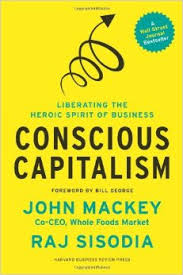
Recently, I finished reading Conscious Capitalism, written by Whole Foods Market co-CEO John Mackey and Babson College professor Raj Sisodia.

The book is much more “popular press” than academic, as should be clear from the splashy subtitle “liberating the heroic spirit of business.” There is a bit of academic influence in the appendix and notes, but it is mostly social business advocacy and story telling. In fact, the authors state that the primary purpose of the book “is to inspire the creation of more conscious businesses: businesses galvanized by higher purposes that serve and align the interests of all their major stakeholders.” (pg. 8). The book is interesting, passionate, and may accomplish its primary purpose.

The authors paint a compelling picture of Whole Foods Market and similar companies like Trader Joe’s, The Container Store, Costco, and Southwest Airlines. These companies appear to take a long-term view and consider what is best for all their stakeholders. I would have appreciated, however, more attention to the struggles the companies must have faced in attempting to satisfy all of their stakeholders. After finishing the book, I was left wishing the authors would have spent more time discussing how to make decisions in

On June 11, 2015, the Delaware House of Representatives joined the Delaware Senate in passing a bill that would prohibit fee-shifting bylaws by Delaware stock corporations. The bill awaits signature by Delaware Governor Jack Markell. Nonetheless, the panel provides a nice debate, between practicing attorneys, and is available here. The information from the Chancery Daily is below. 

Fordham Law School hosted a panel on Fee Shifting in Shareholder Litigation, featuring three members of the corporate law council of the Delaware State Bar Association, which submitted proposed amendments to the Delaware General Corporation Law that would preclude the adoption of fee-shifting provisions in corporate instruments, on Thursday, March 26, 2015.  A webcast video of the panel is now available online here.
 
Moderated by:

Professor Sean J. Griffith – Fordham Law School

Panelists:

Frederick Alexander – Morris Nichols Arsht & Tunnell
Chris Cernich – Institutional Shareholder Services
Kurt Heyman – Proctor Heyman Enerio
Mark Lebovitch – Bernstein Litowitz Berger & Grossman
Norman Monhait – Rosenthal Monhait & Goddess
Andrew Pincus – Mayer Brown

Oregon has done those interested in social enterprise a great service by posting a list of their benefit companies online. Oregon also has a nice page about becoming an Oregon benefit company.

By my count, the version updated 6/3/15, lists the following number of entities (for a total of 500 benefit companies):

  • 1 professional benefit corporation 
  • 74 benefit corporations 
  • 425 benefit LLCs

Oregon is one of a very few states that provides for the formation of benefit LLCs, in addition to benefit corporations. As you can see, the benefit LLCs are a good bit more popular than the benefit corporations, likely because most social enterprises are small, closely-held entities that should probably be LLCs instead of corporations.  

LLC law is generally flexible enough to allow a social purpose and Oregon’s corporation law expressly allows corporations to be formed for a social purpose, so the main draw seems to be branding/signaling based rather than law based.

These are still relatively small numbers in the grand scheme, but it was a fairly short time ago that there were fewer than 500 total benefit companies nationwide.