
National Business Law Scholars Conference (NBLSC)

Thursday & Friday, June 8-9, 2017

Call for Papers

The National Business Law Scholars Conference (NBLSC) will be held on Thursday and Friday, June 8-9, 2017, at the University of Utah S.J. Quinney College of Law. 

This is the eighth meeting of the NBLSC, an annual conference that draws legal scholars from across the United States and around the world.  We welcome all scholarly submissions relating to business law. Junior scholars and those considering entering the legal academy are especially encouraged to participate. 

To submit a presentation, email Professor Eric C. Chaffee at eric.chaffee@utoledo.edu with an abstract or paper by February 17, 2017.  Please title the email “NBLSC Submission – {Your Name}.”  If you would like to attend, but not present, email Professor Chaffee with an email entitled “NBLSC Attendance.”  Please specify in your email whether you are willing to serve as a moderator.  We will respond to submissions with notifications of acceptance shortly after the deadline. We anticipate the conference schedule will be circulated in May. 

Keynote Speaker:

Lynn A. Stout, Distinguished Professor of Corporate & Business Law, Cornell Law School

Plenary Author-Meets-Reader Panel:

Selling Hope, Selling Risk: Corporations, Wall Street, and the Dilemmas of Investor Protection by Donald C.
RESEARCH COLLOQUIUM: CALL FOR PAPERS

Law and Ethics of Big Data

Hosted and Sponsored by:

The Carol and Lawrence Zicklin Center for Business Ethics Research

The Wharton School of the University of Pennsylvania

Co-Hosted by:

Virginia Tech Center for Business Intelligence Analytics

The Department of Business Law and Ethics, Kelley School of Business

Washington & Lee Law School

April 21st and 22nd 2017

at the

Wharton School of the University of Pennsylvania, Philadelphia, Pennsylvania

Abstract Submission Deadline: February 24, 2017

We are pleased to announce the research colloquium, “Law and Ethics of Big Data,” at The Wharton School of the University of Pennsylvania, Philadelphia, Pennsylvania, co-hosted by Professor Philip M. Nichols, Assistant Professor Angie Raymond of Indiana University and Professor Janine Hiller of Virginia Tech.

Due to the success of this multi-year event that is in its fourth year, the colloquium will be expanded and we seek broad participation from multiple disciplines; please consider submitting research that is ready for the discussion stage. Each paper will be given detailed constructive critique. We are targeting cross-discipline opportunities for colloquium participants, and the Wharton community has expressed interest in sharing in these dialogues.

A non-inclusive list of topics that are appropriate

Wharton’s Legal Studies & Business Ethics Department invites submissions for its inaugural Conference on Business Law and Ethics, to take place March 31-April 1, 2017.

This is the first meeting of what will be a recurring conference: we aim to gather together each year the most cutting-edge work on law, ethics and business. Papers are invited from scholars both senior and junior, and from diverse disciplines, on the theme of “The Ethical Lives of Corporations.” Submit an abstract of an unpublished paper to Phil Nichols (nicholsp@wharton.upenn.edu ) and Gwendolyn Gordon (gwgordon@wharton.upenn.edu). The deadline for abstract submissions is January 6th, 2017.

National Business Law Scholars Conference (NBLSC)
Thursday & Friday, June 8-9, 2017

Call for Papers

The National Business Law Scholars Conference (NBLSC) will be held on Thursday and Friday, June 8-9, 2017, at the University of Utah S.J. Quinney College of Law. 

This is the eighth meeting of the NBLSC, an annual conference that draws legal scholars from across the United States and around the world.  We welcome all scholarly submissions relating to business law. Junior scholars and those considering entering the legal academy are especially encouraged to participate. 

To submit a presentation, email Professor Eric C. Chaffee at eric.chaffee@utoledo.edu with an abstract or paper by February 17, 2017.  Please title the email “NBLSC Submission – {Your Name}.”  If you would like to attend, but not present, email Professor Chaffee with an email entitled “NBLSC Attendance.”  Please specify in your email whether you are willing to serve as a moderator.  We will respond to submissions with notifications of acceptance shortly after the deadline. We anticipate the conference schedule will be circulated in May. 


Keynote Speaker:

Lynn A. Stout, Distinguished Professor of Corporate & Business Law, Cornell Law School


Plenary Author-Meets-Reader Panel:

Selling Hope, Selling Risk: Corporations, Wall Street, and the Dilemmas of Investor Protection by Donald C. Langevoort

JLSE

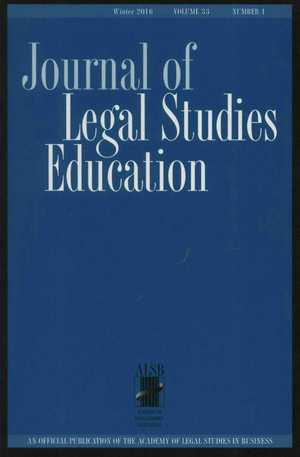
The Journal of Legal Studies Education (“JLSE“) is accepting article and case study submissions. The JLSE is a peer-reviewed legal journal focused on pedagogy. In 2015, I published a case study with the JLSE, had an excellent experience, and received helpful comments from the reviewers. The announcement is below:

——————

The Journal of Legal Studies Education is seeking submissions of manuscripts. The JLSE publishes refereed articles, teaching tips, and review of books.  Manuscripts must relate to teaching, research, or related disciplines such as business ethics, business and society, public policy and individual areas of business law related specialties. The Editorial Board selects high quality manuscripts that are of interest to a substantial portion of its readers. 

The JLSE is a double-blind peer-reviewed journal.

Please submit directly to Stephanie Greene, JLSE Editor-in-Chief, at stephanie.greene@bc.edu.

Stephanie M. Greene

Chair, Business Law Department

Professor, Business Law

Carroll School of Management

Boston College

Chestnut Hill, MA 02467

Proposal Due October 7, 2016

The Anti-Corruption Law Interest Group of the American Society of International Lawyers Law (ASIL)
 
Invites you to Attend and/or Submit a Proposal for its Winter Conference in Miami
 
Controlling Corruption:  Possibilities, Practical Suggestions & Best Practices
 
January 13-14, 2017, at the University of Miami, Coral Gables, Florida
Co-sponsored by:
The Business Ethics Program, University of Miami School of Business Administration,
The Zicklin Center for Business Ethics Research, Wharton, University of Pennsylvania,
University of Richmond School of Law and Bentley University
 
The conference will examine the state of international and domestic efforts to reduce corruption, with a focus on practical applications and emerging best practices.  We invite proposals for papers that approach the topic with fresh perspectives that promote productive action.   The goal of the conference is to help develop publishable papers and to foster dialogue between academics and practitioners engaged in anti-corruption and compliance efforts.
 
     Topics might include, but are not limited to:
·       The Mossack Fonseca (Panama) Papers, Evidence of Corruption and Resulting Enforcement Action
·       The future of the UK Bribery Act
·       “Goals Gone Wild”:  Rethinking Incentives to Combat Corruption
·      

See below for information on the The Midwest Academy of Legal Studies in Business (MALSB) Annual Conference in Chicago, IL and their call for papers. I attended MALSB this year, found it beneficial, and reflected on the conference in this post.

———

Midwest Academy of Legal Studies in Business

2017 Annual Conference

March 22 – 24, 2017

The Palmer House Hilton Hotel – Chicago, Illinois

Conference Registration and Call for Papers

The Midwest Academy of Legal Studies in Business (MALSB) Annual Conference is held in conjunction with the MBAA International Conference, long billed as “The Best Conference Value in America.”

The MBAA International Conference draws hundreds of academics from business-related fields such as accounting, business/society/government, economics, entrepreneurship, finance, health administration, information systems, international business, management, and marketing. Although the MALSB will have its own program track on legal studies, attendees will be able to take advantage of the multidisciplinary nature of this international conference and attend sessions held by the other program tracks. 

For more information on the MALSB and its Annual Conference, please see the attached Call for Papers or go to http://www.malsb.org/

The Duke Law School will host the 11th Annual Conference on Empirical Legal Studies (CELS) on November 18-19, 2016.  CELS is a highly regarded interdisciplinary gathering that draws scholars from across the country and internationally and is sponsored by the Society for Empirical Legal Studies. The conference brings together hundreds of scholars from law, economics, political science, psychology, policy analysis, and other fields who are interested in the empirical analysis of law and legal institutions. Papers are selected through a peer review process and discussion at the conference includes assigned commentators and audience questions.

Paper submissions are due by July 10, 2016.

For more information about the conference click here.

At the 2017 AALS annual meeting, January 3-7 in San Francisco, the AALS Sections on Agency, Partnerships LLCs, and Unincorporated Associations & Nonprofit and Philanthropy Law will hold a joint session on LLCs, New Charitable Forms, and the Rise of Philanthrocapitalism.

In December 2015, Facebook founder Mark Zuckerberg and his wife, Dr. Priscilla Chan, pledged their personal fortune—then valued at $45 billion—to the Chan-Zuckerberg Initiative (CZI), a philanthropic effort aimed at “advancing human potential and promoting equality.” But instead of organizing CZI using a traditional charitable structure, the couple organized CZI as a for-profit Delaware LLC. CZI is perhaps the most notable example, but not the only example, of Silicon Valley billionaires exploiting the LLC form to advance philanthropic efforts. But are LLCs and other for-profit business structures compatible with philanthropy? What are the tax, governance, and other policy implications of this new tool of philanthrocapitalism? What happens when LLCs, rather than traditional charitable forms, are used for “philanthropic” purposes?

From the heart of Silicon Valley, the AALS Section on Agency, Partnerships LLCs, and Unincorporated Associations and Section on Nonprofit and Philanthropy Law will host a joint program tackling these timely issues. In addition to featuring invited speakers, we seek speakers

Submissions: manuscripts or abstracts must be submitted electronically to Professor Michelle Harner, Chair-Elect of the Section on Business Associations, at mharner@law.umaryland.edu August 24, 2016.

The AALS Section on Business Associations and the AALS Section on Comparative Law are pleased to announce a Call for Papers for a joint program to be held on January 5, 2017, at the AALS 2017 Annual Meeting in San Francisco.  The topic of the program is “Business Law in the Global Gig Economy:  Legal Theory, Doctrine, and Innovations in the Context of Startups, Scaleups, and Unicorns.”  

Startups and entrepreneurs have long played an important role in the U.S. economy.  From Henry Ford to Mark Zuckerberg, entrepreneurs have revolutionized the ways in which their customers receive products and services. As Phil Libin, CEO of Evernote, has explained, “There’s lots of bad reasons to start a company. But there’s only one good, legitimate reason, and I think you know what it is: it’s to change the world.”

That philosophy continues today as entrepreneurs disrupt markets and challenge business and legal norms. Traditional notions of the firm, fiduciary duties, contractual bargains, and optimal capital structures may not aptly fit entrepreneurial approaches. Indeed, entrepreneurs’ business models, financing needs, and operational objectives require lawyers and scholars to rethink governance, capital structures, and regulatory schemes that may limit or impede further innovation, both nationally and transnationally.