

Image1

The NYU Pollack Center for Law & Business, Indiana University Maurer School of Law, and Securities and Exchange Commission Historical Society invite you to a virtual program entitled “Insider Trading: Honoring the Past|A Program Commemorating the 40th Anniversary of Chiarella v. United States,” which will take place on Thursday, November 5th from 10am-noon Eastern Time.

The program will explore the fascinating backstories of the Chiarella prosecution and the Supreme Court argument as well as the SEC’s and DOJ’s insider trading enforcement strategies in the wake of the Court’s ruling. The Chiarella case is also the subject of Donna Nagy’s recent essay, Chiarella v. United States and its Indelible Impact on Insider Trading Law.

A webinar link will be circulated to all those who RSVP, which you can do here. Conference details and schedule are below.

Conference Organizers:

Stephen Choi, Murray and Kathleen Bring Professor of Law, NYU School of Law, Co-Director Pollack Center for Law and Business
Donna M. Nagy, C. Ben Dutton Professor of Law, Indiana University Maurer School of Law
Jane Cobb, Executive Director, SEC Historical Society

Schedule:

10:00am Welcome by Stephen Choi, Murray and Kathleen Bring Professor of Law, NYU School of
How are you doing? I’m exhausted between teaching, grading, consulting, writing, and living through a pandemic. I actually wasn’t planning to post today because I post every other Friday, as a way to maintain some balance. I may not post next Friday because I’ll be participating in  Connecting the Threads, IV, our business law professor blog annual conference. It’s virtual and you may get up to 8 CLE credits, including an ethics credit. If you love our posts, you’ll get to see us up close and personal, and you won’t even need a mask.

I decided to do this short post today because it may help some of you, whether you’re professors or practitioners. Several years ago, Haskell Murray wrote that he does a mid-semester survey. He asks his students what they like and don’t like. I love this idea … in theory. How many of us really want to know how we’re doing? I’ve done it a couple of times when I knew that the class was going great, but I don’t do it consistently. I decided to do it this year because we are piloting a new program modeled after Emory’s Transactional Law Program. I used

ConnectingThreadsIV-1024x683

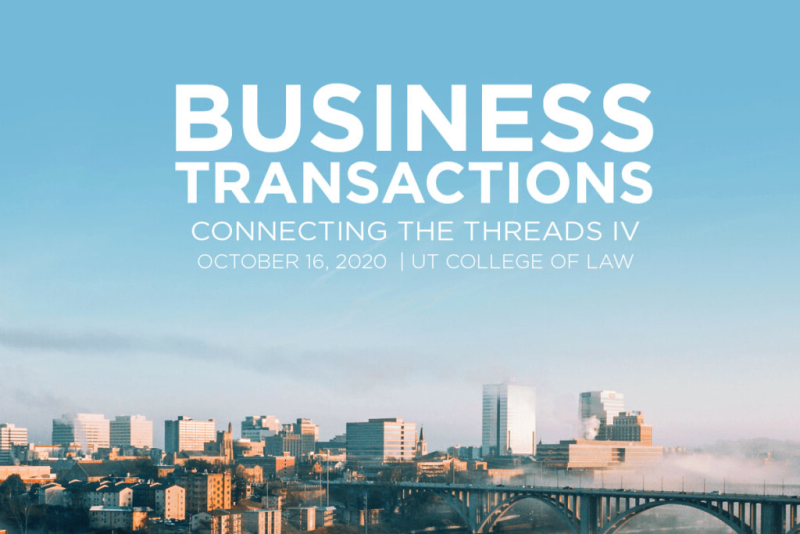
The fourth annual Business Law Prof Blog symposium, Connecting the Threads, is happening, despite the pandemic.  We are proceeding in a virtual format, hosted on Zoom on Friday, October 16.  More information is available here.

The line-up includes an impressive majority of our bloggers speaking on a wide range of topics from shareholder proposals to social enterprise, opting out of partnership, and much more.  Most papers will have a faculty and student discussant.  My submission, “Business Law and Lawyering in the Wake of COVID-19,” is coauthored with two students and carries one hour of Tennessee ethics credit.  While I wish we could host everyone in person in Knoxville, it always is an amazing day when we all get together.  I look forward to learning more about what everyone is working on and hearing what everyone has to say.

Call for Papers – EXTENDED DEADLINE

AALS Section on Transactional Law and Skills

The New Public Interest in Private Markets: Transactional Innovation for Promoting Inclusion

January 5-9, 2021, AALS Annual Meeting

The AALS Section on Transactional Law and Skills is pleased to announce a program titled The New Public Interest in Private Markets: Transactional Innovation for Promoting Inclusion during the 2021 AALS Annual Meeting, which will be held virtually. This session will explore how recent developments in corporate and transactional practice address issues of bias in corporate governance and the workplace, with examples ranging from Weinstein representations & warranties in M&A agreements to California’s Women on Boards statute to inclusion riders in the entertainment industry. These developments raise immediate questions of whether public policy goals of achieving greater inclusivity are being met, and they also shed light on perennial debates about the role public law and private ordering play in spurring social innovation.

In addition to paper presentations, the program will feature a panel focusing on how to incorporate concepts, issues, and discussions of equity and inclusivity across the transactional curriculum, including in clinics and other experiential courses, as well as in doctrinal courses.

FORMAT: Scholars whose papers are selected

The Academy of Legal Studies in Business is in the midst of its annual conference.  And, not surprisingly, it’s completely online.  Although we aren’t able to meet in person this year, the event has been a really great, remarkably smooth experience.  Pre-pandemic, the Program Chair, Professor Robert Bird, at the University of Connecticut School of Business, presciently selected the theme of “Managing Disruption.”

For me, one highlight of the conference thus far has been the opportunity to hear guest speaker Lee Buchheit’s remarks to the ALSB’s International Section on the “State of the Art of Sovereign Debt Restructuring.”  Buchheit is arguably the world’s leading expert on sovereign debt restructuring.  As an FT Alphaville piece put it: Buchheit “has represented nearly every country that has gone bankrupt since the 1980s, sparring with aggrieved creditors and cajoling stricken governments back to fiscal health — and in the process almost single-handedly building up an entire field of international law.”  He didn’t disappoint, giving us a fascinating overview of the major disruption the pandemic is causing in the sovereign debt arena, and the likely challenges that lie ahead, including the risk of a systemic sovereign debt crisis such as happened in the 1980s. 

Greetings from SEALS (virtually). I’ve just finished sitting in on the last of several excellent panels on online teaching. Below are tips from the panelists, some of my own lessons learned, and key takeaways from the excellent book Small Teaching Online.  For more of the foundations of online teaching see Part I,   Part IIPart III, and Part IV.

  • Have a class zero- you and students can record an introduction of themselves, pets, hobbies, skills, talents etc. Make sure you’re smiling and conveying your excitement in the video about the class.
  • You can also have a class zero where you spend 5 minutes on Zoom with each student before the first day of class talking to them about any questions they have about the class, their tech etc. 
  • Let students know that this online format is not just a pandemic issue. Virtual offices are increasingly common in practice.
  • Think about how to motivate students- what counts as a grade? Should you raise the class participation component and if so, how will you measure it? Will watching videos before class and participating in discussion boards count?
  • Stand when recording your video lectures or teaching synchronously. Students

The title of this post is the title of a panel discussion I organized for the 2019 Business Law Prof Blog symposium, held back in September of last year.  (Readers may recall that I posted on this session back at the time, under the same title.)  The panel experience was indescribably satisfying for me.  It represented one of those moments in life where one just feels so lucky . . . .

Why?  Because it fulfilled a dream, of sorts, that I have had for quite a while.  Here’s the story.

About ten years ago, I ended up in a conversation with two of my beloved Tennessee Law colleagues while we were grabbing afternoon beverages.  One of these colleagues is a tax geek; the other is a property guy.  Somehow, we got into a discussion about mergers and acquisitions.  I was asked how I would define a merger as a matter of corporate law, and part of my answer (that mergers are magic) got these two folks all riled up (in a professional, academic, nerdy way).  The conversation included some passionate exchanges.  It was an exhilerating experience.

I have remembered that exchange for all of these years, vowing to myself

Thanks to all of our readers who were able to come to the National Business Law Scholars Conference (NBLSC) last Thursday and Friday.  It was lovely to see so many of you there, even though it was somewhat sad that we could not be with each other in person.  The conference enjoyed record participation, and we have received a lot of useful informal feedback about our virtual format from folks who attended.

I was the beneficiary of many “teaching moments” in hosting and participating in the NBLSC this year.  I later will post on some of the outtakes from the NBLSC teaching panel (to which co-blogger Marcia Narine Weldon–who blogged about teaching on Friday–contributed meaningfully).  Today, however, I am focusing my post on a few new things my fellow UT Law conference hosts and I learned about Zoom in the process of hosting the conference.  A list follows.  

  • Although meeting participants should mute themselves on entering a meeting, it is best for a meeting host to set up the meeting so that all participants will be muted on entry, especially for large meetings.  It can be challenging to track down and mute participants who join a meeting and bring

Just a quick reminder that the 2020 National Business Law Scholars Conference–the 11th annual conference and our first virtual conference–begins tomorrow morning at 9:00 am EDT and extends through Friday afternoon at 4:30 pm EDT.  The conference schedule is available here.  Even if your workday is full, think about joining us (with or without a beverage) for some business law fellowship at 6:15 pm EDT tomorrow during our virtual happy hour.

Please make sure that you have upgraded your Zoom client to Zoom 5.0 before attempting to join in from your computer.  Effective as of June 1, Zoom is no longer supporting earlier versions.  If you have questions about upgrading, check out this page from the Zoom Support Center.

We hope to see many of you there!

The full schedule for the 2020 National Business Law Scholars Conference, which is being hosted on Zoom Thursday and Friday of this week, is now available.  You can find it here.  If and as additional changes are necessary, we will re-post.

As is always the case, the conference includes folks presenting work in a variety of areas of business law.  These traditional paper panels are the heart of the conference.  In addition, as I noted in my post last week, we are including three plenary sessions–one on “Business Law in the COVID-19 Era,” one reflecting on teaching business law in the current environment, and one on current bankruptcy law and practice issues.  There is something for almost everyone in the business law space in the conference program.

I am pleased and proud to note that several of my fellow bloggers from the Business Law Prof Blog are participating in the conference this year.  They include (in addition to me): Colleen Baker, Ben Edwards, Ann Lipton, and Marcia Narine Weldon.  I hope many of you will join us for all or part of the program and offer comments to colleagues on and relating to their work.