GruninBanner_2019_0

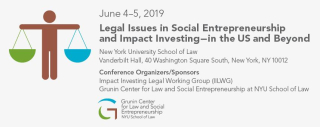
Earlier this month, I attended and presented at the 2019 Legal Issues in Social Entrepreneurship and Impact Investing–in the US and Beyond conference co-organized by the Impact Investing Legal Working Group and the Grunin Center for Law and Social Entrepreneurship at the NYU School of Law.  My friends Deb Burand and Helen Scott (also my Corporations and Securities Regulation professor when I was at NYU Law) co-direct the Grunin Center.  They organized a super conference this year.  Each year, the conference draws more folks–and with good reason.

I presented as part of a panel that compared and contrasted the use of different forms of entity for social enterprise businesses.  My role was (perhaps predictably, given that I wrote this piece) to defend the use of traditional for-profit corporations for this purpose.  I got some love from the panel and the audience, but so did others with different views . . . .

One of the nifty features of this conference is the use of lunchtime slots for “table talks” (roundtable discussions) and workshops.  I attended a table talk entitled “Gender Lens Investing: A Year in Review and A Look Ahead” and a workshop on “Re-Designing Legal Education for Lawyers, Social

At the 2019 Law and Society Association Annual Meeting last week, Geeyoung Min presented her paper Governance by Dividends.  In the paper, she focuses attention on stock dividends.  Near the end of her presentation, Geeyoung trod over ground on which so many of us also have trod–relating to judicial standards of review in fiduciary duty actions.  As familiar as the story was, she helped me to see something I had not seen before.  Perhaps many of you already have identified this.  If so, I am sorry to bore you with my new insight.

Essentially, what I came to realize during her talk–and develop with her and members of the audience in the ensuing discussion–was that Delaware’s judiciary may have (and I may be quoting Geeyoung or someone else who was there, since I wrote this down long-form in my contemporaneous notes) muddied the waters by seeking clarity.  What do I mean by that?  Well, by addressing relatively clearly the circumstances in which the business judgment rule, on the one hand, or entire fairness, on the other, govern the judicial review of corporate fiduciary duty allegations, the Delaware judiciary has effectively made the interstitial space between the two–intermediate tier scrutiny–less

The AALS Section on Transactional Laws and Skills is pleased to announce its program, “Markets and Regulation: The Shifting Context of Transactional Practice,” to be held (per the draft program) from 8:30-10:30 on Sat. Jan. 4 at the AALS 2020 Annual Meeting in Washington D.C. on “Pillars of Democracy: Law, Representation, and Knowledge.” This session will explore the changing regulatory context of transactional legal practice, which is rapidly evolving in response to new innovations and challenges across a range of markets. Emerging issues range from privacy law and cybersecurity, to national security concerns, antitrust, and international trade and investment, to the prospect of new regulatory responses to climate change and other environmental threats. The forms these regulatory responses take are also diverse, including not only traditional public regulation, but also private governance, which draws upon the efforts of NGOs, trade associations, and international organizations.

Pedagogy Panel: In addition to paper presentations from our Call for Papers (circulated separately), the program will feature a panel of 3-4 speakers who will focus on how to incorporate regulatory concepts and issues across the transactional curriculum, including in clinics and other experiential courses, as well as in doctrinal courses. Our Section is proud to

AALS SECTION ON TRANSACTIONAL LAW AND SKILLS Markets & Regulation: The Shifting Context of Transactional Practice 2020 AALS Annual Meeting Washington, D.C.

The AALS Section on Transactional Laws and Skills is pleased to announce a call for papers for its program, “Markets and Regulation: The Shifting Context of Transactional Practice,” to be held at the AALS 2020 Annual Meeting in Washington D.C. on “Pillars of Democracy: Law, Representation, and Knowledge.” This session will explore the changing regulatory context of transactional legal practice, which is rapidly evolving in response to new innovations and challenges across a range of markets. Emerging issues range from privacy law and cybersecurity, to national security concerns, antitrust, and international trade and investment, to the prospect of new regulatory responses to climate change and other environmental threats. The forms these regulatory responses take are also diverse, including not only traditional public regulation, but also private governance, which draws upon the efforts of NGOs, trade associations, and international organizations.

In addition to paper presentations, the program will feature a panel focusing on how to incorporate regulatory concepts and issues across the transactional curriculum, including in clinics and other experiential courses, as well as in doctrinal courses. This program


Join me in Miami, June 26-28.

http://media.law.miami.edu/communications/email-blast/2015/img/miami-law-logo.png


http://media.law.miami.edu/communications/emails/2015/gen/facebook.png

http://media.law.miami.edu/communications/emails/2015/gen/twitter.png

http://media.law.miami.edu/communications/emails/2015/gen/instagram.png

http://www.law.miami.edu/communications/emails/2015/gen/linkedin.png

http://media.law.miami.edu/communications/emails/2015/gen/youtube.png


Managing Compliance Across Borders

June 26-28, 2019

Managing Compliance Across Borders is a program for world-wide compliance, risk and audit professionals to discuss current developments and hot topics (e.g. cybersecurity, data protection, privacy, data analytics, regulation, FCPA and more) affecting compliance practice in the U.S., Canada, Europe, and Latin America. Learn more

See a Snapshot: Who Will Be There?
You will have extensive networking opportunities with high-level compliance professionals and access to panel discussions with major firms, banks, government offices and corporations, including:

  • BRF Brazil
  • Carnival Corporation
  • Central Bank of Brazil
  • Endeavor
  • Equal Employment Opportunity Commission
  • Eversheds Sutherland
  • Fidelity Investments
  • Hilton Grand Vacations
  • Ingram Micro
  • Jones Day
  • Kaufman Rossin
  • LATAM Airlines
  • Laureate Education, Inc.


  • MasterCard Worldwide
  • MDO Partners
  • Olin Corporation
  • PwC
  • Royal Caribbean Cruises
  • Tech Data
  • The SEC
  • TracFone Wireless
  • U.S. Department of Justice
  • Univision
  • UPS
  • XO Logistics
  • Zenith Source


Location
Donna E. Shalala Student Center
1330 Miller Drive
Miami, FL 33146


CLE Credit
Upwards of 10 general CLE credits in ethics and technology applied for with The Florida Bar


Program Fee: $2,500 

My friend and colleague, Priya Baskaran, asked me to post the following, which I am happy to do: 

Over the past year, a critical mass of law school faculty and staff have expressed interest in establishing an AALS Section on Community Economic Development (CED). The proposed section will provide a dynamic, collaborative environment to enhance the scholarship, activism, and direct legal work of CED-focused faculty and professional staff. Notably, the section will help bridge existing gaps between various actors in the CED universe by increasing opportunities for networking and enabling greater synergy and collaboration between scholars and experts in various substantive subjects and disciplines related to CED. Interested faculty and professional staff are invited to read the full petition.

I think this is a great idea, and I will be signing the petition (here).  I have been working with an interdisciplinary group on my campus, WVU Center for Innovation in Gas Research and Utilization (CIGRU). We are a multidisciplinary group of researchers who are experts in science, engineering, environmental, policy, law, and finance. The CIGRU conducts research and services relevant to gas, oil, and chemicals. Our experimental research includes broad areas covering catalysis, reaction engineering, material science, power generation, and gas turbine. The CIGRU undertakes U.S. government- and industry-funded research projects developing clean and renewable energy technologies. Our services include air emission control, regulatory and policy, law and finance relevant to shale gas.

I have been leading CIGRU’s Economic and Community Development Group for the past few years.  About 18 months ago, CIGRU earned a five-year seed grant awarded by the West Virginia Higher Education Policy Commission, under its Research Challenge Grant program. The WVU gas utilization team includes eight CIGRU researchers, working in partnership with Marshall University, the WVU Energy Institute, the WVU Bureau for Business and Economic Research, the West Virginia Chemical Alliance Zone, Morgantown’s National Energy Technology Laboratory and the Mid-Atlantic Technology, Research and Innovation Center. So, this idea resonates with me. I think this is a great idea, and it has my support. If you agree, I hope you’ll sign on, too.  

For anyone interested, CIRGUs grant announcement and a description of the program are available after the jump. 

More on leadership!  It must be in the air . . . .

Last year, I blogged about the inaugural Women’s Leadership in Academia Conference.  It was an amazing event.  The second conference is just a few months away (July 18-19), and organizer Leslie Kendrick (Vice Dean and David H. Ibbeken ’71 Research Professor of Law at the University of Virginia School of Law) recently circulated important information about the 2019 conference that I want to share here.

Specifically, she has encouraged folks to register and has offered three ways to engage with the conference at this juncture.  They are (and I am quoting her here):

Propose a panel: We’ve gotten some great proposals and would love to hear from you! The link for proposing a panel is on the website and here. Proposals are due by May 1.

Request a travel scholarship: If you could use financial assistance to defray the costs of attending the conference, please apply for a travel scholarship on the conference website or here. We’d love to hear from you. If at all possible, it would be helpful to receive requests by June 1.

Extend the welcome: Our mailing list includes attendees

This “just in” from BLPB friends Beate Sjåfjell and Afra Afsharipour:

We are thrilled to co-organise a workshop at UC Davis School of Law on 26 April 2019, with the aim of facilitating an in-depth comparative analysis of the relationship between takeovers and value creation.

We invite submissions on themes concerning takeovers and value creation from any jurisdiction around the world as well as comparative contributions. Themes include but are not limited to:

What are the implications of a takeover on sustainability efforts?

What is the scope for using sustainability arguments as a defense by the target board in a takeover?

What should be the role of the bidder board?

What are the implications of large M&A transactions for building/growing a culture of sustainability at a firm?

Is there a distinct difference between planned mergers and uninvited takeovers?

How could takeovers be regulated to promote sustainable value creation?

We especially encourage female scholars and scholars from diverse backgrounds to submit abstracts. Participation at the workshop will be limited to the presenters, to facilitate in-depth discussions. Deadline for submission of abstracts: 27 March 2019!

Please feel free to send this call for papers on to colleagues who may be

Received today from BLPB friends Beate Sjåfjell and María Jesús Muñoz Torres:

Happy International Women’s Day! We celebrate this day by issuing the call for papers for the 5th international workshop of Daughters of Themis: International Network of Female Business Scholars. The theme is Finance for Sustainability; a highly topical theme! The deadline is 26 March, and we hope that the brief window of opportunity will be large enough for all interested to respond.

We appreciate if you would circulate this call to any interested colleagues identifying as female business scholars, including junior scholars (PhD candidates) as well as colleagues in lower-income countries. Please note that we this year do have some, very limited, funds available so that we can contribute to the funding for one or two participants based on financial hardship.

For those unfamiliar with Daughters of Themis: our annual workshop is the heart of our network, and you can read more here, reporting back from our three last workshops here: 2018, 2017 and 2016.

Please feel free to contact Beate or María Jesús with any questions you might have.

Unfortunately, this workshop overlaps a bit with the Grunin Center’s annual conference (which focuses in

ARTIFICIAL INTELLIGENCE:

Thinking About Law, Law Practice, and Legal Education

Hosted by the Duquesne University School of Law

Pittsburgh, Pennsylvania

Friday & Saturday, April 26-27, 2019

Developments in artificial intelligence are changing virtually all aspects of our world, ranging from autonomous vehicles to robotic surgery, and from smartphones to smart speakers.  Lawyers, legal educators, and policymakers are already experiencing the effects of computers that aid and, in some cases, replace the often-tedious work done by lawyers and other members of society.  Law school graduates will need to understand how intelligent systems can enhance and streamline the work that they do, and how their careers may be changed in the future.  Furthermore, artificial intelligence technology will likely call for greater government oversight, result in new laws, and trigger litigation. 

This two-day conference will feature presentations by educators, practitioners, policymakers, and computer scientists that will demonstrate how the development of artificial intelligence is affecting society, the law, the legal profession, and legal education.   The Duquesne Law Review will dedicate space in its Winter 2019 symposium issue to publishing papers from this conference. 

Presenters & Agenda, Day One (Law and Law Practice):

  • Dean Alderucci (Carnegie Mellon Univ.): Customized Artificial Intelligence Techniques for the