
Earlier this month, the DC Circuit denied a petition for rehearing on the conflict minerals disclosure, meaning the SEC needs to appeal to the Supreme Court or the case goes back to the District Court for further proceedings. At issue is whether the Dodd-Frank requirement that issuers who source minerals from the Democratic Republic of Congo label their products as “DRC-conflict free” (or not) violates the First Amendment. I have argued in various blog posts and an amicus brief that this corporate governance disclosure is problematic for other reasons, including the fact that it won’t work and that the requirement would hurt the miners that it’s meant to protect. Congress, thankfully, recently held hearings on the law.

I’ve written more extensively on conflict minerals and the failure of disclosures in general in two recent publications. The first is my chapter entitled, Living in a material world – from naming and shaming to knowing and showing: will new disclosure regimes finally drive corporate accountability for human rights? in a new book that we launched two weeks ago at the UN Forum on Business and Human Rights in Geneva. You’ll have to buy the book The Business and Human Rights Landscape: Moving
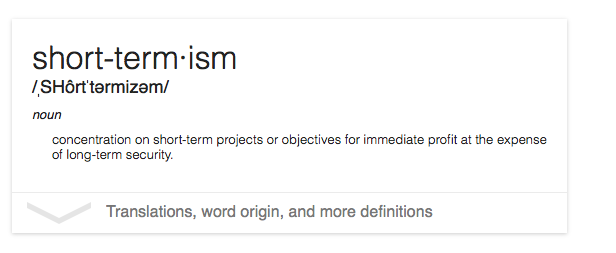
I am about 10, if not 15 years late to this party.  This is not a new question:  have investment time horizons shrunk, and if so, in a way that extracts company value at the expense of long-term growth and sustainability?

Short termism definition image

Since this isn’t a new question, there is a considerable amount of literature available in law and finance (and a definition available on investopedia).  This may seem like great news, if like me, you are interested in acquiring a solid understanding of short termism.  By solid understanding,  I mean internalization of knowledge, not mere familiarity where I can be prompted to recall something when someone else talks/writes about it.  I have some basic questions that I want answers to:   What is short-termism?,  What empirical evidence best proves or disproves short-termism?  Which investors, if any, are short-term?  What are the consequences (good and bad) of a short-term investment horizon?  If there is short-termism, what are the solutions?  I’ll briefly discuss each below, and my utter failure to answer these questions with any real certainty thus far.

What is the definition of short-termism and does it change depending upon context or user?  There appears to be consensus on the conceptual definition

I so often find Keith Bishop‘s blog, California Corporate & Securities Law, both informative and entertaining.  Monday’s post in that forum is no exception.  In that post, Keith describes three important principles of Delaware corporate law that are not codified in the General Corporation Law of the State of Delaware (commonly and fondly known as the Delaware General Corporation Law or DGCL).  No surprise, but the three principles he identifies and describes are:

  • the business judgment rule;
  • derivative suit pleading requirements; and
  • the intermediate standard of review applicable in certain limited fiduciary duty actions.

Great list.  And I agree with what he says.

Of course, anyone who teaches corporate law has had to consider (and, to sone degree, call out) the areas of that body of law that derive from decisional, rather than statutory, law.  I often have been heard to say, in the basic Business Associations course, that if students forget–or need to leave behind–one of the two required texts (a casebook and a statutory resource book) when they come to class, most days, they should forget/leave behind the casebook, since it is more important for them to have the statutory law in front of them to answer most Business Associations law questions.  I note, however, that there are two large areas of exception:  veil piercing and fiduciary duty.  For those two doctrinal areas, I inform them that they won’t need the statutory resource book as much as the casebook.

I try to read everything Lyman Johnson writes, so my Thanksgiving break reading is his recent book chapter The Reconfiguring of Revlon. The abstract is below:

Three decades later, an irksome uncertainty still impedes a settled understanding of the Delaware Supreme Court’s landmark ruling in Revlon, Inc. v. MacAndrews & Forbes Holdings, Inc. For such a towering doctrine, Revlon’s underlying rationales remain controversial, its exact contours and demands continue to be surprisingly unclear, and it holds out scant hope for remedial relief. In spite of these troubling features of today’s Revlon jurisprudence, however, Revlon is slowly being worked back into the larger fabric of Delaware’s fiduciary duty law and away from being a gangling, standalone doctrine. The organizing themes of this judicial project are strong deference in the deal context to decisions made by independent directors without regard to deal structure, the substantially reduced likelihood of equitable or monetary remedies in all types of deal-related lawsuits, and a nascent effort at harmonizing Revlon with Delaware’s more general, and ill-defined, doctrine on corporate purpose.

This chapter discusses the original Revlon decision and its rapid expansion before turning to lingering uncertainties surrounding the reach of Revlon, the decline of Revlon’s remedial

This post concludes the Contract Is King, But Can It Govern Its Realm? Micro-symposium.  The symposium was hosted as part of the AALS section on Agency, Partnership, LLCs and Unincorporated Associations in advance of the section meeting on January 7th at 1:30 where the conversation will be continued.

I summarized the conversation and provided links to all of the individual posts.  Bookmark this page– there is great commentary at your finger tips on a range of topics.  Please keep reading (and commenting) on these great contributions by our insightful participants to whom we are very grateful.

Jeffrey Lipshaw kicked off the symposium conversation with his post (available here) questioning, in practice, how different LLCs are from traditional corporations.  He used a great map analogy to talk about the role of formation documents and default rules as gap fillers. 

“The contractual, corporate, and uncorporate models are always reductions in the bits and bytes of information from the complex reality, and that’s what makes them useful, just as a map of Cambridge, Massachusetts that was as complex as the real Cambridge would be useless.” 

After asserting that LLCs differ from corporations only in matters of degrees, Jeff went on to

Guest Post by Daniel Kleinberger

Part IV– Delaware’s Implied Contractual Covenant of Good Faith and Fair Dealing

Delaware case law applying the implied contractual covenant of good faith and fair dealing to a limited partnership dates back to at least 1993,[i] and Delaware’s limited partnership and limited liability company acts have expressly recognized the covenant since 2004.[ii] However, the contents of the implied covenant have not always been crystal clear.[iii]

     A passage from a 2000 Chancery Court decision is illustrative:

The implied covenant of good faith requires a party in a contractual relationship to refrain from arbitrary or unreasonable conduct which has the effect of preventing the other party to the contract from receiving the fruits of the contract.  This doctrine emphasizes faithfulness to an agreed common purpose and consistency with the justified expectations of the other party.  The parties’ reasonable expectations at the time of contract formation determine the reasonableness of the challenged conduct.  [C]ases invoking the implied covenant of good faith and fair dealing should be rare and fact-intensive.  Only where issues of compelling fairness arise will this Court embrace good faith and fair dealing and imply terms in an agreement.[iv]

     This

I would like to thank the Business Law Professor Blog for this very important symposium. My brief thoughts are filling in for Marcia Narine. I became well acquainted with LLCs when I practiced in the alternative entities group of a Delaware law firm. What most stood out during my time there was the freedom enjoyed by LLCs and LPs to abridge fiduciary duties and deviate from other corporate orthodoxies. I constantly thought about whether this freedom of contract was a good thing; after all, case law tells only the tragic stories.

As mentioned in other posts, contractual freedom is ideal when sophisticated parties of comparable strengths are allowed to define their relationships. And generally, few problems arise from the LLC form. Law firms typically provide those seeking to form an LLC one of their standard, boilerplate operating agreements, which includes fiduciary duties. In turn, business owners are able to enjoy limited liability while avoiding many of the formalities, transactions costs, and tax burdens associated with traditional corporations. However, there seems to be an increasing number of cases where operating agreements resemble adhesion contracts, creating opportunities for abuse. Is it wise that unsophisticated are more at risk for contractual related harms so

Guest post by Mohsen Manesh:

In my previous post, I suggested that we are unlikely to see Delaware ever step back from its statutory commitment to freedom of contract in the alternative entity context. And that is true even if Chief Justice Strine, Vice Chancellor Laster, and others might believe that unlimited freedom of contract has been bad public policy.

Why? To be cynical, it’s about money.

It is well known that Delaware, as a state, derives substantial profits, in the form of franchise taxes, as a result of its status as the legal haven for a majority of publicly traded corporations. In 2014 alone, Delaware collected approximately $626 million—that is almost 16% of the state’s total annual revenue—from corporate franchise taxes. (For scale, that’s almost $670 per natural person in Delaware.)

Less well documented, however, is that Delaware also now derives substantial—and growing—revenues as the legal home from hundreds of thousands of unincorporated alternative entities. My chart below tells the story. Over the last decade, while the percentage of the state’s annual revenue derived from corporate franchise taxes has been flat, an increasingly larger portion of the state’s annual revenue has been derived from the taxes paid

 Guest post by Sandra Miller:

The ratio of LLC filings to corporate filings in Delaware from 2010 to 2014 was over 3 to 1.  Alternative business entities are no longer the province of a relatively small number of sophisticated investors.  Increasingly, corporations are becoming the “alternative” and LLCs and other unincorporated entities the norm.  Mom and Pop business as well as sophisticated real estate syndicators use alternative business entities.  Additionally, as discussed below, publicly-traded limited partnerships and LLCs are now being aggressively marketed. 

Accordingly, the assumptions that might once have justified greater reliance on private ordering in LLCs and alternative business entities should be revisited.  Not all investors are highly sophisticated parties and a relentlessly contractual approach to business entity governance is not appropriate for unsophisticated parties.   Nor is it appropriate for those without sophisticated legal counsel.  In backhanded fashion, this point was recognized by Larry E. Ribstein who advocated the removal of restrictions on waivers of fiduciary duties in limited partnerships when these entities were used by sophisticated firms that were unlikely to be publicly traded.   Ribstein expressly stated that limited partnership interests may be less vulnerable than corporate shareholders and are unlikely to be publicly traded.  (

Guest post by Daniel Kleinberger:

Part I – Introduction

My postings this week will seek to delineate Delaware’s implied contractual covenant of good faith and fair dealing and the covenant’s role in Delaware entity law

An obligation of good faith and fair dealing is implied in every common law contract and is codified in the Uniform Commercial Code (“U.C.C”). The terminology differs:  Some jurisdictions refer to an “implied covenant;” others to an “implied contractual obligation;” still others to an “implied duty.”  But whatever the label, the concept is understood by the vast majority of U.S. lawyers as a matter of commercial rather than entity law.  And, to the vast majority of corporate lawyers, “good faith” does not mean contract law but rather conjures up an important aspect of a corporate director’s duty of loyalty.

Nonetheless, Delaware’s “implied contractual covenant of good faith and fair dealing” has an increasingly clear and important role in Delaware “entity law” – i.e., the law of unincorporated business organizations (primarily limited liability companies and limited partnerships) as well as the law of corporations.

Because to the uninitiated “good faith” can be frustratingly polysemous, this first blog “clears away the underbrush” by explaining what Delaware’s