
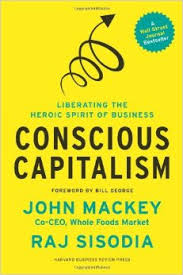
Conscious

Recently, I finished reading Conscious Capitalism, written by Whole Foods Market co-CEO John Mackey and Babson College professor Raj Sisodia.

The book is much more “popular press” than academic, as should be clear from the splashy subtitle “liberating the heroic spirit of business.” There is a bit of academic influence in the appendix and notes, but it is mostly social business advocacy and story telling. In fact, the authors state that the primary purpose of the book “is to inspire the creation of more conscious businesses: businesses galvanized by higher purposes that serve and align the interests of all their major stakeholders.” (pg. 8). The book is interesting, passionate, and may accomplish its primary purpose.

The authors paint a compelling picture of Whole Foods Market and similar companies like Trader Joe’s, The Container Store, Costco, and Southwest Airlines. These companies appear to take a long-term view and consider what is best for all their stakeholders. I would have appreciated, however, more attention to the struggles the companies must have faced in attempting to satisfy all of their stakeholders. After finishing the book, I was left wishing the authors would have spent more time discussing how to make decisions in

Last week I posted the first of three posts regarding doing business in Cuba. In my initial post I discussed some concerns that observers have regarding Cuba’s readiness for investors, the lack of infrastructure, and the rule of law issues, particularly as it relates to Cuba’s respect for contracts and debts. Indeed today, Congress heard testimony on the future of property rights in Cuba and the claims for US parties who have had billions in property confiscated by the Castro government- a sticking point for lifting the embargo. (In 1959, Americans and US businesses owned or controlled an estimated 75-80% of Cuban land and resources). Clearly there is quite a bit to be done before US businesses can rush back in, even if the embargo were lifted tomorrow. This evening, PBS speculated about what life would be like post-embargo for both countries. Today I will briefly discuss the Cuban legal system and then focus the potential compliance and ethical challenges for companies considering doing business on the island.

Cuba, like many countries, does not have a jury system. Cuba’s court system has a number of levels but they have both professional judges with legal training, and non-professional judges who are

On June 11, 2015, the Delaware House of Representatives joined the Delaware Senate in passing a bill that would prohibit fee-shifting bylaws by Delaware stock corporations. The bill awaits signature by Delaware Governor Jack Markell. Nonetheless, the panel provides a nice debate, between practicing attorneys, and is available here. The information from the Chancery Daily is below. 

Fordham Law School hosted a panel on Fee Shifting in Shareholder Litigation, featuring three members of the corporate law council of the Delaware State Bar Association, which submitted proposed amendments to the Delaware General Corporation Law that would preclude the adoption of fee-shifting provisions in corporate instruments, on Thursday, March 26, 2015.  A webcast video of the panel is now available online here.
 
Moderated by:

Professor Sean J. Griffith – Fordham Law School

Panelists:

Frederick Alexander – Morris Nichols Arsht & Tunnell
Chris Cernich – Institutional Shareholder Services
Kurt Heyman – Proctor Heyman Enerio
Mark Lebovitch – Bernstein Litowitz Berger & Grossman
Norman Monhait – Rosenthal Monhait & Goddess
Andrew Pincus – Mayer Brown

Cuba has been in the news a lot lately. I’ve just returned from ten days in Havana so I could see it first hand both as a person who writes on business and human rights and as an attorney who consults occasionally on corporate issues. The first part of the trip was with the International Law Section of the Florida Bar. The second was with a group of art lovers. I plan to write two or three blog posts about the prospects of doing business in Cuba if and when the embargo is lifted. Because I do some consulting work, I want to make clear that these views are my own as an academic and should not be attributed to anyone else.

In this post I will just briefly list some basic facts about Cuba and foreign investment. Next week I will talk a bit more about investment, introduce the Cuban legal system, and talk about some of the business and compliance challenges. That’s the subject of my research this summer. The following week I will address human rights in Cuba and how various governments and businesses are addressing those issues, the subject of another article I am

Last week, I attended the National Business Law Scholars Conference at Seton Hall University School of Law in Newark, NJ.  It was a great conference, featuring (among others) BLPB co-blogger Josh Fershee (who presented a paper on the business judgment rule and moderated a panel on business entity design) and BLPB guest blogger Todd Haugh (who presented a paper on Sarbanes-Oxley and over criminalization).  I presented a paper on curation in crowdfunding intermediation and moderated a panel on insider trading.  It was a full two days of business law immersion.

The keynote lunch speaker the second day of the conference was Kent Greenfield.  He compellingly argued for the promotion of corporate personhood, following up on comments he has made elsewhere (including here and here) in recent years.  In his remarks, he causally mentioned B corporations and social enterprise more generally.  I want to pick up on that thread to make a limited point here that follows up somewhat on my post on shareholder primacy and wealth maximization from last week.

This week, while preparing for and attending the National Business Law Scholars Conference, I have had to deal with a Tennessee corporate law “brushfire” of sorts generated by a Nashville Business Journal (NBJarticle published earlier this week.  The article, written by a Nashville lawyer, took a somewhat alarmist–and substantively inaccurate–view of a recent addition to the Tennessee Business Corporation Act drafted by the Business Entity Study Committee (BESC) of the Tennessee Bar Association, of which I am a member (and about which I have written here in the past, including here, here, and here).  Specifically, the author asserted that Tennessee’s adoption of the text of Model Business Corporation Act Section 14.09 creates new liability for Tennessee corporate directors–especially directors of insolvent Tennessee corporations.  Somewhat predictably, calls and emails from directors, executives, and the Tennessee Secretary of State’s office (which, itself, received many calls) ensued.

By design, and (we believe) by effect, the statutory section at issue clarifies the duties of directors of dissolved Tennessee corporations and establishes a safe harbor from liability.  Accordingly, the drafting team from the BESC (me included) believed we had to jump in and correct the mischaracterizations in the

The New Yorker recently ran an interesting article entitled Patagonia’s Anti-Growth Strategy. Patagonia is a certified B corporation and a California benefit corporation.

As a customer, Patagonia is my favorite company for casual/outdoor clothing, and one of my favorite companies in any industry. Initially, I thought Patagonia’s clothes were insanely expensive, but their clothes have been much cheaper on a “cost-per-wear” basis than any other clothes I have bought. In an age of cheap products and rampant consumerism, Patagonia is striking a chord with those who wish to buy fewer, quality products.

A taste of the article follows, but go read the entire thing.

The company’s anti-materialistic stance ramped up on Black Friday, 2011, with a memorable full-page advertisement in the Times that read, “Don’t Buy This Jacket.” The ad’s text broke down the environmental costs of the company’s top-selling R2 fleece sweater and asked consumers to think twice before buying it or any other product. The attention the ad received helped to bump Patagonia’s 2012 sales significantly. . . . Patagonia is trying second-hand-clothing sales at its shop in Portland, Oregon, and has made product repair and recycling a growing part of its business model. It recently invested

I just returned early Monday from this year’s Law and Society Association conference.  I presented my paper on LLC operating agreements as contracts–about which I later will blog here–on a panel as part of a CRN (Collaborative Research Network) on corporate and securities law.  I enjoyed the conference and being in Seattle (a city I rarely get a chance to visit).

I noticed something in a number of the sessions I attended, however, that I want to share here.  A number of scholars referenced, in their presentations or in comments to the presentations of others, “shareholder primacy.”  As I listened, it was clear these folks were referring to the prioritizing of shareholder interests–especially financial interests–ahead of the interests of other stakeholders in corporate decision-making, rather than the elements of corporate control (few as there are) enjoyed by shareholders.  As I began to recognize this, several things happened in rapid succession.

First, I remembered David Millon’s recent paper on this subject, which (among other things) tells a history of the use of the “shareholder primacy” term.  It’s well worth a read.  Or a re-read!

Second, I remembered Steve Bainbridge’s earlier work on this same topic. Ditto on that paper; read

Yesterday Martin Lipton, of Wachtell, Lipton, Rosen & Katz, posted “Dealing with Activist Hedge Funds” at the Harvard Law School Forum on Corporate Governance and Financial Reform. This is more like a checklist included at the end of a treatise than a typical blog post and it promises many different uses from new associate training to inclusion in a corporate governance seminar syllabus  (CHECK!), to helping clients understand the landscape of activist hedge funds.  The post summarized common activist attack methods like proxy fights, withhold votes, proxy resolutions, and PR campaigns, etc.  It also provides a company/target defense checklist addressing major categories of action such as:

  • Creating designated corporate teams
  • Shareholder relations
  • Board of Director management strategies
  • Stock & financial monitoring

Additionally, the post categorizes, in some detail, the various response options available to targets as well as documents the shifting landscape of hedge fund activism: 

Many major activist attacks involve a network of activist investors (“wolf pack”) which supports the lead activist hedge fund, but attempts to avoid the disclosure and other laws and regulations that would hinder or prevent the attack if they were, or were deemed to be, a “group” that is acting in

Earlier I blogged (on the BLPB here and CLS Blue Sky Blog here) about my co-authored piece, Institutional Investing When Shareholders Are Not Supreme–a 30-year empirical and case review study analyzing institutional investors’ response to constituency statutes as one lens into the question of institutional capital available for alternative purpose firms, like benefit corporations.  On Monday, I wrote a short post on our article for the Harvard Law School Forum on Corporate Governance and Financial Reform, which is available here.  

-Anne Tucker