
Still grading, and (in the process) reflecting on the line in Marcia Narine’s post from last week on the references to “creepy tender offers” and “limited liability corporations” in her students’  final exam submissions . . . .  I thought I might share today a few of my own favorite outtakes from my students’ Business Associations exams.  I know that the time crunch and the nature of the exam software contribute mightily to the typing errors in student submissions, but on the reading end, some of the answers submitted are just . . . well . . . funny.  As you’ll no doubt note, today’s post focuses mostly on closely held corporations (with one typo relating to limited partnerships).

First , there are, of course, the transposed letters.  Most of these don’t warrant more than a brief mention.  The limited partnership act references to UPLA and RUPLA, instead of ULPA and RULPA fit into this category.  Similar are the inevitable variants of case names (Donahue becoming Danahue, Donahur, and Donaue, etc.). 

Then, there are the many misspelling of fiduciary(ies)–which I have come to believe may just be a hard word to type.  (Or maybe no one actually knows how to spell it.)  Un
A year ago today, President Obama shocked the world and enraged many in Congress by announcing normalization of relations with Cuba. A lot of the rest of the United States didn’t see this as much of a big deal, but here in Miami, ground zero for the Cuban exile community, this was a cataclysmic event. Now Miami is one of the biggest sources of microfinance for the island.

Regular readers of this blog know that I have been writing about the ethical and governance issues of doing business with the island since my 10-day visit last summer. I return to Cuba today on a second research trip to validate some of my findings for my second article on governance and compliance risks and to begin work on my third article related to rule of law issues, the realities of foreign direct investment and arbitration, what a potential bilateral or multilateral investment agreement might look like, and the role that human rights requirements in these agreements could play.

This is an interesting time to be visiting Cuba. The Venezuelan government, a large source of income for Cuba has suffered a humiliating defeat. Will this lead to another “special period” for the

As I continue my mission to solidify the limited liability company (LLC) as its own entity, and not a corporation or corporate derivative, I have come to realize that U.S.-based distinctions are usually easier than international ones. One challenge we have is that we often try to find direct entity analogies from country to country, when none may exist.  

Case in point: Over at Lexology.com lat week, an article titled Is litigation funding in peril? appeared.  The article states, “In its ruling (KKO 2015:17), the Finnish Supreme Court found that under certain criteria it is possible to hold the shareholders of a limited liability company liable for the company’s liabilities.” So, if this were a U.S. LLC, we’d know there are no “shareholders” of an LLC.  We have members (or should).  But, I am no expert in Finnish law, but it is different than U.S. law.  According to Wikipedia (that all-knowing source), Osakeyhtiö, abbreviated Oy, means “stock company,” thought others sources says it means “limited company” or limited stock company.” Nonetheless, the shareholder characterization appears acceptable for a Finnish (but not a U.S.) entity.    

Finnish entities do not break down the same way as U.S. entities (this is not surprising).  Thus

I’m knee deep in grading my business associations exams and so far, I’m pretty pleased. Maybe it’s my in-house background, but I spend a lot of time with my students getting them to focus on providing strategic advice to their fictional clients because that’s what my former clients demanded. My operations and executive colleagues complained that lawyers didn’t understand business or their pressure points and offered legal advice without thinking of the big picture or strategic considerations. With that in mind, my students work in law firms and do a variety of exercises from Michelle Harner’s skills book. When they answer questions in class based on cases or drafting exercises, I force them to think like a client rather than just the lawyer. I drill into them the importance of speaking to their clients in plain English, and I tell them if they can’t break the concepts down in their own words, then they don’t really understand them. Their final exam required them to advise a number of different clients based on the same fact pattern, and I am enjoying reading the different strategies that my 69 students devised based upon the same set of facts.

I get a

Earlier this month, the DC Circuit denied a petition for rehearing on the conflict minerals disclosure, meaning the SEC needs to appeal to the Supreme Court or the case goes back to the District Court for further proceedings. At issue is whether the Dodd-Frank requirement that issuers who source minerals from the Democratic Republic of Congo label their products as “DRC-conflict free” (or not) violates the First Amendment. I have argued in various blog posts and an amicus brief that this corporate governance disclosure is problematic for other reasons, including the fact that it won’t work and that the requirement would hurt the miners that it’s meant to protect. Congress, thankfully, recently held hearings on the law.

I’ve written more extensively on conflict minerals and the failure of disclosures in general in two recent publications. The first is my chapter entitled, Living in a material world – from naming and shaming to knowing and showing: will new disclosure regimes finally drive corporate accountability for human rights? in a new book that we launched two weeks ago at the UN Forum on Business and Human Rights in Geneva. You’ll have to buy the book The Business and Human Rights Landscape: Moving

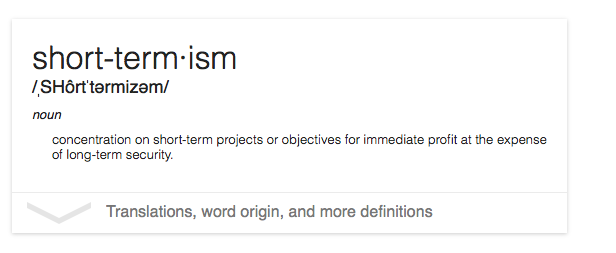
I am about 10, if not 15 years late to this party.  This is not a new question:  have investment time horizons shrunk, and if so, in a way that extracts company value at the expense of long-term growth and sustainability?

Short termism definition image

Since this isn’t a new question, there is a considerable amount of literature available in law and finance (and a definition available on investopedia).  This may seem like great news, if like me, you are interested in acquiring a solid understanding of short termism.  By solid understanding,  I mean internalization of knowledge, not mere familiarity where I can be prompted to recall something when someone else talks/writes about it.  I have some basic questions that I want answers to:   What is short-termism?,  What empirical evidence best proves or disproves short-termism?  Which investors, if any, are short-term?  What are the consequences (good and bad) of a short-term investment horizon?  If there is short-termism, what are the solutions?  I’ll briefly discuss each below, and my utter failure to answer these questions with any real certainty thus far.

What is the definition of short-termism and does it change depending upon context or user?  There appears to be consensus on the conceptual definition

I so often find Keith Bishop‘s blog, California Corporate & Securities Law, both informative and entertaining.  Monday’s post in that forum is no exception.  In that post, Keith describes three important principles of Delaware corporate law that are not codified in the General Corporation Law of the State of Delaware (commonly and fondly known as the Delaware General Corporation Law or DGCL).  No surprise, but the three principles he identifies and describes are:

  • the business judgment rule;
  • derivative suit pleading requirements; and
  • the intermediate standard of review applicable in certain limited fiduciary duty actions.

Great list.  And I agree with what he says.

Of course, anyone who teaches corporate law has had to consider (and, to sone degree, call out) the areas of that body of law that derive from decisional, rather than statutory, law.  I often have been heard to say, in the basic Business Associations course, that if students forget–or need to leave behind–one of the two required texts (a casebook and a statutory resource book) when they come to class, most days, they should forget/leave behind the casebook, since it is more important for them to have the statutory law in front of them to answer most Business Associations law questions.  I note, however, that there are two large areas of exception:  veil piercing and fiduciary duty.  For those two doctrinal areas, I inform them that they won’t need the statutory resource book as much as the casebook.

A short while ago, some commentators declared that the Treasury had successfully ended corporate inversions. But after several recent corporate migrations, reports of the inversion’s death appear to have been greatly exaggerated.

A corporate inversion is a complicated and costly transaction used by American corporations to avoid particularly burdensome aspects of the U.S. tax code. The United States not only enforces the OECD’s highest corporate tax rate (the tax rate for most U.S. corporations ranges between 35% to 39%) but also worldwide taxation. This latter feature subjects an American corporation’s entire revenue stream to the United States’ extraordinary tax rate, whereas most countries tax only what is earned inside their territorial borders. In simplified terms, a corporation hoping to invert must merge with a foreign corporation—while satisfying some very idiosyncratic conditions—in order to reorganize in the foreign company’s country. After inverting, a company’s foreign generated income becomes subject to more favorable foreign tax rates, though it must still pay U.S. taxes on domestically generated revenue.

The rhetoric surrounding inversions has been heating up since Pfizer announced its intentions to invert into an Irish entity after acquiring Allegran in a $160 billion deal. The chief complaint against inversions is that inverted companies

This post concludes the Contract Is King, But Can It Govern Its Realm? Micro-symposium.  The symposium was hosted as part of the AALS section on Agency, Partnership, LLCs and Unincorporated Associations in advance of the section meeting on January 7th at 1:30 where the conversation will be continued.

I summarized the conversation and provided links to all of the individual posts.  Bookmark this page– there is great commentary at your finger tips on a range of topics.  Please keep reading (and commenting) on these great contributions by our insightful participants to whom we are very grateful.

Jeffrey Lipshaw kicked off the symposium conversation with his post (available here) questioning, in practice, how different LLCs are from traditional corporations.  He used a great map analogy to talk about the role of formation documents and default rules as gap fillers. 

“The contractual, corporate, and uncorporate models are always reductions in the bits and bytes of information from the complex reality, and that’s what makes them useful, just as a map of Cambridge, Massachusetts that was as complex as the real Cambridge would be useless.” 

After asserting that LLCs differ from corporations only in matters of degrees, Jeff went on to

I would like to thank the Business Law Professor Blog for this very important symposium. My brief thoughts are filling in for Marcia Narine. I became well acquainted with LLCs when I practiced in the alternative entities group of a Delaware law firm. What most stood out during my time there was the freedom enjoyed by LLCs and LPs to abridge fiduciary duties and deviate from other corporate orthodoxies. I constantly thought about whether this freedom of contract was a good thing; after all, case law tells only the tragic stories.

As mentioned in other posts, contractual freedom is ideal when sophisticated parties of comparable strengths are allowed to define their relationships. And generally, few problems arise from the LLC form. Law firms typically provide those seeking to form an LLC one of their standard, boilerplate operating agreements, which includes fiduciary duties. In turn, business owners are able to enjoy limited liability while avoiding many of the formalities, transactions costs, and tax burdens associated with traditional corporations. However, there seems to be an increasing number of cases where operating agreements resemble adhesion contracts, creating opportunities for abuse. Is it wise that unsophisticated are more at risk for contractual related harms so