
Earlier this month, the EU announced plans to implement its version of conflict minerals legislation, which covers all “conflict-affected and high-risk areas” around the world. Once approved by the Council of the EU, the law will apply to all importers into the EU of minerals or metals containing or consisting of tin, tantalum, tungsten, or gold (with some exceptions). Compliance and reporting will begin in January 2021. Importers must use OECD due diligence standards, report on their progress to suppliers and the public, and use independent third-party auditors. President Trump has not yet issued an executive order on Dodd-Frank §1502, aka conflict minerals, but based on a leaked memo, observers believe that it’s just a matter of time before that law is repealed here in the U.S. So why is there a difference in approach?

In response to a request for comments from the SEC, the U.S Chamber of Commerce, which led the legal battle against §1502, claimed, “substantial evidence shows that the conflict minerals rule has exacerbated the humanitarian crisis on the ground in the Democratic Republic of the Congo…The reports public companies are mandated to file also contribute to ―information overload and create further disincentives
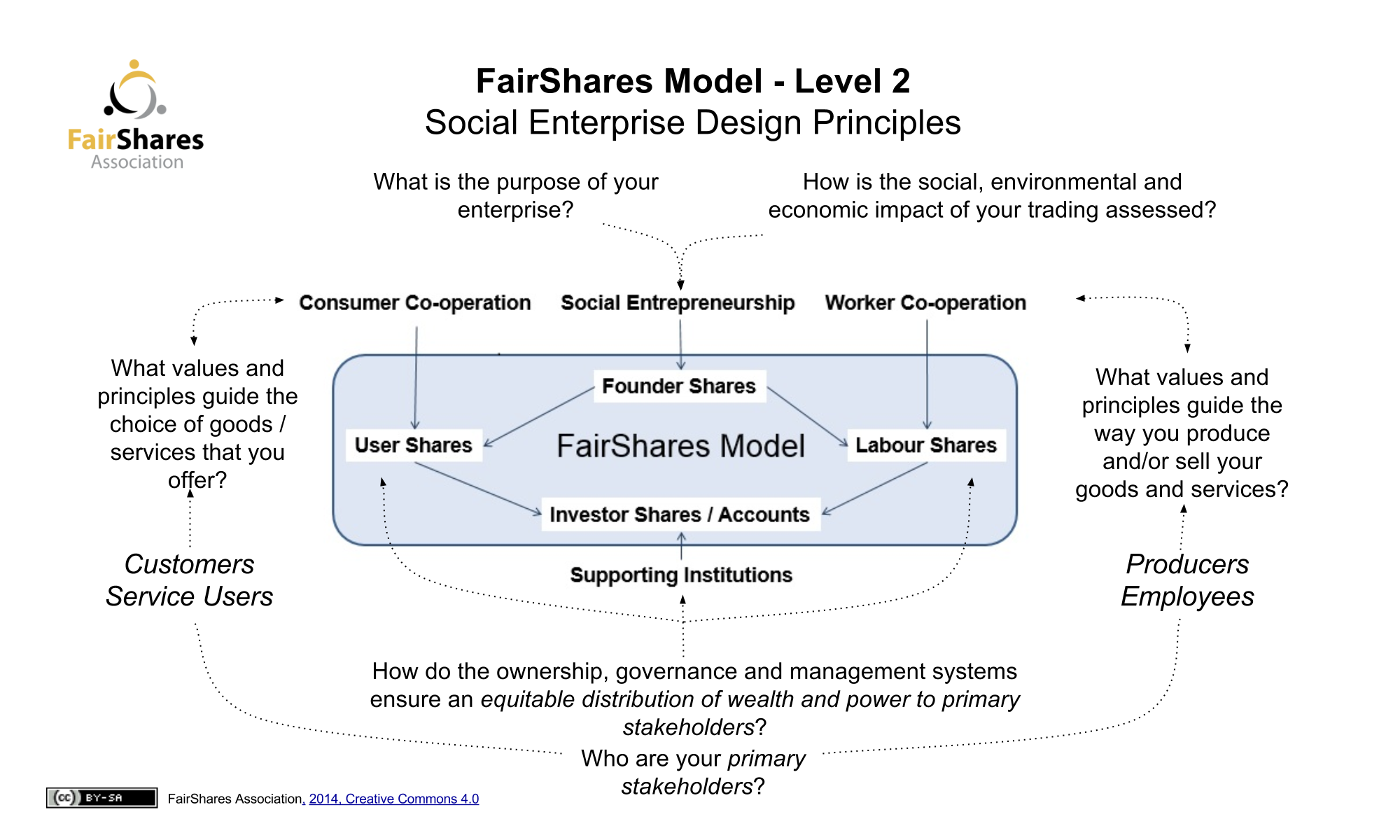
On of the many interesting things discussed during the social enterprise law workshop at Notre Dame Law School was the “FairShares Model.” Nina Boeger (University of Bristol-UK) brought the model to the group’s attention, and the model was new news to me.

The FairShares Model was “created during a research programme on democratising charities, co-operatives and social enterprises involving academics at Sheffield Hallam University and Manchester Metropolitan University in the UK.”

The FairShares Model cites the “Social Enterprise Europe Ltd” when noting that social enterprises “aim to generate sustainable sources of income, but measure their success through:

  • Specifying their purpose(s) and evaluating the impact(s) of their trading activities;

  • Conducting ethical reviews of their product/service choices and production/consumption practices;

  • Promoting socialized and democratic ownership, governance and management.”

To address theses aims, the FairShares Model offers social audits and suggests the issuing some combination of (1) founder shares, (2) labour shares, (3) investor shares, (4) user shares.

While I agree that significant corporate governance changes should be considered, at first glance this model seems a bit unwieldy if all four types of shares are issued. Still, I am interested in learning more. 

Virginia E. Harper Ho has posted “The SEC’s Sustainability Imperative” on SSRN.  You can download the paper here.  Here is the abstract:

In 2016, the Securities and Exchange Commission (SEC) for the first time sought public comment on whether financial disclosure reform should address indicators of firms’ sustainability risks and practices. Securities disclosure reform now appears poised to take a deregulatory turn, and innovations at the intersection of sustainability and finance appear unlikely in the face of new policy priorities. Whether the SEC should take any steps to improve how sustainability-related information is disclosed to investors is also deeply contested.

This Article argues that the SEC nonetheless faces a sustainability imperative, first to address this issue in the near term as part of its ongoing review of the reporting framework for financial disclosure, and second, to promote disclosure of material sustainability information within financial reports in furtherance of its core statutory mandate. This conclusion rests on evidence that the current state of sustainability disclosure is inadequate for investment analysis and that these deficiencies are largely problems of comparability and quality, which cannot readily be addressed by private ordering, nor by deference to policymaking at the state level. This Article

A few weeks ago I blogged about the spate of boycotts and buycotts responding to President Trump’s travel ban. Since that time, the #grabyourwallet campaign has taken credit for a number of stores dropping Ivanka Trump’s merchandise. In response, celebrities and others flocked to Nordstrom after criticism by the President’s surrogates about the retailer’s decision to drop the products, even though Nordstrom cited falling sales. Within days, news outlets reported that her perfume was a top seller on Amazon, and that many reviewers indicated that they had bought the product to show support for the President. 

Yesterday, NPR reported that the United Auto Workers will revive its 1980s Buy American campaign, which will not only promote American-made products but will also encourage the boycott of cars made by American companies overseas. I’ve argued in the past that boycotts don’t work, and the NPR story provided some support from a professor who noted, “these campaigns, even with catchy song lyrics, almost never work. For instance, garment work essentially left the U.S. almost completely a few years after [the look for the union label ad] ran, and after the last UAW campaign, the American car companies continued to lose market share.” The

     This post does not concern President Trump’s own business empire. Rather, this post will be the first of a few to look at how the President retains, repeals, or replaces some of the work that President Obama put in place in December 2016 as part of the National Action Plan on Responsible Business Conduct. Many EU nations established their NAPS year ago, but the U.S. government engaged in two years of stakeholder consultations and coordinated with several federal agencies before releasing its NAP.

     Secretary of State Tillerson will play a large role in enforcing or revising many of the provisions of the NAP because the State Department promotes the Plan on its page addressing corporate social responsibility. Unlike many federal government pages, this page has not changed (yet) with the new administration. As the State Department explained in December, “the NAP reflects the government’s commitment to promoting human rights and fighting corruption through partnerships with domestic and international stakeholders. An important part of this commitment includes encouraging companies to embrace high standards for responsible business conduct.” Over a dozen federal agencies worked to develop the NAP.

     We now have a new Treasury Secretary and will soon have a

Donald Trump has had a busy two weeks. Even before his first official day on the job, then President-elect Trump assembled an economic advisory board. On Monday, January 23rd, President Trump held the first of his quarterly meetings with a number of CEOs to discuss economic policy. On January 27th, the President issued what some colloquially call a “Muslim ban” via Executive Order, and within days, people took to the streets in protest both here and abroad.

These protests employed the use of hashtag activism, which draws awareness to social causes via Twitter and other social media avenues. The first “campaign,” labeled #deleteuber, shamed the company because people believed (1) that the ride-sharing app took advantage of a work stoppage by protesting drivers at JFK airport, and (2) because they believed the CEO had not adequately condemned the Executive Order. Uber competitor Lyft responded via Twitter and through an email to users that it would donate $1 million to the ACLU over four years to “defend our Constitution.” Uber, which is battling its drivers in courts around the country, then established a $3 million fund for drivers affected by the Executive Order. An

As regular readers of this blog know, I am skeptical of many disclosure regimes, particularly those related to conflict minerals. I am, however, a fan of the Sustainability Accounting Standard Board’s (SASB’s) efforts to streamline the disclosure process and provide industry-specific metrics that tie into accepted definitions of materiality.

Dr. Jean Rogers, the CEO and Founder of SASB, presented at the Association of American Law Schools yesterday with other panelists discussing the pros and cons of environmental, social, and governance disclosures. To prove SASB’s case that investors care about sustainability, Dr. Rogers noted that in 2016, sustainable investment strategies came into play in one out of every five dollars under professional management. She cited a number of key sustainability initiatives that investors considered including the United Nations Principles for Responsible Investments ($59 trillion AUM), the Carbon Disclosure Project ($95 trillion AUM), the International Corporate Governance Network ($26 trillion AUM), and the Investor Network on Climate Risk ($13 trillion AUM).

Despite this interest, SASB argues, investors lack information that equips them with an apples to apples comparison on material information related to sustainability. What might be material in the beverage industry such as water usage for example, may

It is not secret that Patagonia is one of the companies that I admire most; it may be my favorite company and is certainly in my top-five.

Patagonia’s decision regarding its Black Friday sales adds to the reason I like the company. Patagonia will donate 100% of its Black Friday sales to grassroots environmental groups.

As I read it, the donations will be 100% of revenue, not profits, and the donations are estimated to be millions of dollars.

Patagonia is both a California benefit corporation and B corporation certified, but unlike many social enterprises, Patagonia often does things like the above that don’t appear to be done just for the PR, and may actually hurt the company in the very short-term.

That said, Patagonia definitely has a good PR team and is probably getting millions of dollars of exposure out of this decision. And their apparel is quite expensive, so they may be able to afford to do things like this, based, in part, on the margins and goodwill built over time.  

Happy Thanksgiving from the Dominican Republic. I’m blogging from the Fathom Adonia, Carnival’s fledgling social impact cruise line. I’ve spent the past few days in Puerto Plata teaching English in schools and local communities. Other passengers worked on reforestation projects, built water filtration systems, installed concrete floors in homes, worked with women on cocoa farms, and learned how to recycle paper with local workers. Passengers can  also do typical excursions such as zip lining and snorkeling, or can lounge around in the $80 million dollar Amber Cove built up like a resort. But most people come on this cruise for the volunteer activities and don’t expect frills (our bus got stuck in the mud and we needed pig farmers in a truck to help push us out on the way back from teaching English 75 minutes outside of town). Fathom has restaurants, a spa, dancing, bars, onboard activities such as wine and paint, extremely friendly staff, and enthusiastic, young “impact guides” but no Vegas-style shows and only carries approximately 700 passengers.

Carnival has banked on profiting from people’s stated desire to do good in the world. Lots of surveys support this idea in theory. However, as regular readers of this

Prof. Bainbridge the other day commented on the following, which is item 10 from the Modern Corporation Statement on Company Law (available here):  

Contrary to widespread belief, corporate directors generally are not under a legal obligation to maximise profits for their shareholders. This is reflected in the acceptance in nearly all jurisdictions of some version of the business judgment rule, under which disinterested and informed directors have the discretion to act in what they believe to be in the best long term interests of the company as a separate entity, even if this does not entail seeking to maximise short-term shareholder value. Where directors pursue the latter goal, it is usually a product not of legal obligation, but of the pressures imposed on them by financial markets, activist shareholders, the threat of a hostile takeover and/or stock-based compensation schemes.

Bainbridge take a contrary position, citing Delaware Supreme Court Chief Justice Strine, who says, “a clear-eyed look at the law of corporations in Delaware reveals that, within the limits of their discretion, directors must make stockholder welfare their sole end, and that other interests may be taken into consideration only as a means of promoting stockholder welfare.” Strine further