
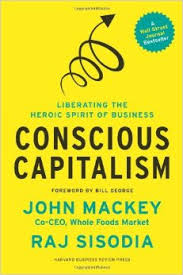
Conscious

Recently, I finished reading Conscious Capitalism, written by Whole Foods Market co-CEO John Mackey and Babson College professor Raj Sisodia.

The book is much more “popular press” than academic, as should be clear from the splashy subtitle “liberating the heroic spirit of business.” There is a bit of academic influence in the appendix and notes, but it is mostly social business advocacy and story telling. In fact, the authors state that the primary purpose of the book “is to inspire the creation of more conscious businesses: businesses galvanized by higher purposes that serve and align the interests of all their major stakeholders.” (pg. 8). The book is interesting, passionate, and may accomplish its primary purpose.

The authors paint a compelling picture of Whole Foods Market and similar companies like Trader Joe’s, The Container Store, Costco, and Southwest Airlines. These companies appear to take a long-term view and consider what is best for all their stakeholders. I would have appreciated, however, more attention to the struggles the companies must have faced in attempting to satisfy all of their stakeholders. After finishing the book, I was left wishing the authors would have spent more time discussing how to make decisions in

Last week I posted the first of three posts regarding doing business in Cuba. In my initial post I discussed some concerns that observers have regarding Cuba’s readiness for investors, the lack of infrastructure, and the rule of law issues, particularly as it relates to Cuba’s respect for contracts and debts. Indeed today, Congress heard testimony on the future of property rights in Cuba and the claims for US parties who have had billions in property confiscated by the Castro government- a sticking point for lifting the embargo. (In 1959, Americans and US businesses owned or controlled an estimated 75-80% of Cuban land and resources). Clearly there is quite a bit to be done before US businesses can rush back in, even if the embargo were lifted tomorrow. This evening, PBS speculated about what life would be like post-embargo for both countries. Today I will briefly discuss the Cuban legal system and then focus the potential compliance and ethical challenges for companies considering doing business on the island.

Cuba, like many countries, does not have a jury system. Cuba’s court system has a number of levels but they have both professional judges with legal training, and non-professional judges who are

Apparently, there is a split of opinion on what some people believe God wants the world to do about the climate. On one side, Senator Jim Inhofe does not believe the man is responsible for climate change. He has publicly stated that, “[T]he Genesis 8:22 that I use in there is that ‘as long as the earth remains there will be seed time and harvest, cold and heat, winter and summer, day and night.’ My point is, God’s still up there. The arrogance of people to think that we, human beings, would be able to change what He is doing in the climate is to me outrageous.” When I mentioned this quote to a European audience at a conference on climate change and business in 2013, there was an audible gasp. He also wrote a 2012 book, The Greatest Hoax: How the Global Warming Conspiracy Threatens Your Future. His position did not change after the 2013 Intergovernmental Commission on Climate Change Report definitively declared that climate change was largely man made. This would all be irrelevant if Senator Inhofe wasn’t the Chair of the Senate committee that oversees the environment. Inhofe was the keynote speaker last week at the

Cuba has been in the news a lot lately. I’ve just returned from ten days in Havana so I could see it first hand both as a person who writes on business and human rights and as an attorney who consults occasionally on corporate issues. The first part of the trip was with the International Law Section of the Florida Bar. The second was with a group of art lovers. I plan to write two or three blog posts about the prospects of doing business in Cuba if and when the embargo is lifted. Because I do some consulting work, I want to make clear that these views are my own as an academic and should not be attributed to anyone else.

In this post I will just briefly list some basic facts about Cuba and foreign investment. Next week I will talk a bit more about investment, introduce the Cuban legal system, and talk about some of the business and compliance challenges. That’s the subject of my research this summer. The following week I will address human rights in Cuba and how various governments and businesses are addressing those issues, the subject of another article I am

Last week, I attended the National Business Law Scholars Conference at Seton Hall University School of Law in Newark, NJ.  It was a great conference, featuring (among others) BLPB co-blogger Josh Fershee (who presented a paper on the business judgment rule and moderated a panel on business entity design) and BLPB guest blogger Todd Haugh (who presented a paper on Sarbanes-Oxley and over criminalization).  I presented a paper on curation in crowdfunding intermediation and moderated a panel on insider trading.  It was a full two days of business law immersion.

The keynote lunch speaker the second day of the conference was Kent Greenfield.  He compellingly argued for the promotion of corporate personhood, following up on comments he has made elsewhere (including here and here) in recent years.  In his remarks, he causally mentioned B corporations and social enterprise more generally.  I want to pick up on that thread to make a limited point here that follows up somewhat on my post on shareholder primacy and wealth maximization from last week.

The New Yorker recently ran an interesting article entitled Patagonia’s Anti-Growth Strategy. Patagonia is a certified B corporation and a California benefit corporation.

As a customer, Patagonia is my favorite company for casual/outdoor clothing, and one of my favorite companies in any industry. Initially, I thought Patagonia’s clothes were insanely expensive, but their clothes have been much cheaper on a “cost-per-wear” basis than any other clothes I have bought. In an age of cheap products and rampant consumerism, Patagonia is striking a chord with those who wish to buy fewer, quality products.

A taste of the article follows, but go read the entire thing.

The company’s anti-materialistic stance ramped up on Black Friday, 2011, with a memorable full-page advertisement in the Times that read, “Don’t Buy This Jacket.” The ad’s text broke down the environmental costs of the company’s top-selling R2 fleece sweater and asked consumers to think twice before buying it or any other product. The attention the ad received helped to bump Patagonia’s 2012 sales significantly. . . . Patagonia is trying second-hand-clothing sales at its shop in Portland, Oregon, and has made product repair and recycling a growing part of its business model. It recently invested

I haven’t met Hollywood producer Edward Zwick, who brought the movie and the concept of Blood Diamonds to the world’s attention, but I have had the honor of meeting with medical rock star, and Nobel Prize nominee Dr. Denis Mukwege. Both Zwick and Mukwege had joined numerous NGOs in advocating for a mandatory conflict minerals law in the EU. I met the doctor when I visited Democratic Republic of Congo in 2011 on a fact finding trip for a nonprofit that focuses on maternal and infant health and mortality. Since Mukwege works with mass rape victims, my colleague and I were delighted to have dinner with him to discuss the nonprofit. I also wanted to get his reaction to the Dodd-Frank conflict minerals regulation, which was not yet in effect. I don’t remember him having as strong an opinion on the law as he does now, but I do remember that he adamantly wanted the US to do something to stop the bloodshed that he saw first hand every day.

The success of the Dodd-Frank law is debatable in terms of stemming the mass rape, use of child slaves, and violence against innocent civilians. Indeed, earlier this month


Business and Human Rights Junior Scholars Conference
                          
The Rutgers Center for Corporate Governance, The University of Washington School of Law, and the Business and Human Rights Journal (Cambridge University Press) announce the first Business and Human Rights Junior Scholars Conference, to be held September 18, 2015 at the Rutgers School of Law – Newark in Newark, New Jersey, just outside of New York City.  The Conference will pair approximately ten junior scholars writing at the intersection of business and human rights issues with senior scholars in the field.  Junior scholars will have an opportunity to present their papers and receive feedback from senior scholars.   Upon request, participants’ papers may be considered for publication in the Business and Human Rights Journal (BHRJ), published by Cambridge University Press.
 
All junior scholars will be tenure-track professors who are either untenured or have been tenured in the past three years.  The Conference is interdisciplinary; scholars from all disciplines are invited to apply, including law, business, human rights, and global affairs.  The papers must be unpublished at the time of presentation.
 
To apply, please submit an abstract of no

Recently, I have seen a fair bit written about states, the federal government, and individual firms raising or potentially raising the minimum wage for the lowest paid workers.

Low pay, however, is only one of many problems facing low-wage earners.

After hearing Charlotte Alexander (Georgia State) present on this co-authored paper – Stabilizing Low-Wage Work: Legal Remedies for Unpredictable Work Hours and Income Instability – I have become convinced that unpredictable work hours is a significant issue. The article is well worth reading. 

Unpredictable work hours can be problematic for many people – attorneys in BigLaw for example – but low-wage earners do not have disposable income to throw at the problem. Childcare and transportation, for example, become even more of a challenge when work hours are not stable and not set in advance.  Unpredictable, inconsistent work hours also hamper economic mobility by making it difficult or impossible to take classes or get a second job.    

For more on this issue, listen to MIT Operations Management Professor Zeynep Ton’s talk at the Aspen Institute. Her discussion of Mercadona, a low-cost supermarket based in Spain (discussion starts at 14:50), and QuickTrip, a convenience store with gas

Last week, I looked lovingly at a picture of a Starbucks old-fashioned grilled cheese sandwich. It had 580 calories. I thought about getting the sandwich and then reconsidered and made another more “virtuous” choice. These calorie disclosures, while annoying, are effective for people like me. I see the disclosure, make a choice (sometimes the “wrong” one), and move on.

Regular readers of this blog know that I spend a lot of time thinking about human rights from a corporate governance perspective. I thought about that uneaten sandwich as I consulted with a client last week about the California Transparency in Supply Chains Act. The law went into effect in 2012 and requires retailers, sellers, and manufacturers that exceed $100 million in global revenue that do business in California to publicly disclose the degree to which they verify, audit, and certify their direct suppliers as it relates to human trafficking and slavery. Companies must also disclose whether or not they maintain internal accountability standards, and provide training on the issue in their direct supply chains. The disclosure must appear prominently on a company’s website, but apparently many companies, undeterred by the threat of injunctive action by the state Attorney