

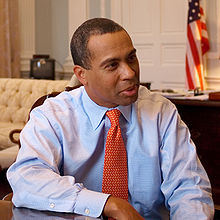
Bain Deval

The New York Times DealB%k recently reported that Deval Patrick, former governor of Massachusetts, will join Bain Capital to head a new social impact fund.

These types of social impact funds seem to becoming more and more common. Social impact funds, however, vary greatly. Some social impact funds appear to be primarily focused on profits (while simply avoiding some “sin stocks“), others focus on serious social enterprises, and others fall somewhere in-between.  

SE2-Logo2

At the end of next week, I will be at the University of Connecticut School of Business and the Thomas J. Dodd Research Center for their Social Enterprise and Entrepreneurship Conference.

Further information about the conference is available here, a portion of which is reproduced below:

In October 2014, Connecticut joined a growing number of states that empower for-profit corporations to expand their core missions to expressly include human rights, environmental sustainability, and other social objectives. As a new legal class of businesses, these benefit corporations join a growing range of social entrepreneurship and enterprise models that have the potential to have positive social impacts on communities in Connecticut and around the world. Designed to evaluate and enhance this potential, SE2 will feature a critical examination of the various aspects of social entrepreneurship, as well as practical guidance on the challenges and opportunities presented by the newly adopted Connecticut Benefit Corporation Act and other forms of social enterprise.

Presenters at the academic symposium on April 23 are:

  • Mystica Alexander, Bentley University
  • Norman Bishara, University of Michigan
  • Kate Cooney, Yale University
  • Lucien Dhooge, Georgia Institute of Technology
  • Gwendolyn Gordon, University of Pennsylvania
  • Gil Lan, Ryerson University
  • Diana Leyden, University of

Regular readers know that I have blogged repeatedly about my opposition to the US Dodd-Frank conflict minerals rule, which aims to stop the flow of funds to rebels in the Democratic Republic of Congo. Briefly, the US law does not prohibit the use of conflict minerals, but instead requires certain companies to obtain an independent private sector third-party audit of reports of the facilities used to process the conflict minerals; conduct a reasonable country of origin inquiry; and describe the steps the company used to mitigate the risk, in order to improve its due diligence process. The business world and SEC are awaiting a First Amendment ruling from the DC Circuit Court of Appeals on the “name and shame” portion of the law, which requires companies to indicate whether their products are DRC Conflict Free.” I have argued that it is a well-intentioned but likely ineffective corporate governance disclosure that depends on consumers to pressure corporations to change their behavior.

The proposed EU regulation establishes a voluntary process through which importers of certain minerals into the EU self-certify that they do not contribute to financing in “conflict-affected” or “high risk areas.” Unlike Dodd-Frank, it is not limited to Congo.

It’s that time of year again where I have my business associations students pretend to be shareholders and draft proposals. I blogged about this topic last semester here. Most of this semester’s proposals related to environmental, social and governance factors. In the real world, a record 433 ESG proposals have been filed this year, and the breakdown as of mid-February was as follows according to As You Sow:

Environment/Climate Change- 27%

Political Activity- 26%

Human Rights/Labor-15%

Sustainability-12%

Diversity-9%

Animals-2%

Summaries of some of the student proposals are below (my apologies if my truncated descriptions make their proposals less clear): 

1) Netflix-follow the UN Guiding Principles on Business and Human Rights and the core standards of the International Labour Organization

2) Luxottica- separate Chair and CEO

3) DineEquity- issue quarterly reports on efforts to combat childhood obesity and the links to financial risks to the company

4) Starbucks- provide additional disclosure of risks related to declines in consumer spending and decreases in wages

5) Chipotle- issue executive compensation/pay disparity report

6) Citrix Systems-add board diversity

7) Dunkin Donuts- eliminate the use of Styrofoam cups

8) Campbell Soup- issue sustainability report

9) Shake Shack- issue sustainability report

10) Starbucks- separate

Yesterday, Prof. Bainbridge annotated my “creed” on corporate governance, and I appreciated his take. In fact, many of his chosen sources would have been mine.

In a later footnote, he noted that he was not sure what I meant by my statement: “I believe that public companies should be able to plan like private companies . . . .” I thought I’d try to explain. 

My intent there was to address my perception that there is a prevailing view that private companies and public companies must be run differently.  Although there are different disclosure laws and other regulations for such entities that can impact operations, I’m speaking here about the relationship between shareholders and directors when I’m referencing how public and private companies plan. 

Public companies generally have far more shareholders than private companies, so the goals and expectations of those shareholders will likely be more diverse than in a private entity. Therefore, a public entity may need to keep multiple constituencies happy in a way many private companies do not.  However, that is still about shareholder wishes, and not the public or private nature of the entity itself.  A private company with twenty shareholders could crate similar

Below is a call for papers and description of a weeklong project on business and human rights. If you are interested, please contact one of the organizers below. I plan to participate and may also be able to answer some questions.

Lat Crit Study Space Project in Guatemala

Corporations, the State, and the Rule of Law

We are excited to invite you to participate in an exciting Study Space Project in Guatemala. Study Space, a LatCrit, Inc. initiative, is a series of intensive workshops, held at diverse locations around the world. This 2015 Study Space project involves a 7 working day field visit to Guatemala between Saturday June 27 (arrival date) and Saturday July 4, 2015 (departure date).  We are reaching out to you because we believe that your interests, scholarship, and service record align well with the proposed focus of our trip.

This call for papers proposes a trip to Guatemala to study more closely the phenomena of failed nations viewed from the perspective of the relationship of the state of Guatemala with corporations. With the recent surge of Central American unaccompanied minors and children fleeing with their mothers, the United States has had to confront the human face

Prof. Bainbridge yesterday posted about The Modern Corporation Statement on Company Law.  The statement has ten fundamental rules, of which number ten is:

Contrary to widespread belief, corporate directors generally are not under a legal obligation to maximise profits for their shareholders. This is reflected in the acceptance in nearly all jurisdictions of some version of the business judgment rule, under which disinterested and informed directors have the discretion to act in what they believe to be in the best long term interests of the company as a separate entity, even if this does not entail seeking to maximise short-term shareholder value. Where directors pursue the latter goal, it is usually a product not of legal obligation, but of the pressures imposed on them by financial markets, activist shareholders, the threat of a hostile takeover and/or stock-based compensation schemes.

Prof. Bainbridge is with Delaware Chief Justice Strine in that profit maximization is the only role (or at least only filter) for board members.  As he asserts, “The relationship between the shareholder wealth maximization norm and the business judgment rule, . . . explains why the business judgment rule is consistent with the director’s “legal obligation to maximise profits for

Last week, I posted about Walmart’s ballyhooed wage hike and asked whether boycotts and activism actually work. Apparently, the President was so impressed that he called the company’s CEO to thank him. Some Walmart workers, however, aren’t as pleased because without more hours, they still can’t make ends meet. Nonetheless, TJX, the parent company of retailers TJ Maxx and Home Goods announced yesterday that its employees would also receive a pay raise. Is this altruism? Have the retail giants caved to pressure?

As some commented on the blog last week and to me privately, it’s more likely that these megaretailers have implemented these “pro-employee” moves to reduce turnover, raise morale, and most important compete in a tightening job market. But one LinkedIn commenter from Australia believes that boycotts in general can work, stating:

My experience with having organised boycotts is that they work, but they take time. They create the conditions for public awareness of corporate activities, and put pressure on the company to change. They are effectively the ‘bad cop’ of civil society pressure. Consequently, they do not work on their own, requiring also the ‘good cop’ – civil society organisations and market conditions that allow the subject

I have just finished a draft of an article arguing that disclosures don’t work because consumers and investors don’t read them, can’t understand them, don’t take any real action when they do pay attention to them, and fail to change corporate behavior when they do threaten boycott. I specifically pointed out the relative lack of success of consumer protests over the years. I also noted that Wal-Mart continues to get bad press for how it treats its employees despite the fact the Norwegian Pension Fund divested hundreds of millions of dollars due to the company’s labor practices, prompting other governments and cities to follow. My thesis—it takes a lot more than divestment and threats of boycott to change company behavior. But perhaps I’m wrong. Yesterday, Wal-Mart CEO Doug McMillon announced a significant wage increase declaring:

We’re strengthening investments in our people to engage and inspire them to deliver superior customer experiences… We will earn the trust of all Walmart stakeholders by operating great retail businesses, ensuring world-class compliance, and doing good in the world through social and environmental programs in our communities.

The letter to Wal-Mart associates is here. I don’t know which was more striking, the $1 billion dollar move

I oppose the Dodd-Frank conflict minerals rule, which requires companies to conduct due diligence and report on their sourcing of certain minerals from the war-ravaged Democratic Republic of Congo and surrounding countries. As I have written before repeatedly on this blog, a law review article, and an amicus brief, it is a flawed “name and shame law” that assumes that consumers and investors will change their purchasing decisions based upon a corporate disclosure, which they may not read, understand, or care about. The name and shame portion of the law was struck down on First Amendment grounds, and the business lobby, the SEC, and the NGO community are eagerly awaiting a decision by the full DC Circuit Court of Appeals.

A disclosure law that does not take into account the true causes for the violence that has killed millions is not the most effective way to have a meaningful impact for the Congolese people. The Democratic Republic of Congo needs outside governments to provide more aid on security sector, criminal justice, education, and judicial reform at the very least. Indeed, the Congolese government is still trying to defeat the rebels that this law was meant to weaken