
On a previous post about Etsy dropping its B corp. certification, because of the B Lab requirement to convert to a public benefit corporation, I received the following comments:

  • “I simply believe that, in most ways, being a public benefit entity is more about a marketing strategy than a business plan.” (Tom N.)
  • “I had my students read the NY Times articles on Etsy as a part of their last class in my clinic this semester (thanks to my fellow Joe Pileri who alerted me to the article). We represent social enterprises in the clinic so this was a perfect wrap-up. The questions that I posed to my students: what social enterprise isn’t a soft target like Etsy? Won’t they all eventually cave to profit maximization?” (Alicia Plerhopes)
  • “I agree with To[m] N … Also, no theory of CSR actually requires an explicit weighting of the various stakeholders of a firm, so in reality, if the interests of shareholders are receiving the greatest weight, then Milton Friedman was right all along!” (Enrique)

I wanted to respond to these thoughtful comments, briefly, above the line.

Tom, I think the marketing benefits of becoming a PBC, currently, are weak. How many of
Call for Papers

The NYU Stern Center for Business and Human Rights and the Global Business and Human Rights Scholars Association invite you to submit papers: 4th Annual Conference of the Global Business and Human Rights Scholars Association at New York University, New York City, on September 14-15, 2018. Scholars from all disciplines are invited to apply, and we invite contributions that reflect the interdisciplinary character of BHR in theory and in practice.

We will also consider applications to participate as observers and discussants. Anyone interested in this possibility should submit their application in a few sentences to the email address below. Doctoral candidates are not eligible to present their research at this workshop, but they are welcome to attend. To discuss their work, PhD students may apply to the Young Researchers Summit (https://bhr.stern.nyu.edu/youngresearchers/). This is a workshop to discuss research-in-progress; papers must be unpublished at the time of presentation.

In addition to presenting a paper at the conference, participants are expected to read and be prepared to comment on and discuss the papers of other participants. The conference will be organized around three parallel working groups. Please indicate in your application to which of the three broad tracks you

Article-h-m2-0108

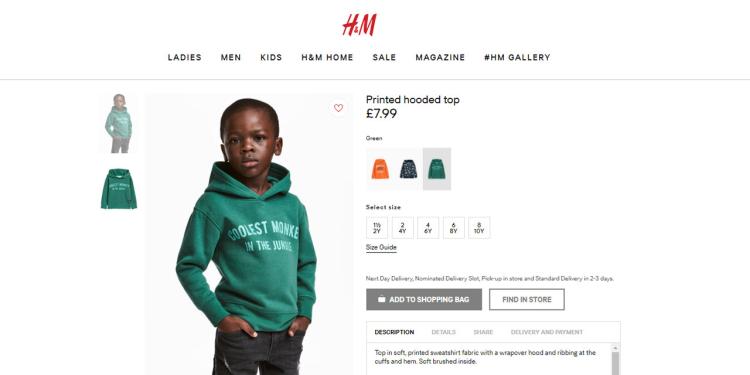
Swedish clothing giant H & M caused a huge stir this week with an ad campaign depicting a young black boy in a sweatshirt that proclaimed him the “Coolest Monkey In the Jungle.”  The company’s misstep is surprising given the public condemnations of the use of the word “monkey” in Europe over the past few years when soccer fans have used it as a slur against black players. Notwithstanding H & M’s many apologies, several megastars have denounced the company and some have even pulled their fashion collaborations. As usual, several have called for boycotts of the retailer. But will all of this really matter? The sweatshirt was still for sale in the UK days for days after the controversy erupted, and the Weeknd, one of the megastars who vowed to never work with H & M, still has his 18-piece H & M collection available online and available for purchase on the store’s  U.S. portal.

I’m headed out of the country tomorrow and in my quest for a new sweater, I glanced in the H & M store in my local mall earlier today. The store was packed and likely with fans of the artists who called for a boycott.

At a time when many boards may be thinking of tax planning and possible M & A deals, they may have to start focusing more on the unseemly topic of their executives’ sex lives because the flood of terminations and resignations due to sexual misconduct shows no signs of slowing down. One of the most shocking but underreported terminations in 2017 related to VISA. The CEO, one year into the role, chose to terminate one of his most valuable executives after an anonymous tip about sexual misconduct.  He wanted his employees to know that the corporate culture and values mattered. Board members should look closely at the VISA example.

We will continue to see the rise of the #MeToo movement spurred on in part by the messaging from a star-studded task force  formed to address Hollywood issues and the establishment of a multimillion-dollar legal defense fund to help blue-collar workers. Even Supreme Court Chief Justice Roberts addressed sexual harassment in the court system in his Year-End Report on the Federal Judiciary.  More people than ever may now choose to come forward with claims of harassment or assault. Whether companies choose to terminate wrongdoers or the accused choose to

Two weeks ago, I asked whether companies were wasting time on harassment training given the flood of accusations, resignations, and terminations over the past few weeks. Having served as a defense lawyer on these kinds of claims and conducted hundreds of trainings, I know that most men generally know right from wrong before the training (and some still do wrong). I also know that in many cases, people look the other way when they see or hear about the complaints, particularly if the accused is a superstar or highly ranked employee. Although most men do not have the power and connections to develop an alleged Harvey Weinstein-type “complicity machine” to manage payoffs and silence accusers, some members of management play a similar role when they ignore complaints or rumors of inappropriate or illegal behavior. 

The head in the sand attitude that executives and board members have displayed in the Weinstein matter has led to a lawsuit arguing that Disney knew or should have known of Weinstein’s behavior. We may see more of these lawsuits now that women have less fear of speaking out and Time honored the “Silence Breakers” as the Person of the Year. As I

The DePaul Law Review recently posted the article, Cooperatives: The First Social Enterprise, written by my friend and colleague Elaine Waterhouse Wilson (West Virginia Univ. College of Law). I recommend checking it out. Here is an overview: 

As the cooperative and social enterprise movements merge, it is necessary to examine the legal and tax structures governing the entities to see if they help or hinder growth. If the ultimate decision is to support the growth of cooperatives as social enterprise, then those legal and tax structures that might impede this progress need to be re-examined.

This Article considers some of the issues that may impede the charitable sector in supporting the growth of the cooperative business model as a potential solution to issues of income inequality. To do so, the Article first defines a “cooperative.” Part II examines the definition of a cooperative from three different viewpoints: cooperative as social movement, cooperative as economic arrangement, and cooperative as legal construct. From these definitions, it is possible to identify those elements inherent in the cooperative model that might qualify as a tax-exempt purpose under the Internal Revenue Code (the Code) §501(c)(3). Part III reviews the definition of “charitable” for

I have written about Etsy in at least three past posts: (1) Etsy becoming a certified B Corp, (2) Etsy going public, and (3) Delaware amending it’s public benefit corporation laws (likely, in part, to help Etsy convert to a PBC, which Etsy would need to do to maintain its certification because it incorporated in a non-constituency statute state that does have a benefit corporation statute (Delaware)).

In May, some questioned whether Etsy would keep its social focus after a “management shakeup.” In September, B Lab granted Etsy an extension on converting to a PBC. That article claims that B Lab would reset the deadline for conversion to 2019, if Etsy re-certified as a B Corp by the end of 2017 and would commit to converting to a PBC.

The 2019 date was 4 years from the 2015 Delaware PBC amendments (instead of 4 years from Etsy’s first certification). One of B Lab’s co-founder reportedly said that the statutory amendments were needed because the original 2013 version of the Delaware PBC law was “perfectly fine for private companies and unworkable for public companies.”

Just a few days ago, however, Etsy announced that it would abandon its B

I’m passing this on from Karen Bravo at IU  given all of the ESG disclosures on slavery, supply chains, and human trafficking. 

Call for Papers

SLAVERY PAST, PRESENT & FUTURE: 3rd Global Meeting

Indiana University Europe Gateway, Berlin, Germany
July 10 & 11, 2018


Throughout history, slavery (the purchase and sale of human beings as chattel), enslavement (through conquest, and exploitation of indebtedness, among other vulnerabilities), and similar extreme forms of exploitation and control have been an intrinsic part of human societies. 

Is slavery an inevitable part of the human condition?

Controversial estimates indicate that up to 35 million people worldwide are enslaved today.  This modern re-emergence of slavery, following legal abolition over two hundred years ago, is said to be linked to the deepening interconnectedness of countries in the global economy, overpopulation, and the economic and other vulnerabilities of the individual victims and communities.

This conference will explore slavery in all its dimensions and, in particular, the ways in which individual humans and societies understand and attempt to respond to it. 

The varieties of contemporary forms of exploitation appear to be endless.  Consider, for example, enslavement or mere “exploitation” among:

  • fishermen in Thailand’s

Every year, the United Nations holds a symbolic but important vote on a resolution condemning the U.S. embargo against Cuba and every year the United States and Israel are the only two countries to vote against it. Last year, the United States abstained in accordance with the rapprochement that the Obama administration began in 2014. A few hours ago, the U.S. and Israel stood alone and voted once again against the UN resolution, while 192 other nations voted for it. Ambassador Haley explained that the vote demonstrated, “continued solidarity with the Cuban people and in the hope that they will one day be free to choose their own destiny.” Prior to the vote she announced to the General Assembly that “today, the crime is the Cuban government’s continued repression of its people and failure to meet even the minimum requirements of a free and just society… The United States does not fear isolation in this chamber or anywhere else. Our principles are not up for a vote … We will stand for respect for human rights and fundamental freedoms that the member states of this body have pledged to protect, even if we have to stand alone.” The United States

Earlier this week, my two-year old daughter was in the pediatric ICU with a virus that attacked her lungs. We spent two nights at The Monroe Carell Jr. Children’s Hospital at Vanderbilt (“Vanderbilt Children’s). Thankfully, she was released Wednesday afternoon and is doing well. Unfortunately, many of the children on her floor had been in the hospital for weeks or months and were not afforded such a quick recovery. There cannot be many places more sad than the pediatric ICU.

Since returning home, I confirmed that Vanderbilt Children’s is a nonprofit organization, as I suspected. I do wonder whether the hospital would be operated the same if it were a benefit corporation or as a traditional corporation.

Some of the decisions made at the hospital seems like they would have been indefensible from a shareholder perspective, if the hospital had been for-profit. Vanderbilt Children’s has a captive market, with no serious competitors that I know of in the immediate area. Yet, the hospital doesn’t charge for parking. If they did, I don’t think it would impact anyone’s decision to choose them because, again, there aren’t really other options, and the care is the important part anyway. The food court