Call for Papers (DEADLINE: August 24, 2017)

AALS Section on Business Associations

Institutional Investors and Corporate Governance

AALS Annual Meeting, January 5, 2018

The AALS Section on Business Associations is pleased to announce a Call for Papers for a joint program to be held on Friday, January 5, 2018 at the 2018 AALS Annual Meeting in San Diego, California.  The topic of the program is “Institutional Investors and Corporate Governance.”

In thinking through the difficulty of agency costs within the public corporation, corporate law academics have turned repeatedly to institutional investors as a potential solution.  The agglomeration of shares within a large investing firm, together with ongoing cooperation amongst a large set of such investors, could overcome the rational apathy the average shareholder has towards participation in corporate governance.  Alternatively, activist investors could exert specific pressure on isolated companies that have been singled out—like the weakest animals in the herd—for extended scrutiny and pressure.  In these examples, the institutionalization of investing offers a counterbalance to the power of management and arguably provides a systematized way of reorienting corporate governance.  These institutional-investor archetypes have, in fact, come to life since the 1970s and have disrupted the stereotype of the passive investor.  But

Yesterday, on the last morning of the 2017 Southeastern Association of Law Schools (SEALS) conference, Matt Lyon, the Associate Dean at Lincoln Memorial University – Duncan School of Law (UT Law’s Knoxville neighbor) convened a discussion group on “Corporate and Financial Reform in the Trump Administration.” I was grateful to be asked to participate.  In addition to me, BLPB co-bloggers Josh Fershee and Marcia Narine Weldon, my UT Law coworker Brian Krumm, Securities Law Prof Blog editor Eric Chaffee, and University of Houston Law Center colleague Darren Bush were among the discussants.

SEALS2017(RegReformDiscGrp-1)

Each of us came with issues and questions for discussion.  Each of us offered reflections.  Recently made, currently proposed, and possible future changes to business regulation were all on the table.  I wish this session had been held earlier in the program, since many had left before the Sunday morning sessions (and we were competing with, among other enticing alternatives, a discussion session on marijuana regulation). However, we honestly had more than enough to discuss as among the seven of us, in any case.

I had to leave the session early to attend the SEALS board meeting.  But before I left, I took some notes on topics relating to my interest in and potential future work on regulatory reform.  I continue, for example, to be interested in the best approaches to reducing and streamlining regulation.  (See my posts here and here.)  A few additional outtakes follow.

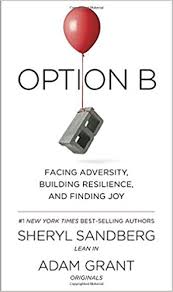
OptionB

Shortly after hearing Sheryl Sandberg and Adam Grant speak on a Harvard Business Review podcast, I purchased Option B.

After listening to the podcast, I expected the book to contain more references to the research on resilience than it ultimately did. While I knew the book was popular press, I expected Penn Professor Adam Grant to add a more scholarly flavor. As it was, the book was a relatively short memoir focused on the death of Sheryl Sandberg’s husband Dave. Had I started the book expecting a window into Sandberg’s grieving process rather than an accessible integration of the resilience research, I think I would have appreciated the book more.  

On the positive side, the book is an extremely easy read and is written with a punchy, engaging style. Sandberg is quite honest, and is blunt in sharing with the readers what is and isn’t helpful in interacting with those who have experienced great personal loss. In Sanberg’s opinion, you should address the elephant in the room, and should not worry about reminding them of their loss, as they are already thinking about it all the time. Vague offers like “let me know if I can do anything to help”

Good morning from gorgeous Belize. I hope to see some of you this weekend at SEALS. A couple of weeks ago, I posted about the compliance course I recently taught. I received quite a few emails asking for my syllabus and teaching materials. I am still in the middle of grading but I thought I would provide some general advice for those who are considering teaching a similar course. I taught thinking about the priorities of current employers and the skills our students need.

1) Picking materials is hard– It’s actually harder if you have actually worked in compliance, as I have, and still consult, as I do from time to time. I have all of the current compliance textbooks but didn’t find any that suited my needs. Shameless plug- I’m co-authoring a compliance textbook to help fill the gap. I wanted my students to have the experience they would have if they were working in-house and had to work with real documents.  I found myself either using or getting ideas from many primary source materials from the Society of Corporate Compliance and Ethics, the  Institute of Privacy ProfessionalsDLA Piper, the Federal Sentencing Guidelines for

The corporate form has been compared and contrasted favorably and unfavorably with government.  The literature is broad and deep.  Having said that, there is, perhaps, no one who writes more passionately on this topic than Daniel Greenwood.  Set forth below are two examples of text from his work that illustrate my point.

We live in a democratic age, in which the sole legitimate source of political power is the consent of the governed. Yet our business corporations defy every norm of democracy.
 
Most fundamentally, corporate law and our major business corporations treat the people most analogous to the governed, those most concerned with corporate decisions, as mere helots. Employees in the American corporate law system have no political rights at all—not only no vote, but not even virtual representation in the boardroom legislature. Board members owe a fiduciary duty to the corporation, according to most of the statutes, and to the shareholders, according to the popular shareholder primacy narratives, but they owe no consideration at all to employees.
 
Daniel J.H. Greenwood, Essay: Telling Stories of Shareholder Supremacy, 2009 Mich. St. L. Rev. 1049, 1060 (2009).
 
The corporation as a state-within-the-state . . . cannot be justified under any democratic theory, because this state-like entity defies all democratic norms internally. No corporation operates by the principle of one person, one vote. All economically significant corporations disenfranchise a substantial portion of the affected populace, while even shareholders vote according to the number of shares they hold. Moreover, standard corporate law sharply limits the control that even the “voters” have over “their” entity. The law bars them, in the absence of unanimous consent, from making fundamental value choices, for example, from balancing the pursuit of profit against other potential corporate goals, such as quality products, interests of non-shareholder participants or even the actual financial interests of the real human beings who own the shares. Moreover, it even bars them from electing directors pledged to particular interests: directors, unlike ordinary politicians, are bound by law to pursue the interests of all (and only) shares, and courts will enforce this duty-subject to the often significant limitations of the business judgment rule-at the behest of any shareholder, regardless of election results. Theorists, therefore, usually resort to market-based explanations of why the corporation is unable to exert any power over its shareholders, employees and other participants.
 
Daniel J.H. Greenwood, Markets and Democracy: The Illegitimacy of Corporate Law, 74 UMKC L. Rev. 41, 54–55 (2005) (footnotes omitted).  Whether you agree with Daniel or not on the substance, his views are transparent and his belief and energy are palpable.
 
With politics in the news every day and corporations on my mind, I have been pondering certain elements of democracy as they play themselves out in corporate governance.  In particular, of late, I have focused in on accountability as a core democratic norm.  

These days it is easy to get discouraged on how divided our nation seems to be on a number of issues. John Inazu, Distinguished Professor of Law, Religion, and Political Science at Washington University, maps a way forward in his book Confident Pluralism (2016).

The book is divided into two parts: (1) Constitutional Commitments, and (2) Civic Practices.

The first part “contend[s] that recent constitutional doctrine has departed from our longstanding embrace of pluralism and the political arrangements that make pluralism possible.” (8) Further, the first part offers guideposts for future decisions and political solutions. The first part argues for both inclusion and dissent, for the free formation of voluntary groups, for meaningful access to public forums, and for access to publicly available funding for diverse organizations. Provocatively, Inazu claims that Bob Jones case – which stripped tax-exempt status from Bob Jones University due to its prohibition of interracial dating/marriage – is “normatively attractive to almost everyone, [but] is conceptually wrong.” (75) Inazu claims that “[t]he IRS should not limit tax-exempt status based on viewpoint of ideology.” (79) He extends the argument to “generally available resources.” While the Trinity Lutheran case was decided by the Supreme Court after publication

A few weeks ago, Stephen Bainbridge asked about the benefits of the social media site LinkedIN. His question caused me to revisit the costs/benefits of social media. Below I reflect on the social media websites I use.

With so many professors getting in trouble on social media – see, e.g., here, here, here, here, and here – it may make sense to ask if any of the websites are worth the risk. As long as you are wise when you post, and assume a post will be seen in the worst possible light, I think social media can be worth using. 

Facebook. 

  • Benefits. Facebook has a broader network of people than any of the other social media sites I use. My parents are on Facebook, as is my wife’s grandmother and great aunt, as are my peers, as are my much younger cousins. Facebook also has a wide range of user generated content — photos, links, short & long posts, groups, etc. The “Friends in ___ City” feature has allowed me to catch up with old acquaintances when traveling for conferences or family trips. Just a few weeks ago, I visited with two

With a Fourth of July post, I was inclined to write something patriotic and connected with our great nation and to law schools generally. As an unabashed and unapologetic fan of the Hamilton: An American Musical, a couple of analogies from this brilliant production seemed appropriate to convey my thoughts on law school and leaving a legacy.  

First, I think most of us who are fortunate enough to serve as law professors recognize the great gift we have to pursue our passion and to be part of educating the next generation of people who understand the rule of law and have the skills to protect the rights of individuals and groups. This is especially needed for those who are marginalized or under represented and thus less likely to be able to enforce their rights without the help of our legal system.  This is an incredible legacy in America, set in motion by some our nation’s founders.  

Like John Adams defending British soldiers and Alexander Hamilton defending Loyalists after the war, lawyers (and law professors) do not need to compromise their own views to embrace the ideals they seek to uphold. We can vigorously maintain our personal views

Reuters reports that minor league baseball players lost a claim for artificially low” wages.  The court found, appropriately: “The employment contracts of minor league players relate to the business of providing public baseball games for profit between clubs of professional baseball players.”

Samuel Kornhauser, the player’s lawyer plan to ask the 9th Circuit to reconsider (probably en banc) or appeal to the U.S. Supreme Court. Kornhasuer, in an interview, stated: 

“Obviously, we think it’s wrong, and that the ‘business of baseball’ is a lot different today than it was in 1922. There is no reason minor leaguers should not have the right to negotiate for a competitive wage.”

Kornhauser is certainly correct that things have changed in the last 100 years, though I would argue that the justification for the antitrust exemption was just as unfounded in 1922 as it is today. The origin is the Federal Baseball decision, and it was wrong then, and it is wrong now.  But it is also the law of the land. The 1998 Curt Flood Act, as the court appropriately explains, “made clear [Congress intended] to maintain the baseball exemption for anything related to the employment of minor league players.”

There is no question

Yesterday, during a conversation with a law student about whether corporate social responsibility is a mere marketing ploy to fool consumers, the student described her conflict with using Uber. She didn’t like what she had read in the news about Uber’s workplace culture issues, sex harassment allegations, legal battles with its drivers, and leadership vacuum. The student, who is studying for the bar, probably didn’t even know that the company had even more PR nightmares just over the past ten days— the termination of twenty employees after a harassment investigation; the departure of a number of executives including the CEO’s right hand man; the CEO’s “indefinite” leave of absence to “mourn his mother” following a scathing investigative report by former Attorney General Eric Holder; and the resignation of a board member who made a sexist remark during a board meeting (ironically) about sexism at Uber. She clearly hadn’t read Ann Lipton’s excellent post on Uber on June 17th.

Around 1:00 am EST, the company announced that the CEO had resigned after five of the largest investors in the $70 billion company issued a memo entitled “Moving Uber Forward.” The memo was not available as