In each of the classes I have taught I have offered extra credit for a reflection paper on how the media portrays the particular subject because most Americans, including law students, form their opinions about legal issues from television and the movies. Sometimes the media does a great job. I’m told by my friends who teach and practice criminal law that The Wire gets it right. Although I have never practiced criminal law, I assume that ABC’s How to Get Away With Murder, in which first-year students skip their other classes to both solve and commit murders, is probably less accurate. I do have some students who now watch CNBC because I show relevant clips in class. After a particularly heated on-air debate, one student called the network “the ESPN for business people.”

I’m looking for new fiction movies or TV shows to suggest to my students next semester. In addition to the standard business movies and documentaries, what makes your list of high-quality business-related shows? Friends, colleagues, and students have suggested the following traditional and nontraditional must-sees: 

1)   Game of Thrones (one student wrote about it in the partnership context)

2)   House of Cards (not purely business, but
Earlier this week, I watched Ivory Tower: Is College Worth the Cost? on CNN, which was a somewhat depressing documentary for someone who hopes to spend the next 30+ years in higher education.

One of the things the documentary decries is the construction of more and more extravagant buildings and amenities on college campuses.

While the extent and type of building that should occur can be reasonably debated – and my own institution has almost doubled the number of buildings on campus in the past decade – I want to make a relatively modest claim here: aesthetics matter in higher education.

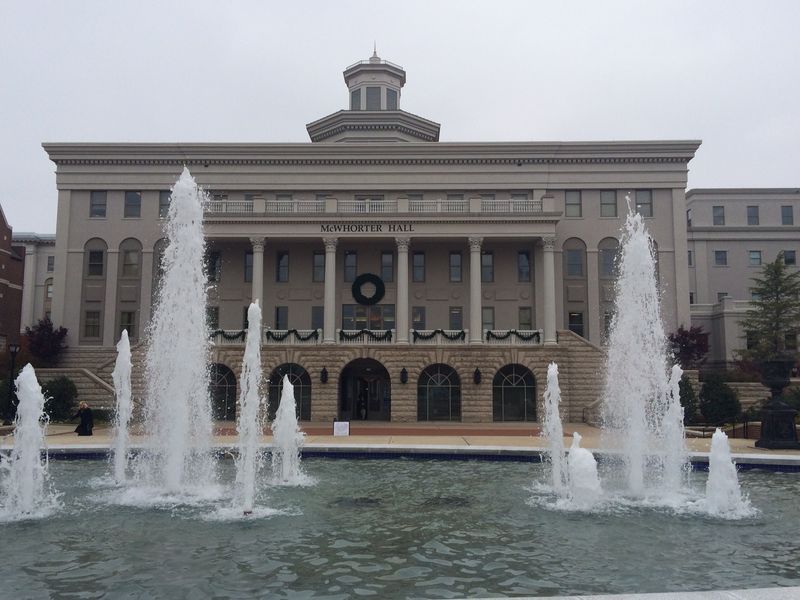
Belmont University

(Photo of a Belmont University building and fountain from my iPhone).

Perhaps some schools have gone overboard in creating beautiful campuses. However, at institutions that exist to illuminate for students something much more important than mere financial returns, I think it is fitting to invest in beautiful campuses, for their own sake.

Again, perhaps most schools do not need student recreation centers than costs hundreds of millions of dollars, but there is something inspiring about going to a school, and teaching at a school, that is breathtakingly beautiful. 

This post may surprise some people who know me because I

The-giver-banner

Much has been written about the protests at various schools over proposed commencement speakers.  I am not sure I have much original to add to the many thoughts that have been shared on the issue (See, e.g., Jonathan Adler (Case Western), The Volokh Conspiracy; Stephen Carter (Yale), Bloomberg; Glenn Harlan Reynolds (Tennessee), USA Today; Editorial Board, Washington Post), but the controversy did make me think of the dystopian society in The Giver where “Sameness” rules.

One of my younger sisters recently accepted a job with Walden Media, which is producing the upcoming film version of The Giver with The Weinstein Company (shameless plug – in theatres August 15, 2014).  My sister was amazed that I hadn’t read The Giver, as it is supposedly regular middle school reading, but it looks like the book (published in 1993) was not in the curriculum in time for me.  Yes, I feel older every day. 

Anyway, in a single day a few weeks ago, I read a borrowed copy of The Giver, which was a nice break from legal treatises and law review articles.  While I understand the “Elders” in The Giver were trying to protect

“Man grows used to everything, the scoundrel!” 
― Fyodor DostoyevskyCrime and Punishment

This week two articles caught my eye.  The New York Times’ Room for Debate feature presented conflicting views on the need to “prosecute executives for Wall Street crime.” My former colleague at UMKC Law School, Bill Black, has been a vocal critic of the Obama administration’s failure to prosecute executives for their actions during the most recent financial crisis, and recommended bolstering regulators to build cases that they can win. Professor Ellen Podgor argued that the laws have overcriminalized behavior in a business context, and that the “line between criminal activities and acceptable business judgments can be fuzzy.” She cited the thousands of criminal statutes and regulations and compared them to what she deems to be overbroad statutes such as RICO, mail and wire fraud, and penalties for making false statements. She worried about the potential for prosecutors to abuse their powers when individuals may not understand when they are breaking the law.

Charles Ferguson, director of the film “Inside Job,” likened the activity of some major financial executives to that of mobsters and argued that they have actually done more damage to the