
On Sunday, the world lost a musical giant in David Bowie, who died of cancer at 69.  He was the first artist who that made me a true music fan. Like buy all the records, read the biographies, hang-posters-on-the-wall type fan.  I grew up with a love for Motown music, especially Smokey Robinson, the Supremes, and the Four Tops, that I still have, but my appreciation for that music came from listening to my parent’s records.

When it came time to choose my own artists, other kids were into Led Zeppelin and Pink Floyd, but Bowie emerged as my guy.  He was later followed by bands like R.E.M., the English Beat, and The Cure, among others, as I moved into more of the college radio scene, and I really liked Joan Jett, but Bowie was always The Guy.  My fandom started with an album I poached from my aunt, Heroes.  I also got ahold of David Live (1974), and then worked my way back before going forward.  The Rise and Fall of Ziggy Stardust and the Spiders from Mars, Space Oddity, The Man Who Sold the World, Aladdin Sane, Diamond Dogs, and
The AALS Annual meeting starts today in New York.  The full program is available here, and listed below are two Section meeting announcements of particular interest to business law scholars:

Thursday, January 7th from 1:30 pm – 3:15 pm the SECTION ON AGENCY, PARTNERSHIP, LLC’S AND UNINCORPORATED ASSOCIATIONS, COSPONSORED BY TRANSACTIONAL LAW AND SKILLS will meet in the Murray Hill East, Second Floor, New York Hilton Midtown for a program titled:

“Contract is King, But Can It Govern Its Realm?”  

The program will be moderated by Benjamin Means, University of South Carolina School of Law.  Discussants include:

  • Joan M. Heminway, University of Tennessee College of Law
  • Lyman P.Q. Johnson, Washington and Lee University School of Law
  • Mark J. Loewenstein, University of Colorado School of Law
  • Mohsen Manesh, University of Oregon School of Law
  • Sandra K. Miller, Professor, Widener University School of Business Administration, Chester, PA

BLPB hosted an online micro-symposium in advance of the Contract is King meeting.  The wrap up from this robust discussion is available here.

Friday January 8th, from 1:30 pm – 3:15 pm join the SECTION ON BUSINESS ASSOCIATIONS AND LAW
AND ECONOMICS JOINT PROGRAM at the Sutton South, Second Floor, New York Hilton Midtown for a program titled:

 “The Corporate

On Saturday, January 9, 2016, I will be spending the day at the AALS Section on Socio-Economics Annual Meeting at the Sheraton New York Times Square Hotel.  Among other things, I will be part of a panel discussion from 9:50 – 10:50 AM, Death of the Firm: Vulnerabilities and the Changing Structure of Employment.  My co-panelists will be June Carbone and Katherine Stone (I am very tempted to give up my 15 minutes and just sit back and listen to these two great scholars, but please don’t use the comments section to encourage me to do that).  As I understand it, the gist of the discussion will be that while firms once supported a significant part of the safety net that provided employee health and retirement benefits, they have recently abdicated more and more of these responsibilities.  At the same time, however, what may be described as subsidies granted by the state to firms — particularly corporations — as part of a social contract whereby these firms provided the aforementioned benefits, have not been correspondingly reduced.  In fact, the rights of corporations have been expanded by, for example, cases like Citizens United and Hobby Lobby — suggesting a possible windfall

I am about 10, if not 15 years late to this party.  This is not a new question:  have investment time horizons shrunk, and if so, in a way that extracts company value at the expense of long-term growth and sustainability?

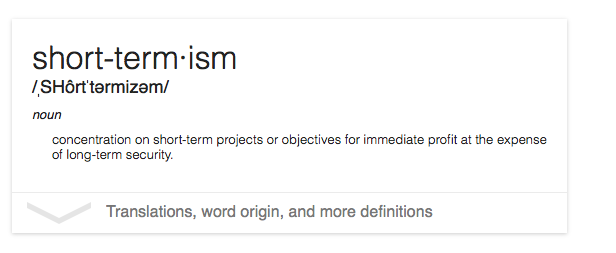
Short termism definition image

Since this isn’t a new question, there is a considerable amount of literature available in law and finance (and a definition available on investopedia).  This may seem like great news, if like me, you are interested in acquiring a solid understanding of short termism.  By solid understanding,  I mean internalization of knowledge, not mere familiarity where I can be prompted to recall something when someone else talks/writes about it.  I have some basic questions that I want answers to:   What is short-termism?,  What empirical evidence best proves or disproves short-termism?  Which investors, if any, are short-term?  What are the consequences (good and bad) of a short-term investment horizon?  If there is short-termism, what are the solutions?  I’ll briefly discuss each below, and my utter failure to answer these questions with any real certainty thus far.

What is the definition of short-termism and does it change depending upon context or user?  There appears to be consensus on the conceptual definition

My recent article:  Locked In: The Competitive Disadvantage of Citizen Shareholders, appears in The Yale Law Journal’s Forum.  In this article I examine the exit remedy for unhappy indirect investors as articulated by Professors John Morley and Quinn Curtis in their 2010 article, Taking Exit Rights Seriously.  Their argument was that the rational apathy of indirect investors combined with a fundamental difference between ownership of stock in an operating company and a share of a mutual fund.  A mutual fund redeems an investor’s fund share by cashing that investor out at the current trading price of the fund, the net asset value (NAV). An investor in an operating company (a direct shareholder) exits her investment by selling her share certificate in the company to another buyer at the trading price of that stock, which theoretically takes into account the future value of the company. The difference between redemption with the fund and sale to a third party makes exit in a mutual fund the superior solution over litigation or proxy contests, they argue, in all circumstances. It is a compelling argument for many indirect investors, but not all.

In my short piece, I highlight how exit remedies are

My co-blogger Haskell Murray had an interesting post on Friday about the use of crowdfunding as a strategy to attract venture capital. He points out that many companies that had successful crowdfunding campaigns on Kickstarter or Indiegogo subsequently raised venture capital. He argues that a successful crowdfunding campaign might be a signal to venture capitalists.

If you haven’t read Haskell’s post yet, it’s well worth reading. I want to take the discussion in a slightly different direction.

I don’t think venture capitalists should be waiting to see if a company has a successful crowdfunding campaign. I think they should use crowdfunding listings as leads and try to preemptively capture those companies before they complete their crowdfunding campaigns—convince the good companies to forego crowdfunding and go the venture capital route instead.

If I were a wealthy venture capitalist, I would have someone skimming through all of the crowdfunding sites, including the equity crowdfunding sites, looking for potential investments. The venture capital business is extremely competitive. Getting to the good companies before they have a successful raise is one way to one-up the competition. Once a company has shown crowdfunding success, others will want a piece.

Many of the companies doing crowdfunding

A student of mine studying peer-to-peer lending ran across an interesting provision in the securities filings of Prosper Marketplace,  one of the two main peer-to-peer lending sites. (The other is Lending Club.) 

Here is one of the risk factors in Prosper’s filings:

In the unlikely event that PFL receives payments on the Borrower Loan corresponding to an investor’s Note after the final maturity date, such investor will not receive payments on that Note after maturity.

Each Note will mature on the initial maturity date, unless any principal or interest payments in respect of the corresponding Borrower Loan remain due and payable to PFL upon the initial maturity date, in which case the maturity of the Note will be automatically extended to the final maturity date. If there are any amounts under the corresponding Borrower Loan still due and owing to PFL on the final maturity date, PFL will have no further obligation to make payments on the related Notes, even if it receives payments on the corresponding Borrower Loan after such date.

To understand how this works, you need to understand a little about how the Prosper site works. When a loan is funded by the peer-to-peer lenders

I think my life as a compliance officer would have been much easier had the DOJ issued its latest memo when I was still in house. As the New York Times reported yesterday, Attorney General Loretta Lynch has heard the criticism and knows that her agency may face increased scrutiny from the courts. Thus the DOJ has announced via the “Yates Memorandum” that it’s time for some executives to go to jail. Companies will no longer get favorable deferred or nonprosecution agreements unless they cooperate at the beginning of the investigation and provide information about culpable individuals.

This morning I provided a 7-minute interview to a reporter from my favorite morning show NPR’s Marketplace. My 11 seconds is here. Although it didn’t make it on air, I also discussed (and/or thought about) the fact that compliance officers spend a great deal of time training employees, developing policies, updating board members on their Caremark duties, scanning the front page of the Wall Street Journal to see what company had agreed to sign a deferred prosecution agreement, and generally hoping that they could find something horrific enough to deter their employees from going rogue so that they wouldn’t be

Last week I attended a panel discussion with angel investors and venture capitalists hosted by Refresh Miami. Almost two hundred entrepreneurs and tech professionals attended the summer startup series to learn the inside scoop on fundraising from panelists Ed Boland, Principal Scout Ventures; Stony Baptiste, Co-Founder & Principal, Urban.Us, Venture Fund; Brad Liff, Founder & CEO, Fitting Room Social, Private Equity Expert; and (the smartest person under 30 I have ever met) Herwig Konings, Co-Founder & CEO of Accredify, Crowd Funding Expert. Because I was typing so fast on my iPhone, I didn’t have time to attribute my notes to the speakers. Therefore, in no particular order, here are the nuggets I managed to glean from the panel.

1) In the seed stage, it’s more than an idea but less than a business. If it’s before true market validation you are in the seed round. At the early stage, there has been some form of validation, but the business is not yet sustainable. Everything else beyond that is the growth stage.

2) The friend and family round is typically the first $50-75,000. Angels come in the early stage and typically invest up to $500,000.

3)

Love him or hate him, you can’t deny that President Obama has had an impact on this country. Tomorrow, I will be a panelist on the local public affairs show for the PBS affiliate to talk about the President’s accomplishments and/or failings. The producer asked the panelists to consider this article as a jumping off point. One of the panelists worked for the Obama campaign and another worked for Jeb Bush. Both are practicing lawyers. The other panelist is an educator and sustainability expert. And then there’s me.

I’ve been struggling all week with how to articulate my views because there’s a lot to discuss about this “lame duck” president. Full disclosure—I went to law school with Barack Obama. I was class of ’92 and he was class of ’91 but we weren’t close friends. I was too busy doing sit-ins outside of the dean’s house as a radical protester railing against the lack of women and minority faculty members. Barack Obama did his part for the movement to support departing Professor Derrick Bell by speaking (at minute 6:31) at one of the protests. I remember thinking then and during other times when Barack spoke publicly that he would run