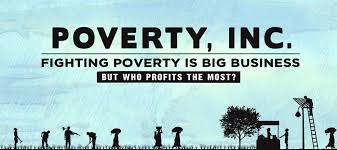
This past Sunday afternoon, I attended a screening of the film Poverty, Inc.
The trailer is available here.
I share a few, somewhat disconnected, thoughts on Poverty, Inc. under the page break.

This past Sunday afternoon, I attended a screening of the film Poverty, Inc.
The trailer is available here.
I share a few, somewhat disconnected, thoughts on Poverty, Inc. under the page break.
I would like to build off of Marcia Narine’s post about binding arbitration clauses. In her post, she discusses two related subjects. The first concerns the importance of civil procedure, noting that jurisdictional problems prevented the human rights victims in Kiobel from finding justice. The second addressed the grim picture painted by the New York Times about how companies use arbitration clauses to undermine meritorious legal claims. I mention this because there seems to be a radical development brewing about how arbitration clauses might actually help human rights victims.
The problem with adjudicating human rights claims is that few courts have been able, or willing, to remedy violations. Most abuses occur in countries where legal systems are too weak to prosecute offenders. And, in light of Kiobel, the United States generally lacks jurisdiction over entirely foreign defendants and events. This has led commentators to conclude that courts of law are poorly equipped to hear human rights cases.
But could arbitration be the answer? Consider the Bangladesh Accord, which was recently signed by over 200 apparel companies—including H&M, Abercrombie & Fitch, and Adidas—after a series of sweatshop fires in Bangladesh. Signatories agree to take numerous proactive and remedial measures
I teach both Civil Procedure and Business Associations. As a former defense-side commercial and employment litigator, I teach civ pro as a strategy class. I tell my students that unfortunately (and cynically), the facts don’t really matter. As my civil procedure professor Arthur Miller drilled into my head 25 ago, if you have procedure on your side, you will win every time regardless of the facts. Last week I taught the seminal but somewhat inscrutable Iqbal and Twombly cases, which make it harder for plaintiffs to survive a motion to dismiss and to get their day in court. In some ways, it can deny access to justice if the plaintiff does not have the funds or the will to re-file properly. Next semester I will teach Transnational Business and Human Rights, which touches on access to justice for aggrieved stakeholders who seek redress from multinationals. The facts in those cases are literally a matter of life and death but after the Kiobel case, which started off as a business and human rights case but turned into a jurisdictional case at the Supreme Court, civil procedure once again “triumphed” and the doors to U.S. courthouses closed a bit tighter for litigants.
Regular readers know that I write a lot about business and human rights and that I have posted about a number of lawsuits brought in California alleging violations of consumer protection statutes and false advertising claiming that companies fail to disclose the use of child slavery on their packaging. The complaints allege that consumers are deceived into “supporting” the child slave labor trade. The latest class action has been filed against Hershey, Mars, and Nestle. Back in 2001, these companies and several others signed the Engel-Harkin Protocol (drafted by Congressman Engel) in an effort to avoid actual FDA legislation regarding “slave-free” labeling. Nestle has touted its work with some of the world’s biggest NGOs to help clean up its supply chain for all of its human rights issues, not just in the cocoa industry. Nestle denies the allegations and actually has an extensive action plan related to child labor. Mars and Hershey also denied the allegations.
I am curious as to whether shareholders demand action from the boards of these companies or if the steady stream of litigation being filed in California causes companies to invest more in supply chain due diligence or to change where and how they source their
Today I will present on a panel with colleagues that spent a week with me this summer in Guatemala meeting with indigenous peoples, village elders, NGOs, union leaders, the local arm of the Chamber of Commerce, a major law firm, government officials, human rights defenders, and those who had been victimized by mining companies. My talk concerns the role of corporate social responsibility in Guatemala, but I will also discuss the complex symbiotic relationship between state and non-state actors in weak states that are rich in resources but poor in governance. I plan to use two companies as case studies.
The first corporate citizen, REPSA (part of the Olmeca firm), is a Guatemalan company that produces African palm oil. This oil is used in health and beauty products, ice cream, and biofuels, and because it causes massive deforestation and displacement of indigenous peoples it is also itself the subject of labeling legislation in the EU. REPSA is a signatory of the UN Global Compact, the world’s largest CSR initiative. Despite its CSR credentials, some have linked REPSA with the assassination last month of a professor and activist who had publicly protested against the company’s alleged pollution of rivers with
Has Wal-Mart reformed? Last week I blogged about whether conscious consumers or class actions can really change corporate behavior, especially in the areas of corporate social responsibility or human rights. I ended that post by asking whether Wal-Mart, the nation’s largest gun dealer, had bowed down to pressure from activist groups when it announced that it would stop selling assault rifles despite the fact that gun sales are rising (not falling as Wal-Mart claims). Fellow blogger Ann Lipton did a great post about the company’s victory over shareholder Trinity over a proposal related to the sale of dangerous products (guns with high capacity magazines). There doesn’t appear to be anything in the 2015 proxy that would necessitate even the consideration of a change that Wal-Mart fought through the Third Circuit to avoid.
So why the change? Is it due to the growing public weariness over mass shootings? Did they feel the sting after Senator Chris Murphy praised them for ceasing the sale of Confederate flags but called them out on their gun sales? Even the demands of a Senator won’t overcome the apparent lack of political will to enact more strict gun control, so fear of legislation is not
I’m the socially-conscious consumer that regulators and NGOs think about when they write disclosure legislation like the Dodd-Frank conflict minerals law that I discussed last week. I drive a hybrid, spend too much money at Whole Foods for sustainable, locally-farmed, ethically-sourced goods, make my own soda at home so I minimize impacts to the environment with cans and plastic bottles, and love to use the canvas bags I get at conferences when I shop at the grocery store. As I (tongue in cheek) pat myself on the back for all the good I hope to do in the world, I realize that I may be a huge hypocrite. I know from my research that consumers generally tell survey takers that they want ethically sourced goods, but they in fact buy on quality, price, and convenience.
I thought about that research when I read the New York Times expose and CEO Jeff Bezos’ response about Amazon’s work environment. As a former defense-side employment lawyer and BigLaw associate for many years, I wasn’t in any way surprised by the allegations (and I have no reason to believe they are either true or false). I have both provided legal defenses and lived
Today’s post will discuss the DC Circuit’s recent ruling striking down portions of Dodd-Frank conflict minerals rule on First Amendment grounds for the second time. Judge Randolph, writing for the majority, clearly enjoyed penning this opinion. He quoted Charles Dickens, Arthur Kostler, and George Orwell while finding that the SEC rule requiring companies to declare whether their products are “DRC Conflict Free” fails strict scrutiny analysis. But I won’t engage in any constitutional analysis here. I leave that to the fine blogs and articles that have delved into that area of the law. See here, here here, here, here, and more. The NGOs that have vigorously fought for the right of consumers to learn how companies are sourcing their tin, tungsten, tantalum and gold have had understandably strong reactions. One considers the ruling a dangerous precedent on corporate personhood. Global Witness, a well respected NGO, calls it a dangerous and damaging ruling.
Regular readers of this blog know that I filed an amicus brief arguing that the law meant to defund the rebels raping and pillaging in the Democratic Republic of Congo was more likely to harm than help the intended recipients—the Congolese people.
This weekend I will be in Panama filling in at the last minute for the corporate law session for an executive LLM progam. My students are practicing lawyers from Nicaragua, El Salvador, Costa Rica and Paraguay and have a variety of legal backgrounds. My challenge is to fit key corporate topics (other than corporate governance, compliance, M & A, finance, and accounting) into twelve hours over two days for people with different knowledge levels and experiences. The other faculty members hail from law schools here and abroad as well as BigLaw partners from the United States and other countries.
Prior to joining academia I spent several weeks a year training/teaching my internal clients about legal and compliance matters for my corporation. This required an understanding of US and host country concepts. I have also taught in executive MBA programs and I really enjoyed the rich discussion that comes from students with real-world practical experience. I know that I will have that experience again this weekend even though I will probably come back too brain dead to be coherent for my civil procedure and business associations classes on Tuesday.
I have put together a draft list of topics with the help