
Today I sat through a panel at the ABA International Law Section Meeting entitled, I, Robot – The Increasing Use and Misuse of Technology by In-House Legal Departments. I have already posted here about Ross and other programs. I thought I would share other vendors that in-house counsel are using according to one of the panelists: 

  • Deal point – virtual deal room.
  • Casetext – legal research.
  • Disco AI; Relativity; Ringtail – apply machine learning to e-discovery.
  • Ebrevia; Kira Systems; RAVN – contract organization and analysis.
  • Julie Desk – AI “virtual assistant” for scheduling meetings.
  • Law Geex – contract review software that catches clauses that are unusual, missing, or problematic.
  • Legal Robot – start-up uses AI to translate legalese into plain English; flags anomalies; IDs potentially vague word choices.
  • LexMachina – litigation analytics.
  • NeotaLogic – client intake and early case assessment.
  • Robot Review – compares patent claims with past applications to predict patent eligibility.
  • Ross Intelligence – AI virtual attorney from IBM (Watson).

These and their future competitors lead to new challenges for lawyers, law professors, and bar associations. Will robots engage in the unauthorized practice of law? What are the ethical ramifications of using artificial intelligence in legal engagements? How
Gabriel (“Gabe”) Azar and I graduated one year apart, from the same law school. He has an undergraduate degree in electrical engineering from Georgia Tech and started his legal career as an associate practicing patent law at Finnegan, Henderson, Farabow, Garrett & Dunner, LLP. He moved from Finnegan to Paul Hastings and from there to an in-house position with FIS. Currently, he is Senior Patent Counsel at Johnson & Johnson. I’ve admired, mostly from a distance (he lives in Jacksonville, FL now), how Gabe has balanced family, work, and health. We recently reconnected on Strava, and it has been inspiring to see a dedicated husband/father/attorney taking his fitness seriously.   


The interview is below the page break.

Reading closely is a highly valuable skill for both lawyers and law students.  But reading closely is not the only key to getting the most out of reading materials.  Often, knowing what to look for can help us discern what we’re really being told. An article at LawFare, How to Read a News Story About an Investigation: Eight Tips on Who Is Saying What, by Benjamin Wittes, does a nice job of providing some tools to help read news stories more carefully, and perhaps accurately, especially when it comes to sources.  Note that this piece applies to reputable reporters, not everyone who has written something about current events.  

One solid takeaway: 

Reporters publish what they know. If a story describes a series of interactions between a witness or a subject of an investigation and the investigators and the story contains information about one side’s thinking but not the other’s, that’s a powerful sign of where the disclosure came from.

Many of the skills here would translate into other settings, too.  For example, Wittes’ first rule: The Words Describing a Source Should Be Presumed Accurate.  He says, “Always start with the precise words the journalist is using to describe

And so it continues:

In a recent case in the United States District Court, District of Columbia, a court messes up the entity (referring to one of the parties as “Howard Town Center Developer, LLC, is a limited liability corporation (‘LLC’)”) and also does a fine job of improperly stating (or really, failing to state) the law for veil piercing. 

I took the initiative to pull the initial complaint and the answer to see if either of the parties were responsible for calling the LLC a corporation. Both sides properly referred to the LLC as a “limited liability company,” so it appears the corporation reference is a court-created issue.

In the case, a property developer brought action to require a university landowner to reinstate a ground lease and development agreement between developer and university, after the university sent notices of termination. The University counterclaimed to recover unpaid rent. The court determined, among other things, that the university was entitled to the damages it sought of $1,475,000 for unpaid rents and to attorney fees related to the developer’s breach of a ground lease and development agreement. But the opinion doesn’t stop there.

It is quite clear that the developer LLC does not have

So, don’t. Over at Above the Law, Prof. Kerriann Stout wrote 10 Things That Will Absolutely Piss Off Your Law Professor.  She notes it is not an exhaustive list, but it is a good one and worth a read.  This year, I added a new bit of information to my first day of class about how to interact with me about absences and workload.  (I often discuss this in class at some point, but I don’t recall ever doing it in both of my classes on day one.) 

So, here’s the deal.  In my classes, I allow a certain number of absences (depending on number of credits and days we meet) without questions for personal reasons, interviews, etc.  Here is an example of my attendance clause: 

Students are expected to attend every class.  Students are permitted to miss up to four classes for other obligations without explanation.  This number is to include virtually all absences, including sickness, out-of-town interviews, etc. (but does not include classes missed for religious observance).  If classes in excess of four are missed, to avoid withdrawal from the course, a written explanation may be required, including the reason for missing additional classes, the student’s

Jodi D. Taylor, a shareholder at the law firm Baker Donelson and a former classmate of mine, recently won the firm’s Work-Life Warrior Award. “Baker Donelson established the Work-Life Warrior Award to honor an attorney in the Firm who demonstrates an ongoing commitment to excellence in maintaining a healthy work-life balance or has advocated on behalf of work-life balance issues for the benefit of others.” Jodi graciously accepted my request to answer a few questions for this post, as part of the series I am doing on law and wellness.

The interview is below the break.

Earlier this week, Professor Bainbridge posted California court completely bollixes up business law nomenclature, discussing Keith Paul Bishop’s post on Curci Investments, LLC v. Baldwin, Cal. Ct. App. Case No. G052764 (Aug. 10, 2017).  The good professor, noting (with approval) what he calls my possibly “Ahabian” obsession with courts and their LLC references, says that “misusing terminology leads to misapplied doctrine.”  Darn right.

To illustrate his point, let’s discuss a 2016 Colorado case that manages to highlight how both Colorado and Utah have it wrong. As is so often the case, the decision turns on incorrectly merging doctrine from one entity type (the corporation) into another (the LLC) without acknowledging or explaining why that makes sense.  To the court’s credit, they got the choice of law right, applying the internal affairs doctrine to use Utah law for veil piercing a Utah LLC, even though the case was in a Colorado court. 

After correctly deciding to use Utah law, the court then went down a doctrinally weak path.  Here we go:

Marquis is a Utah LLC. (ECF No. 1 ¶ 7.) Utah courts apply traditional corporate veil-piercing principles to LLCs. See, e.g., Lodges at Bear Hollow Condo. Homeowners Ass’n, Inc.

Former BLPB editor Steve Bradford has posted a new paper adding to his wonderful series of articles on crowdfunding (on which I and so many others rely in our crowdfunding work).  This article, entitled “Online Arbitration as a Remedy for Crowdfunding Fraud” (and forthcoming in the Florida State University Law Review), focuses on a hot topic in many areas of lawyering–online dispute resolution, or ODR.  Steve brings the discussion to bear on his crowdfunding work.  Specifically, he suggests online arbitration as an efficacious way of resolving allegations of fraud in crowdfunding.  Here’s the abstract:

It is now legal to see securities to the general public in unregistered, crowdfunded offerings. But offerings pursuant to the new federal crowdfunding exemption pose a serious risk of fraud. The buyers will be mostly small, unsophisticated investors, the issuers will be mostly small startups about whom little is known, and crowdfunded offerings lack some of the protections available in registered offerings. Some of the requirements of the exemption may reduce the incidence of fraud, but there will undoubtedly be fraudulent offerings.

An effective antifraud remedy is needed to compensate investors and help deter wrongdoers. But, because of the small dollar amounts

Good morning from gorgeous Belize. I hope to see some of you this weekend at SEALS. A couple of weeks ago, I posted about the compliance course I recently taught. I received quite a few emails asking for my syllabus and teaching materials. I am still in the middle of grading but I thought I would provide some general advice for those who are considering teaching a similar course. I taught thinking about the priorities of current employers and the skills our students need.

1) Picking materials is hard– It’s actually harder if you have actually worked in compliance, as I have, and still consult, as I do from time to time. I have all of the current compliance textbooks but didn’t find any that suited my needs. Shameless plug- I’m co-authoring a compliance textbook to help fill the gap. I wanted my students to have the experience they would have if they were working in-house and had to work with real documents.  I found myself either using or getting ideas from many primary source materials from the Society of Corporate Compliance and Ethics, the  Institute of Privacy ProfessionalsDLA Piper, the Federal Sentencing Guidelines for

ABABookCover

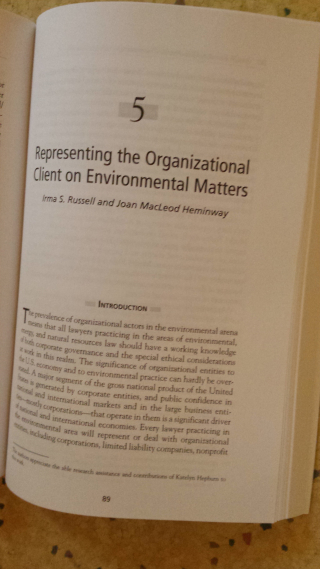
My good friend and long-time mentor Irma Russell and I wrote a chapter for the recently released ABA book, Ethics and the Environment: A Lawyer’s Guide.  Irma also is a co-editor of the book (with Vicki Wright).  In our joint contribution, the chapter entitled “Representing the Organizational Client on Environmental Matters,” Irma and I cover issues involving professional responsibility, corporate governance, and environmental compliance.  Guess which part was my primary responsibility . . . ?!)  Covering some 37 pages of the 242-page book, the rules we cover and the observations we make are fairly wide-ranging.  We hope, as we noted in our conclusion to the chapter, that we supply legal counsel representing corporations and other organizations with “foundational tools to assist them in providing advisory and advocacy-oriented services to organizational clients in the environmental law context.”  Irma and I received our copies last week.  The book soon will be available through the ABA and other outlets.


ABABookChapterPage

SaveSaveSaveSave

SaveSave