
I was fortunate to hear Angela Walch (St. Mary’s) present on this paper at SEALS last summer. Her article, The Bitcoin Blockchain as Financial Market Infrastructure: A Consideration of Operational Risk, has now been published in the NYU Journal of Legislation and Public Policy and is available on SSRN. The abstract is reproduced below:

—————-

“Blockchain” is the word on the street these days, with every significant financial institution, from Goldman Sachs to Nasdaq, experimenting with this new technology. Many say that this remarkable innovation could radically transform our financial system, eliminating the costs and inefficiencies that plague our existing financial infrastructures, such as payment, settlement, and clearing systems. Venture capital investments are pouring into blockchain startups, which are scrambling to disrupt the “quadrillion” dollar markets represented by existing financial market infrastructures. A debate rages over whether public, “permissionless” blockchains (like Bitcoin’s) or private, “permissioned” blockchains (like those being designed at many large banks) are more desirable.

Amidst this flurry of innovation and investment, this paper enquires into the suitability of the Bitcoin blockchain to serve as the backbone of financial market infrastructure, and evaluates whether it is robust enough to serve as the foundation of major payment, settlement, clearing
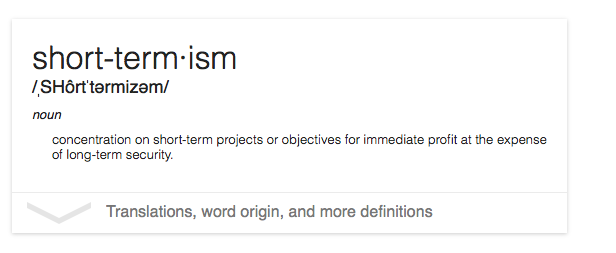
I am about 10, if not 15 years late to this party.  This is not a new question:  have investment time horizons shrunk, and if so, in a way that extracts company value at the expense of long-term growth and sustainability?

Short termism definition image

Since this isn’t a new question, there is a considerable amount of literature available in law and finance (and a definition available on investopedia).  This may seem like great news, if like me, you are interested in acquiring a solid understanding of short termism.  By solid understanding,  I mean internalization of knowledge, not mere familiarity where I can be prompted to recall something when someone else talks/writes about it.  I have some basic questions that I want answers to:   What is short-termism?,  What empirical evidence best proves or disproves short-termism?  Which investors, if any, are short-term?  What are the consequences (good and bad) of a short-term investment horizon?  If there is short-termism, what are the solutions?  I’ll briefly discuss each below, and my utter failure to answer these questions with any real certainty thus far.

What is the definition of short-termism and does it change depending upon context or user?  There appears to be consensus on the conceptual definition

My co-blogger Haskell Murray had an interesting post on Friday about the use of crowdfunding as a strategy to attract venture capital. He points out that many companies that had successful crowdfunding campaigns on Kickstarter or Indiegogo subsequently raised venture capital. He argues that a successful crowdfunding campaign might be a signal to venture capitalists.

If you haven’t read Haskell’s post yet, it’s well worth reading. I want to take the discussion in a slightly different direction.

I don’t think venture capitalists should be waiting to see if a company has a successful crowdfunding campaign. I think they should use crowdfunding listings as leads and try to preemptively capture those companies before they complete their crowdfunding campaigns—convince the good companies to forego crowdfunding and go the venture capital route instead.

If I were a wealthy venture capitalist, I would have someone skimming through all of the crowdfunding sites, including the equity crowdfunding sites, looking for potential investments. The venture capital business is extremely competitive. Getting to the good companies before they have a successful raise is one way to one-up the competition. Once a company has shown crowdfunding success, others will want a piece.

Many of the companies doing crowdfunding