
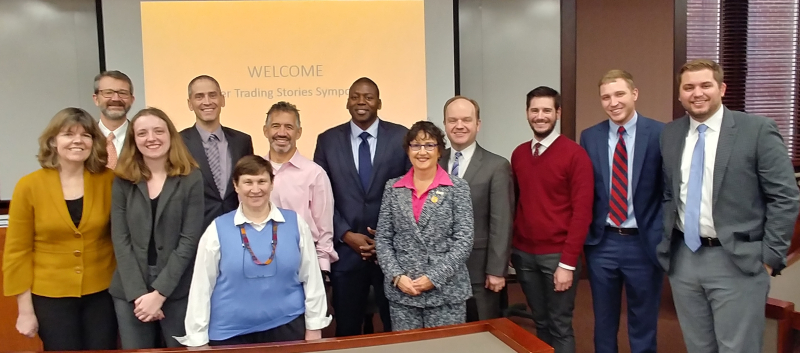
TJLP(InsiderTradingStories2019)

I was thrilled to be with so many wonderful colleagues and students (pictured above) at the Tennessee Journal of Law and Policy‘s symposium at UT Law last Friday.  The symposium, “Insider Trading: Stories from the Attorneys,” featured presentations about famous and not-so-famous insider trading cases.  Presenters included Michael Guttentag (Loyola, Los Angeles), me, Jeremy Kidd (Mercer), Ellen Podgor (Stetson), John Anderson (Mississippi College), Eric Chaffee (Toledo), Kevin Douglas (Scalia), and Donna Nagy (Maurer).  The papers presented highlight a variety of salient issues (including observations about the impact of gender and sexual orientation in specific cases or types of cases) involving or touching insider trading regulation.  They are being published in 2020 by the Tennessee Journal of Law & Policy.

The idea for the symposium came from a Southeastern Association of Law Schools (SEALS) discussion session convened last summer by John and me.  I described it in this post.  Let me or John know if you are working in the insider trading area and would like to join us for our 2020 SEALS discussion group, “Insider Trading: Is It All about the Money?”  The SEALS conference is scheduled to be held July 30 – August 5, 2020.  The

I approached with some curiosity the Securities and Exchange Commission’s recent shareholder proposal guidance in Staff Legal Bulletin No. 14J (“SLB 14J”).  My interest in this topic stems from my past life as a full-time lawyer in private practice.  During that time, I both wrote shareholder proposals and wrote no-action letters to the Securities and Exchange Commission (“SEC”) to keep shareholder proposals out of corporate proxy statements.

In SLB 14J, the SEC clarifies its application of the “ordinary business” exception to the inclusion of a shareholder proposal under Rule 14a-8.  Specifically, “[t]he Commission has stated that the policy underlying the ‘ordinary business’ exception rests on two central considerations. The first relates to the proposal’s subject matter; the second relates to the degree to which the proposal ‘micromanages’ the company.”  I want to share the SEC’s guidance with you on the latter.

The idea of shareholders micromanaging most public firms is almost laughable.  Yet, certain shareholder proposals do get somewhat specific in their direction of the firm and its resources.

In considering arguments for exclusion based on micromanagement, . . . we look to whether the proposal seeks intricate detail or imposes a specific strategy, method, action, outcome or

Have you ever wanted to learn the basics about blockchain? Do you think it’s all hype and a passing fad? Whatever your view, take a look at my new article, Beyond Bitcoin: Leveraging Blockchain to Benefit Business and Society, co-authored with Rachel Epstein, counsel at Hedera Hashgraph.  I became interested in blockchain a year ago because I immediately saw potential use cases in supply chain, compliance, and corporate governance. I met Rachel at a Humanitarian Blockchain Summit and although I had already started the article, her practical experience in the field added balance, perspective, and nuance. 

The abstract is below:

Although many people equate blockchain with bitcoin, cryptocurrency, and smart contracts, the technology also has the potential to transform the way companies look at governance and enterprise risk management, and to assist governments and businesses in mitigating human rights impacts. This Article will discuss how state and non-state actors use the technology outside of the realm of cryptocurrency. Part I will provide an overview of blockchain technology. Part II will briefly describe how public and private actors use blockchain today to track food, address land grabs, protect refugee identity rights, combat bribery and corruption, eliminate voter fraud

Call for Papers
AALS Section on Securities Regulation—2020 AALS Annual Meeting
Emerging Voices in Securities Regulation
Works-in-Progress Program
January 2-5, 2020
Washington, DC

The AALS Securities Regulation section invites proposals for its “Emerging Voices in Securities Regulation” works-in-progress workshop at the 2020 AALS Annual Meeting.  The workshop will bring together junior and senior securities regulation scholars for the purpose of giving junior scholars feedback on their scholarship and helping them prepare their work for the spring law review submission cycle.  A junior scholar is any untenured full-time faculty member as of January 2, 2020. 

FORMAT:  The program will involve multiple simultaneous roundtables, with one junior scholar, one or two senior scholars, and interested observers at each table.  Junior scholars’ presentations of their drafts will be followed by oral comments from senior scholars and further discussion, as time permits. 

SUBMISSION PROCEDURE:  Junior scholars who are interested in participating in the program should send an abstract (or longer summary) or draft-in-progress to Professor Eric C. Chaffee, Chair of the AALS Securities Regulation Section, at Eric.Chaffee@utoledo.edu, on or before September 16, 2019.  The cover email should state the junior scholar’s institution, tenure status, number of years in his or her current position, and any previous positions

Today, I have been attending and presenting at the Midwest Symposium on Social Entrepreneurship in Kansas City, Missouri.  This is the Seventh Annual installment of this event, which engages entrepreneurs, lawyers, government actors, and others in education, networking, and discussions around various issues (which differ from year to year) relating to social enterprise structure, governance, finance, and operations.  I love attending this symposium.  The people are socially and intellectually stimulating.  I appreciate Tony Luppino inviting me to participate.

There is much I could write about the programs today.  However, I will focus in one one small thing for now: Opportunity Zones and more particularly the funds that invest in them.  A quick description of Opportunity Zones and a cautionary message on related investment funds follow.

The U.S. Internal Revenue Service has defined Opportunity Zones as follows in a Q&A posted on its website:

An Opportunity Zone is an economically-distressed community where new investments, under certain conditions, may be eligible for preferential tax treatment. Localities qualify as Opportunity Zones if they have been nominated for that designation by the state and that nomination has been certified by the Secretary of the U.S. Treasury via his delegation of authority to the

Co-blogger Ann Lipton has posted a number of times on Elon Musk’s Twitter disclosures and their potential legal significance.  I chimed in once.  Unless I am mistaken, her most recent post (citing to our prior posts) on this subject is here.  Based on these posts, we both seem to understand that the Twitter Era has spawned some interesting disclosure-related legal questions.

I had these posts in the back of my mind when I got an email invitation yesterday from IPO Docs, a firm that sells “Regulation D Private Placement Memorandum Templates” to check into the firm’s services.  I have never been a fan of online templates or form documents as drafting precedent, especially for investment disclosure documents.  In general, one-size-fits-all disclosure lawyering is just too far from my practice background (which involved reverse-engineering the work of my Skadden colleagues and others).  But I do tell students they should be familiar with these kinds of form/exemplar resources and that, after determining the quality and suitability of a resource for their purposes, they may want to use form documents as a cross-check for contents or phrasing.

These two examples of Internet-related disclosures (online commentary and disclosure forms) are two pieces

A bunch of us sensed that it was coming.  I raised the question in an October 8, 2018 post here.  Now, it has actually happened.

Tesla Chief Executive Officer Elon Musk has finally caught the negative attention of the U.S. Securities and Exchange Commission (SEC) with yet another of his reckless tweets.  The WaPo reported earlier tonight that “[t]he Securities and Exchange Commission . . . asked a federal judge to hold Tesla CEO Elon Musk in contempt for violating the terms of a recent settlement agreement . . . .”  That settlement agreement, as readers will recall, relates to SEC allegations that Musk lied to investors when he posted on Twitter that he had secured the funding needed to take Tesla private.  The settlement agreement provides for the review and pre-approval of Musk’s market-moving public statements.

Ann Lipton and I, as BLPB’s resident fraud mongers, have been following the Musk affaire de Twitter for a number of months now.  (See, e.g., here, here, and here.)  Based on our prior posts, it seems clear the world was destined for this moment–a moment in which the SEC not only catches Musk in a tweeted misstatement but also

A few weeks ago, I posted on the SEC Roundtable on the Proxy Process (here).  I noted in a postscript to that post that friend-of-the-BLPB Bernie Sharfman had an additional comment letter (his fourth) relating to this regulatory project up his sleeve (so to speak).  That comment letter, dated December 17, 2018, was recently filed (see here) and focuses on voting recommendations.  The nub?

Investment advisers should not be in fear of breaching their fiduciary duties if they use board voting recommendations. . . . The SEC needs to go further than just approving the use of board voting recommendations as long as the investment adviser has an agreement with the client to use them. . . . [T]he SEC needs to explicitly state in some way that an investment adviser will not be in breach of its fiduciary duties under the Advisers Act if it uses board voting recommendations when voting its proxies.

To implement such a policy, this comment letter requests the SEC to provide investment advisers with a liability safe harbor under the Advisers Act when using board voting recommendations in voting their proxies as long as their clients do not prohibit their use

On November 15, the Securities and Exchange Commission (SEC) convened a Roundtable on the Proxy Process.  (See also here.)  I have not been following this as closely as co-blogger Ann Lipton has (see recent posts here and here), but friend-of-the-BLPB, Bernie Sharfman (Chairman of the Main Street Investors Coalition Advisory Council) has been active as a comment source.  Both contribute valuable ideas that I want to highlight here as the SEC continues to chew on the information it amassed in the roundtable process. 

Ann, as you may recall, has been focusing attention on the uncertain status of proxy advisors when it comes to liability for securities fraud.  In her most recent post, she observes that

There’s a real ambiguity about where, if it all, proxy advisors fit within the existing regulatory framework, and while I am not convinced there is a specific problem with how they operate or even necessarily a need for regulation, I think it can only be for the good if the SEC were to at least clarify the law, if for no other reason than that these entities play an important role in the securities ecosystem, and if we expect market

From our friend and colleague, Djamchid Assadi at the Burgundy School of Business in Dijon, France:

Lisbon2019_EURAM-banner_1100

SIG 03 – ENT – Entrepreneurship

With our theme Exploring the Future of Management: Facts, Fashion and Fado, we invite you to participate in the debate about how to explore the future of management.

We look forward to receiving your submissions.

T03_08 – Entrepreneurship in the sharing economy: P2P strategies, models, and innovation paradigms

Proponents:

Djamchid Assadi, Burgundy School of Business BSB; Asmae DIANI, Sidi Mohamed Ben Abdellah University, Fez, Morocco; Urvashi Makkar, G.L. Bajaj Institute of Management and Research (GLBIMR), Greater Noida; Julienne Brabet, Université Paris-Est Créteil (UPEC); Arvind ASHTA, Arvind, CEREN, EA 7477, Burgundy School of Business – Université Bourgogne Franche-Comté, France

Short description:

Sharing of funds, files, accommodations, and other utilities and properties has become a vital part of the emerging social life and economy.

The traditional dyadic firm-to-customer transactions has given place to the depositional triadic of P2P platforms game changers which facilitate exchange between peer providers and peer recipients. As these P2P platforms disrupt conventional transactions, for example, P2P home exchange platforms like Airbnb thoroughly disorder the hotel industry, it is crucial that researchers consider conceptual refinement and empirical grounding for providing insights.

This track aims to bring together