
I am about 10, if not 15 years late to this party.  This is not a new question:  have investment time horizons shrunk, and if so, in a way that extracts company value at the expense of long-term growth and sustainability?
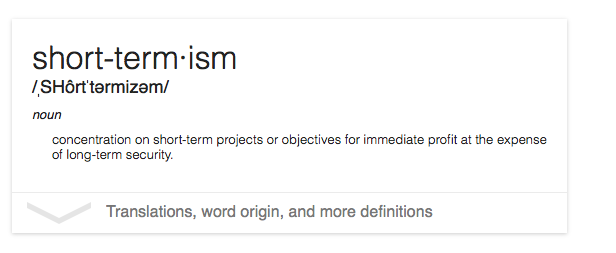
Short termism definition image

Since this isn’t a new question, there is a considerable amount of literature available in law and finance (and a definition available on investopedia).  This may seem like great news, if like me, you are interested in acquiring a solid understanding of short termism.  By solid understanding,  I mean internalization of knowledge, not mere familiarity where I can be prompted to recall something when someone else talks/writes about it.  I have some basic questions that I want answers to:   What is short-termism?,  What empirical evidence best proves or disproves short-termism?  Which investors, if any, are short-term?  What are the consequences (good and bad) of a short-term investment horizon?  If there is short-termism, what are the solutions?  I’ll briefly discuss each below, and my utter failure to answer these questions with any real certainty thus far.

What is the definition of short-termism and does it change depending upon context or user?  There appears to be consensus on the conceptual definition

Part III Another Major “Not” and the Uniform Act’s More (!) Contractarian Approach

C. Not Whatever is Meant by a Contractual Provision Invoking “Good Faith”

Some limited partnership and operating agreements expressly refer to “good faith” and define the term.[1] As the Delaware Supreme Court held in Gerber v. Enter. Products Holdings, LLC (Gerber), such “express good faith provisions” do not affect the implied covenant.[2] In Gerber, the Court rejected the notion that “if a partnership agreement eliminates the implied covenant de facto by creating a conclusive presumption that renders the covenant unenforceable, the presumption remains legally incontestable.” [3]

The rejected notion arose from on an overbroad reading of Nemec v. Shrader [4] – namely that “under Nemec, the implied covenant is merely a ‘gap filler’ that by its nature must always give way to, and be trumped by, an ‘express’ contractual right that covers the same subject matter.”[5] Invoking Section 1101(d) of the Delaware Revised Uniform Limited Partnership Act,[6] the Gerber opinion stated: “That reasoning does not parse. The statute explicitly prohibits any partnership agreement provision that eliminates the implied covenant. It creates no exceptions for contractual eliminations that are ‘express.’”[7] 

Some agreements contain express good faith provisions but omit

My recent article:  Locked In: The Competitive Disadvantage of Citizen Shareholders, appears in The Yale Law Journal’s Forum.  In this article I examine the exit remedy for unhappy indirect investors as articulated by Professors John Morley and Quinn Curtis in their 2010 article, Taking Exit Rights Seriously.  Their argument was that the rational apathy of indirect investors combined with a fundamental difference between ownership of stock in an operating company and a share of a mutual fund.  A mutual fund redeems an investor’s fund share by cashing that investor out at the current trading price of the fund, the net asset value (NAV). An investor in an operating company (a direct shareholder) exits her investment by selling her share certificate in the company to another buyer at the trading price of that stock, which theoretically takes into account the future value of the company. The difference between redemption with the fund and sale to a third party makes exit in a mutual fund the superior solution over litigation or proxy contests, they argue, in all circumstances. It is a compelling argument for many indirect investors, but not all.

In my short piece, I highlight how exit remedies are

The Department of Labor issued new interpretive guidelines for pension investments governed by ERISA.  A thorny issue has been to what extent can ERISA fiduciaries invest in environmental, social and governance-focused (ESG) investments?  The DOL previously issued several guiding statements on this topic, the most recent one in 2008, IB 2001-01, and the acceptance of such investment has been lukewarm. The DOL previously cautioned that such investments were permissible if all other things (like risk and return) are equal.  In other words, ESG factors could be a tiebreaker but couldn’t be a stand alone consideration. 

What was the consequence of this tepid reception for ESG investments?  Over $8.4 trillion in defined benefit and defined contribution plans covered by ERISA have been kept out of ESG investments, where non-ERISA investments in the space have exploded from “$202 billion in 2007 to $4.3 trillion in 2014.” 

In an effort to correct the misperceptions that have followed publication of IB 2008-01, the Department announced that it is withdrawing IB 2008-01 and is replacing it with IB 2015-01

The new guidance admits that previous interpretations may have

“unduly discouraged fiduciaries from considering ETIs and ESG factors. In particular, the Department is

Regular readers know that I write a lot about business and human rights and that I have posted about a number of lawsuits brought in California alleging violations of consumer protection statutes and false advertising claiming that companies fail to disclose the use of child slavery on their packaging. The complaints allege that consumers are deceived into “supporting” the child slave labor trade. The latest class action has been filed against Hershey, Mars, and Nestle. Back in 2001, these companies and several others signed the Engel-Harkin Protocol (drafted by Congressman Engel) in an effort to avoid actual FDA legislation regarding “slave-free” labeling. Nestle has touted its work with some of the world’s biggest NGOs to help clean up its supply chain for all of its human rights issues, not just in the cocoa industry. Nestle denies the allegations and actually has an extensive action plan related to child labor. Mars and Hershey also denied the allegations.

I am curious as to whether shareholders demand action from the boards of these companies or if the steady stream of litigation being filed in California causes companies to invest more in supply chain due diligence or to change where and how they source their

Recently, a number of the sports media outlets, including ESPN, the Pac-12 Network, and Fox Sports featured a company called Oculus that makes virtual reality headsets used by Stanford University quarterback Kevin Hogan, among other players, to prepare for games.

In 2012, Oculus raised about $2.4 million from roughly 9,500 people via crowdfunding website Kickstarter. Following this extremely successful crowdfunding campaign, Oculus attracted over $90 million in venture capital investment. In mid-2014, Facebook acquired Oculus for a cool $2 billion

Oculus is only one example, but it caused me to wonder how many companies are using crowdfunding to attract venture capital, and, if so, whether that strategy is working. This study claims that 9.5% of hardware companies with Kickstarter or Indigogo campaigns that raised over $100,000 went on to attract venture capital. Without a control group, however, it is a bit difficult to tell whether this is a significantly higher percentage than would have been able to attract venture capital money without the big crowdfunding raises. 

If I were a venture capitalist (and I was raised by one, so I have some insight), I would see a big crowdfunding raise as potentially useful evidence

Fellow BLPB editor Haskell Murray highlighted Laureate Education’s IPO (here on BLPB) last week as the first publicly traded benefit corporation.  Steven Davidoff Solomon, the “Deal Professor” on Dealbook at NYT, focused on the interesting issues that can be raised by public benefit corporations in his article, Idealism That May Leave Shareholders Wishing for Pragmatism, which appeared yesterday.  Among the concerns he raised were the  vagueness of the “benefit”provided by the company, the potential laxity or at least untested waters of benefit auditing, and the potential for management rent seeking at the expense of shareholder profit in the new form.  Davidoff Solomon, who (deliciously and derisively) dubs benefit corporations the “hipster alternative to today’s modern company, which is seen as voracious in its appetite for profits,” is certainly skeptical. But the concerns are valid and will have to be worked out successfully for this hybrid form to carve out a place in the securities market.  What I found particularly interesting was his focus on the role of institutional investors, who as fiduciaries for their individual investors, have fiduciary obligations to pursue profits which may be in conflict with or at least require greater monitoring when investing in

Stephen Choi (NYU), Jill Fisch (Penn), Marcel Kahan (NYU), and Ed Rock (Penn) have posted an interesting new paper entitled Does Majority Voting Improve Board Accountability?

The authors report the dramatic increase in majority voting provisions. In 2006, only 16% of the S&P 500 companies used majority voting, but by January of 2014, over 90% of the S&P 500 companies had adopted some form of majority voting. (pg. 6). As of 2012, 52% of mid-cap companies and 19% of small-cap companies had adopted majority voting provisions. (pg. 7)

For the most part, the spread of majority voting has not led to significant reduction in election of nominated directors. In over 24,000 director nominations from 2007 to 2013, at companies with majority voting provisions, “only eight (0.033%) [nominees] failed to receive a majority of ‘for’ votes.” (pg.4)

The authors claim that their “most dramatic finding is”:

a substantial difference between early and later adopters of majority voting. The early adopters of majority voting appear to be more shareholder-responsive than other firms. These firms seem to have adopted majority voting voluntarily, and the adoption of majority voting has made little difference in shareholder-responsiveness going forward. By contrast, later adopters, as a group, seem

Last week I blogged about the Yates Memorandum, in which the DOJ announced that any company that expected leniency in corporate deals would need to sacrfice a corporate executive for prosecution. VW has been unusually public in its mea culpas apologizing for its wrongdoing in its emission scandal this week. VW’s German CEO has resigned, the US CEO is expected to resign tomorrow, and other executives are expected to follow.

It will be interesting to see whether any VW executives will serve as the first test case under the new less kind, less gentle DOJ. Selfishly, I’m hoping for a juicy shareholder derivatives suit by the time I get to that chapter to share with my business associations students. That may not be too far fetched given the number of suits the company already faces.

Has Wal-Mart reformed? Last week I blogged about whether conscious consumers or class actions can really change corporate behavior, especially in the areas of corporate social responsibility or human rights. I ended that post by asking whether Wal-Mart, the nation’s largest gun dealer, had bowed down to pressure from activist groups when it announced that it would stop selling assault rifles despite the fact that gun sales are rising (not falling as Wal-Mart claims). Fellow blogger Ann Lipton did a great post about the company’s victory over shareholder Trinity over a proposal related to the sale of dangerous products (guns with high capacity magazines). There doesn’t appear to be anything in the 2015 proxy that would necessitate even the consideration of a change that Wal-Mart fought through the Third Circuit to avoid.

So why the change? Is it due to the growing public weariness over mass shootings? Did they feel the sting after Senator Chris Murphy praised them for ceasing the sale of Confederate flags but called them out on their gun sales? Even the demands of a Senator won’t overcome the apparent lack of political will to enact more strict gun control, so fear of legislation is not