
As I earlier noted, I participated in a continuing legal education program at The University of Tennessee College of Law last Friday on the basics of crowdfunding.  My partners in crime for the last hour of the event were two folks from Chattanooga, Tennessee (yes, home of the famous choo choo) who have been involved in crowdfunding efforts for local businesses.  One used crowdfunding to finance a change in the location of a business; the other used crowdfunding to gauge interest in his business concept and raise seed capital.  They described their businesses and financing efforts in the second segment of the program (after a foundational hour on crowdfunding from me). 

The business location change was for The Camp House, a coffeehouse owned and operated as part of The Mission Chattanooga, a local church.  Private events, including music performances, also take place at the venue.  The Camp House raised over $32,000 through a crowdfunding campaign on Causeway.  Matt Busby, Director of The Camp House, educated us on donation crowdfunding through a non-profit platform.

The new business concept and capital raise was for Treetop Hideaways (a/k/a, The Treehouse Project), a business that designed, built, and rents time
Transactions: The Tennessee Journal of Business Law is sponsoring a continuing legal education program on the afternoon of Friday, September 18 entitled “Crowdfunding: The Basics.”  If you will be in or near Knoxville at the end of next week (maybe because you’re arriving early for a certain football game on Saturday night versus Western Carolina . . . ), come on over and check it out.  I am presenting for the introductory session.  The second session will feature entrepreneurs from two local (Chattanooga-based) crowdfunded social enterprises, and the third session will be a discussion among the three of us about successful and unsuccessful crowdfunding efforts.  

I am excited to be able to participate in this program with local entrepreneurs and have the opportunity to talk to them about the future of crowdfunding.  I will post important out-takes from the program in the future. I assume there will be a number of them . . . .

Readers of this blog know I am fond of writing about Henry Ford and the Dodge v. Ford case (PDF here).  This summer, I am still working my way through Fordlandia, by Greg Grandin.  It’s a really interesting read.  

Henry Ford had plans to build a town in the Amazon that would run like an ideal American town.  The industry would be rubber for car tires, and he was sure he could make a town that produced rubber AND moral people.  He was wrong.  

The book provides more about Ford than just his Amazon city planning. It highlights all sorts of what I will call “interesting” ideas Ford had (many of the quite appalling), and it provides context for a person who was far more interesting and disruptive than many people appreciate.  A good summary of the book is available from NPR here, where the author explains:

“Ford basically tried to impose mass industrial production on the diversity of the jungle,” Grandin says. But the Amazon is one of the most complex ecological systems in the world — and didn’t fit into Ford’s plan. “Nowhere was this more obvious and more acute than when it came to rubber

UPDATE: The deadline for submissions has been extended to July 21.

[The following is a copy of the official workshop announcement.  I have moved the “Guiding Questions” to the top to highlight the business law aspects.  Registration and submission details can be found after the break.]

A Vulnerability and the Human Condition Initiative Workshop at Emory Law

Guiding Questions:

This workshop will use vulnerability theory to explore the implications of the changing structure of employment and business organizations in the new information age. In considering these changes, we ask:

• What kind of legal subject is the business organization?
• Are there relevant distinctions among business and corporate forms in regard to understanding both vulnerability and resilience?
• What, if any, should be the role of international and transnational organizations in a neoliberal era? What is their role in building both human and institutional resilience?
• Is corporate philanthropy an adequate response to the retraction of state regulation? What forms of resilience should be regulated and which should be left to the ‘free market’?
• How might a conception of the vulnerable subject help our analysis of the changing nature of the firm? What relationships does it bring into relief?
• How have discussions about market vulnerability shifted over time?
• What forms of resilience are available for institutions to respond to new economic realities?
• How are business organizations vulnerable? How does this differ from the family?
• How does the changing structure of employment and business organization affect possibilities for transformation and reform of the family?
• What role should the responsive state take in directing shifting flows of capital and care?
• How does the changing relationship between employment and the family, and particularly the disappearance of the “sole breadwinner,” affect our understanding of the family and its role in caretaking and dependency?
• How does the Supreme Court’s willingness to assign rights to corporate persons (Citizen’s United, Hobby Lobby), affect workers, customers and communities? The relationship between public and private arenas?
• Will Airbnb and Uber be the new model for the employment relationships of the future?

Among the DGCL amendments this year were a number of amendments to the Delaware Public Benefit Corporation (“PBC”) Law. 

I refer to the Delaware PBC amendments as “The Etsy Amendments” because I believe (without being sure) that a main motivation in passing these amendments was to make it easier for Etsy (among other companies) to become a Delaware PBC. These amendments are effective as of August 1, 2015.

As mentioned in a previous post, Etsy is a certified B corporation and a Delaware C-corporation. According to B Lab’s terms for certified B corporations, Etsy will have to convert to a Delaware PBC by August 1, 2017 or forfeit its certification. This assumes that B Lab will not change its requirements or make an exception for publicly-traded companies.

The amendments to the PBC law are summarized below:

  • Eliminates requirement of “PBC” or “Public Benefit Corporation” in the entity’s formal name. This amendment makes it easier and less costly for existing entities to convert, but the amendment also makes it more difficult for researchers (and the rest of the public) to track the PBCs. In addition to the cost of changing names, Rick Alexander notes in his

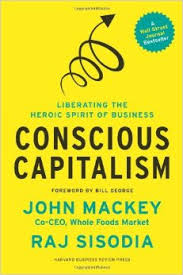
Conscious

Recently, I finished reading Conscious Capitalism, written by Whole Foods Market co-CEO John Mackey and Babson College professor Raj Sisodia.

The book is much more “popular press” than academic, as should be clear from the splashy subtitle “liberating the heroic spirit of business.” There is a bit of academic influence in the appendix and notes, but it is mostly social business advocacy and story telling. In fact, the authors state that the primary purpose of the book “is to inspire the creation of more conscious businesses: businesses galvanized by higher purposes that serve and align the interests of all their major stakeholders.” (pg. 8). The book is interesting, passionate, and may accomplish its primary purpose.

The authors paint a compelling picture of Whole Foods Market and similar companies like Trader Joe’s, The Container Store, Costco, and Southwest Airlines. These companies appear to take a long-term view and consider what is best for all their stakeholders. I would have appreciated, however, more attention to the struggles the companies must have faced in attempting to satisfy all of their stakeholders. After finishing the book, I was left wishing the authors would have spent more time discussing how to make decisions in

Oregon has done those interested in social enterprise a great service by posting a list of their benefit companies online. Oregon also has a nice page about becoming an Oregon benefit company.

By my count, the version updated 6/3/15, lists the following number of entities (for a total of 500 benefit companies):

  • 1 professional benefit corporation 
  • 74 benefit corporations 
  • 425 benefit LLCs

Oregon is one of a very few states that provides for the formation of benefit LLCs, in addition to benefit corporations. As you can see, the benefit LLCs are a good bit more popular than the benefit corporations, likely because most social enterprises are small, closely-held entities that should probably be LLCs instead of corporations.  

LLC law is generally flexible enough to allow a social purpose and Oregon’s corporation law expressly allows corporations to be formed for a social purpose, so the main draw seems to be branding/signaling based rather than law based.

These are still relatively small numbers in the grand scheme, but it was a fairly short time ago that there were fewer than 500 total benefit companies nationwide.    

Last week, I attended the National Business Law Scholars Conference at Seton Hall University School of Law in Newark, NJ.  It was a great conference, featuring (among others) BLPB co-blogger Josh Fershee (who presented a paper on the business judgment rule and moderated a panel on business entity design) and BLPB guest blogger Todd Haugh (who presented a paper on Sarbanes-Oxley and over criminalization).  I presented a paper on curation in crowdfunding intermediation and moderated a panel on insider trading.  It was a full two days of business law immersion.

The keynote lunch speaker the second day of the conference was Kent Greenfield.  He compellingly argued for the promotion of corporate personhood, following up on comments he has made elsewhere (including here and here) in recent years.  In his remarks, he causally mentioned B corporations and social enterprise more generally.  I want to pick up on that thread to make a limited point here that follows up somewhat on my post on shareholder primacy and wealth maximization from last week.

The New Yorker recently ran an interesting article entitled Patagonia’s Anti-Growth Strategy. Patagonia is a certified B corporation and a California benefit corporation.

As a customer, Patagonia is my favorite company for casual/outdoor clothing, and one of my favorite companies in any industry. Initially, I thought Patagonia’s clothes were insanely expensive, but their clothes have been much cheaper on a “cost-per-wear” basis than any other clothes I have bought. In an age of cheap products and rampant consumerism, Patagonia is striking a chord with those who wish to buy fewer, quality products.

A taste of the article follows, but go read the entire thing.

The company’s anti-materialistic stance ramped up on Black Friday, 2011, with a memorable full-page advertisement in the Times that read, “Don’t Buy This Jacket.” The ad’s text broke down the environmental costs of the company’s top-selling R2 fleece sweater and asked consumers to think twice before buying it or any other product. The attention the ad received helped to bump Patagonia’s 2012 sales significantly. . . . Patagonia is trying second-hand-clothing sales at its shop in Portland, Oregon, and has made product repair and recycling a growing part of its business model. It recently invested

As a semi-closeted (now “out,” I guess) foodie* and as a lover of “things Brazilian” (including Havaianas flip-flops and Veja sneakers, as well as churrascarias and caipirinhas), I read with interest a recent electronic newsletter headline about a thriving Brazilian chef.  I clicked through to the article.  I loved it even more than I had thought I would.

The article tells the story of an emergent Brazilian chef and restauranteur, Rodrigo Oliveira, and his flagship establishment (Mocotó), as promised.  That was great.  But that was not all.  The piece also told the story of a business run using a “holistic business model.”

Today, Oliveira focuses on his employees as much as his customers. . . .  Oliveira pays for his employees’ part-time education. And their kids’ health care. And daily jiujitsu and yoga classes in the room he built upstairs. It’s a rarely encountered, holistic business model that contributes to his restaurant’s roaring success. . . .

 . . . 

Beneath the street level they’re boring out new dormitories for employees, for a quick nap and shower between jiujitsu, work and class. . . .

He also seems to be attentive to the greater local community beyond his customers