I’m finishing my second semester of teaching Legal Environment of Business, an introductory undergraduate business law course, asynchronously.  One of the challenges of an asynchronous course is creating a sense of community among students.  I’ve previously blogged about using negotiation exercises in my business law courses (here and here).  In this post, I want to share with readers how I’ve continued to use such materials in my asynchronous courses to promote experiential learning and to create a sense of community.

Canvas is the learning management system for my courses.  My asynchronous courses are organized into weekly modules.  Students can find all materials for a specific week (assigned readings, videos, assignments etc.) in that week’s module.  The feedback I’ve received indicates that students find this an easy to follow format.  So, for any week in which there is a negotiation exercise, the students’ role assignments, the negotiation materials, and the assignment itself will be posted in that week’s module.  For each exercise, I use Canvas groups to randomly organize students into negotiation teams.  Use of Canvas groups also facilitate students’ ability to contact each other, coordinate their negotiation, and complete their assignment.  I group students into a different
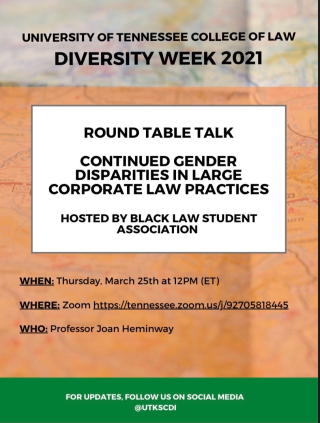
Yesterday, I had the honor of leading a roundtable discussion on women and the practice of business law.  The roundtable was part of a series convened by UT Law’s Student Council on Diversity and Inclusion, and this specific roundtable was hosted by our Black Law Student Association.  Here’s the promotional flyer from the event.

SCDIRoundtableAnnouncement

In preparing for the session, I had occasion to review two ABA reports from the past few years: Roberta D. Liebenberg & Stephanie A. Scharf, Walking Out The Door : The Facts, Figures, and Future of Experienced Women Lawyers in Private Practice (ABA 2019), and Destiny Peery, Paulette Brown & Eileen Letts, Left Out or Left Behind: The Hurdles, Hassles, and Heartaches of Achieving Long-term Legal Careers for Women of Color (ABA 2020). I was reminded of the fall-off in female lawyers in BigLaw over the course of their careers.  Quoting from the first report:

BigLaw is no stranger to the loss of experienced women attorneys. While entering associate classes have been comprised of approximately 45% women for several decades, in the typical large firm, women constitute only 30% of non-equity partners and 20% of equity partners. Women lawyers face many other challenging hurdles

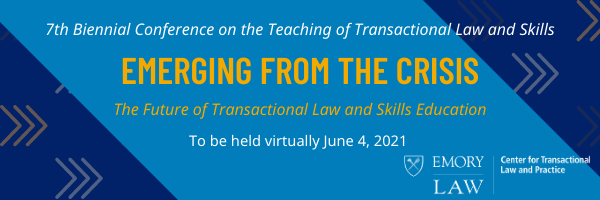
EmoryConference2021

Registration is Open!

It is our great pleasure to announce that registration is now open for the seventh biennial transactional law and skills education conference to be held virtually on June 4, 2021. Please join us to celebrate and explore our theme – Emerging from the Crisis: The Future of Transactional Law and Skills Education with you. This year, we have reduced the registration fee to $50 per person. Secure your space today!

Call for Proposals

Please take a moment to review the Call for Proposals and submit your proposal here. Also, please share the CFP with your colleagues who may not have attended the Conference before. Consider forwarding it to adjuncts and professors teaching relevant subjects. Can you also think of any teachers who might be interested in attending or presenting?

The Call for Proposals deadline is 5 p.m. April 15, 2021. We look forward to receiving your proposals.

Last, but certainly not least, at this year’s Conference, we will announce the winner of the second Tina L. Stark Award for Teaching Excellence. Would you like to nominate yourself or a colleague for this award? More information will be forthcoming regarding award eligibility and the nomination

I tell my students that the participants in securities transactions are “the three Is” or  “I3“: issuers, intermediaries, and investors.  Tomorrow morning, having covered the definition of a security and the concept of materiality, I offer some foundational words on investors. 

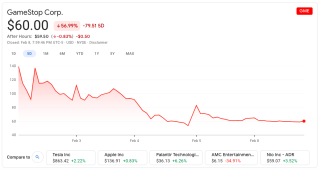
What to tell?  Of course, I will talk a bit about investment theory, the investor protection policy and mechanisms of federal securities law, the composition/demographics of the typical equity ownership of a public company, etc.  But what do I say about GameStop Corp.?  Set forth below is a chart summarizing the trading in GameStop common stock for the past five days: (courtesy of Google Finance):

Screen Shot 2021-02-08 at 11.54.19 PM

Who are the investors in the market for GameStop common stock, options, and short positions now?  Who will they be in a month or six months or a year (assuming a trading market can be sustained)?  And what do the changes in GameStop’s investor profile say about the firm itself, about the New York Stock Exchange, and about various related aspects of securities regulation?  

There remain few answers to the fundamental question of who owns or is trading in GameStop’s publicly traded common stock.  Nevertheless, there are many worthy conversation

Wow.  All I can say is . . . wow.  Last Monday, GameStop Corp. was, for me, just a dinosaur in the computer gaming space–a firm with a bricks-and-mortar retail store in our local mall that I have visited maybe once or twice.  What a difference a week makes . . . .

Now, GameStop is: frequent email messages in my in box; populist investor uprisings against establishment institutional investors; concern about students investing through day-trading accounts; news and opinion commentary on all of the foregoing (and more); compulsion to inform an under-informed (and, in some cases, bewildered) community of friends and family.  This change of circumstances, which is centered on, but not confined to, the volatile market for GameStop’s common stock, raises many, many questions–legal questions and factual questions.  Some are definitively answerable, others are not.

The legal questions run the gamut from possibilities of securities fraud (including insider trading) and market manipulation, to the governance of trading platforms, the propriety of trading limitations and halts, and the authority and control of clearinghouses.  Co-blogger Ben Edwards published a post here last Thursday on the trading halts in GameStop stock, the role of clearinghouses, and the possibility of market manipulation. 

As we launch into another online/hybrid semester of legal education, I want to share a new article by Jen Randolph Reise: Moving Ahead: Finding Opportunities for Transactional Training in Remote Legal Education. Here’s the abstract:

This article builds on the many calls for teaching business acumen and transactional skills in law school with a timely insight: the shift to remote legal education creates opportunities to do so, in particular by incorporating practice problems and mini-simulations in doctrinal courses. Weaving together the literature on emerging best practices in online legal education, cognitive psychology, and the science of teaching and learning, Professor Reise argues that adding formative assessments and experiential education is effective in teaching and is critical in remote learning.

Offering vivid examples from her experience teaching Business Organizations online, she urges legal instructors to use the opportunity presented by the shift to remote education to incorporate problems and simulations as an effective way to motivate students to prepare for class, to expose them to transactional practice skills, and to effectively teach them key doctrinal concepts.

For those of you who do not know Jen, she is currently a Visiting Professor at Mitchell Hamline School of Law (Twitter: @jenreise). 

As our legal academy readers know, this week features the annual conference of the Association of American Law Schools (“AALS”), the professional association for law schools and their faculty and staff.  I am sure many of us will publish posts now and later about the conference and its varied programs.  I focus today on the Section on Leadership, of which my Dean (Doug Blaze) is the current chair.  Doug has been among the national leaders in the movement to teach leadership in law schools.  Among other things, he was a founder of the section and of the Institute for Professional Leadership at UT Law (of which I am the current Interim Director).

I highlight two things in this post.

First, the Fall 2020 section newsletter deserves attention.  The entire issue focuses on racism.  It includes a number of short articles written by a variety of contributors, including (but not limited to) law professors.  Tony Thompson, Professor of Clinical Law at NYU Law, introduces the issue, referencing the events that catapulted racism and racial injustice into the legal news and public eye in meaningful ways earlier this year.  He writes: “T]he public protests have . . . sparked . . .

This post catches up on a few recent position listings that may be of interest to business law faculty and have not yet been posted here.

+++++

TEMPLE UNIVERSITY BEASLEY SCHOOL OF LAW

LOW INCOME TAXPAYER CLINIC DIRECTOR
AND VISITING PRACTICE PROFESSOR OF LAW

Position Summary: The Temple University Beasley School of Law was recently notified that it will receive funding from the IRS to open and operate a Low Income Taxpayer Clinic (LITC) on its Main Campus in North Philadelphia which will also serve taxpayers in northeastern Pennsylvania. It is therefore soliciting applications for the position of Visiting Practice Professor of Law and Director of the LITC, which is expected to operate on a part-time basis during 2021. The position will begin on January 15, 2021 or as soon thereafter as practicable, and will run through the end of the calendar year. The Clinic Director will be expected to establish and operate the LITC, including developing a panel of pro bono attorneys and performing community outreach, and to take a leadership role in applying to the IRS for a multi-year grant, which will likely need to be submitted in June, 2021. In addition, the Clinic Director will be expected

Few of the ten preceding posts I have offered on teaching during the COVID-19 pandemic (links provided at the end of this post) have even mentioned assessment.  Given that the semester’s classes have ended almost everywhere, now seems like a good time to say a few words on that topic, focusing in on written final examinations.  As with everything else in the COVID-19 era, the traditional written, timed final (f/k/a “in class”) examination has received some serious scrutiny and reconsideration in 2020.  The UT Law faculty shared ideas and opinions on the topic of online examinations in a number of faculty meetings and forums.  Perhaps predictably, faculty members teaching in different parts of the curriculum (substantively and otherwise) had individualized views about how their own learning objectives could best be met in an online assessment environment.

After much discussion, UT Law ended up offering multiple options to instructors.  For essay questions, we had the choice of using our proprietary portal’s exam feature (with download/upload capabilities and full use of all computer functionality, including the Internet) or exam software.  We had the choice of engaging monitoring or not.  Multiple choice questions could be submitted electronically on the portal and hand-graded by

This coming spring, I am on sabbatical.

Typically, I teach 4 courses per semester – each with 5 to 8 decent-sized assessments. Among other responsibilities, I am a pre-law advisor for our undergraduate students. So the school year tends to be a bit of blur.

Our fall semester ended just before Thanksgiving, and I already miss teaching. That said, I do feel fortunate to be on sabbatical during what will be another hybrid-teaching semester for us. While hybrid, masked teaching was O.K., it did not hold a candle to typical in-person teaching in my opinion.

In any event, I have my main writing project for the spring (somewhat) mapped out, but would love thoughts on sabbaticals in general for those who have taken them. Some of my plans are a bit uncertain, given the pandemic. In addition to research/writing, a few things I hope to do are – take another Open Yale Course, connect/reconnect with business lawyers/judges in Nashville, and give a few presentations (if COVID allows).

Anyway, feel free to e-mail me here or leave a comment below.