
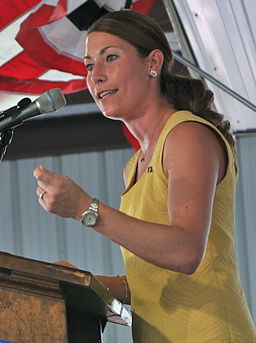
256px-Alison_Lundergan_Grimes

(Photo courtesy of Wikimedia Commons, by Patrick Delahanty from Louisville, United States)

Alison Lundergan Grimes and I both graduated from Rhodes College, a small liberal arts college in Memphis, TN. I have not spoken to Alison since college, so I was surprised to see her mentioned on CNN a number of weeks ago as the democratic nominee for U.S. Senator from Kentucky. Since then, she has been in the news quite a bit. She will face Minority Leader Mitch McConnell, in what has turned into one of the hotter Senate races this year.    

Even in college I did not know Alison well, but we did take a public speaking class together. Alison was the type of student who was often in a suit and pearls in class, while I wore flip flops year-round and whatever wrinkled, Goodwill-purchased clothes were the most clean. She was a Chi Omega (easily the most refined group on campus), and I was a part of the football team for all four years (if there was a rowdier group on campus than the football team, it was the rugby club, which I joined because my playing time on the football team was

I plan to write a more traditional blog post later if I have time, but I am in the midst of midterm grading hell. I was amused today in class when a student compared the drama of the Francis v. United Jersey Bank case with the bankruptcy, bank, and mortgage fraud convictions of husband and wife Joe and Teresa Guidice from the reality TV hit the Real Housewives of New Jersey.

I had provided some color commentary courtesy of Reinier Kraakman and Jay Kesten’s The Story of Francis v. United Jersey Bank: When a Good Story Makes Bad Law, and apparently Mrs. Pritchard’s defenses reminded the student of Teresa Guidice’s pleas of ignorance. Other than being stories about New Jersey fraudsters, there aren’t a lot of similarities between the cases. Based on my quick skim of the indictment I don’t think that Teresa served on the board of any of the companies at issue–Joe apparently had an LLC and was the sole member, and the vast majority of the counts against the couple relate to their individual criminal conduct. In addition, Teresa is also going to jail, and no one suffered that fate in United Jersey.

I am back teaching law students again this semester, in addition to teaching business school students. Last class, I did my “mid-course” teaching evaluations in the law school, which I do voluntarily each semester to gauge how the courses are going for the students. Almost always, I pick up on some important trends from the responses. One somewhat frustrating thing, however, is that students often want contradicting things. (e.g., “the previous class review is extremely helpful” and “the previous class review is a complete waste of time.”)

The Lon Fuller quote below, from his article On Teaching Law, 3 Stan. L. Rev. 35, 42-43 (1950), helped me realize that some of the contradition, even within the same individual, is natural and expected.

Herein lies a dilemma for student and teacher. The good student really wants contradictory things from his legal education. He wants the thrill of exploring a wilderness and he wants to know where he stands every foot of the way. He wants a subject matter sufficiently malleable so that he can feel that he himself may help to shape it, so that he can have a sense of creative participation in defining and formulating it. At the

For the second time, I have assigned my BA students to write their own shareholder proposals so that they can better understand the mechanics and the substance behind Rule 14-a8. As samples, I provided a link to over 500 proposals for the 2014 proxy season. We also went through the Apple Proxy Statement as a way to review corporate governance, the roles of the committees, and some other concepts we had discussed. As I reviewed the proposals this morning, I noticed that the student proposals varied widely with most relating to human rights, genetically modified food, environmental protection, online privacy, and other social factors. A few related to cumulative voting, split of the chair and CEO, poison pills, political spending, pay ratio, equity plans, and other executive compensation factors.

After they take their midterm next week, I will show them how well these proposals tend to do in the real world. Environmental, social, and governance factors (political spending and lobbying are included) constituted almost 42% of proposals, up from 36% in 2013, according to Equilar. Of note, 45% of proposals calling for a declassified board passed, with an average of 89% support, while only two proposals for the separation

Yesterday, I shared with my faculty during our teaching conversations* my research and thinking on gender equality in the classroom.  How do we handle gender in the classroom?  My guess is that most of us teaching honestly strive to achieve and believe that we create a gender-neutral, or more accurately an equally-facilitative classroom environment.  You can image the horror I felt when I received voluntary, anonymous student feedback last spring that said “you may not mean to or know you are doing this, but you treat men and women differently in class.”  From whose perspective was this coming?  How differently? And who gets the better treatment?  I was baffled. As a female law professor, I was hoping that I got a pass on thinking critically about gender because I am female, right?  Wrong. 

This feedback launched my research into the area and a self-audit of the ways in which I may be explicitly treating students differently, implicitly reinforcing gender norms, and unintentionally creating a classroom environment that is different from my ideal.

Below are some observations and discoveries about my own behavior and a summary of some relevant research. 

There is a growing drumbeat for banning laptops in the classroom, as a recent New Yorker article explained. The current case for banning laptops appeared on a Washington Post blog (among other places), in a piece written by Clay Shirky, who is a professor of media studies at New York University, and holds a joint appointment as an arts professor at NYU’s graduate Interactive Telecommunications Program in the Tisch School of the Arts, and as a Distinguished Writer in Residence in the journalism institute.

The piece makes a compelling case for banning laptops, and I agree there are a number of good reasons to do so.  I’ll not recount the whole piece here (I recommend reading it), but here’s a key passage:

Anyone distracted in class doesn’t just lose out on the content of the discussion but creates a sense of permission that opting out is OK, and, worse, a haze of second-hand distraction for their peers. In an environment like this, students need support for the better angels of their nature (or at least the more intellectual angels), and they need defenses against the powerful short-term incentives to put off complex, frustrating tasks. That support and those defenses

Teaching the definition of a “security” to business associations students who: 1) want to be litigators; 2) are afraid of math, finance, and accounting; 3) don’t know anything about business; 4) only take the class because it’s required; and 5) aren’t allowed to distract themselves with electronics in class is no small feat.

Thankfully, as we were discussing the definition and exemptions, we also touched on IPOs. Many of the students knew nothing about IPOs but were already Alibaba customers and going through some of the registration statement made them understand the many reasons companies want to avoid going public. Of course, now that we went through some of the risk factors, my students who seemed gung ho about the IPO after watching some videos about the hype were a little less excited about it (good thing because they probably couldn’t buy anyway).  

Now if I can only figure out how to jazz up the corporate finance chapter next week.

Today started in Williston, ND, and we then went to Mountrail County.  We vistied Tioga and Stanley, then headed south through New Town and Killdeer on the way back to Dickinson, where we stay tonight before flying out tomorrow morning (ridiculously early, I might add). 

We started the day at Williston State College, where we learned about the TrainND program and other degree programs.  TrainND works with companies to do OSHA and other safety training, and trained more than 16,000 people last, the vast majority of whom were employed.  The College also offers degree programs for those seeking to be Lease Operators and PLC-trained operators. Interesting for academics, the college had 38% turnover last summer.  The college has invested in campus housing for faculty, which can be part of the incentive package to bring people.  Apartments run from $2600/mo for 1 and 2 BR options, with home rentals over $3K.  Seventy percent of new faculty hires are moving into the new campus housing apartments (which looked nice from the outside). Just like the industry, the college is “catching up” with the whole thing. 

We saw more densely packed well sites, such at this 9-pack (nine wells on one

I have been an interviewee and an interviewer dozens upon dozens of times in my legal career. As a professor, drawing on my interviewing experience from both sides of the interview table, I spend a fair amount of time giving my students comments on their resumes and giving them advice before they go on interviews. Below are some of the comments that I find myself making consistently.

Generally, I think employers want to know three basics things about you as an interviewee: (1) are you capable?; (2) are you likeable? and (3) are you dedicated? (For the purposes of this post, I am going to assume you haven’t given the employer any reason to question your intergrity, but, obviously, integrity is also extremely important.)

I describe each category in greater detail, and provide advice, after the break.

Rebecca Schuman authored a recent article in Slate entitled Syllabus Tyrannus: The decline and fall of the American university is written in 25-page course syllabi.

In the article Schuman complains that in the last twenty years syllabi have grown from 1-2 page simple documents with only the course location, required books, and assignments to “Ten, 15, even 20 pages of policies, rubrics, and required administrative boilerplate, some so ludicrous (“course-specific expected learning outcomes”) that I myself have never actually read parts of my own syllabi all the way through.”

While I won’t go as far as Professor Paul Horwitz goes in criticizing Schuman’s writing, I do want to push back a bit on her critique of “course-specific expected learning outcomes.” 

I admit that bloated syllabi can be a bit cumbersome, but drafting what we at Belmont call “course objectives” can be a helpful process and can lead to important changes in the course. Believe it or not, each semester I look at my course objectives, evaluate whether they were met, and revise my courses as necessary. My course objectives have reminded me that I shouldn’t drop that undergraduate group presentation assignment, no matter how difficult it gets logistically.