

Shop(Photo from Sharing Christmas)

‘Tis the season when people binge on those made for television holiday romance movies – mostly associated with the Hallmark Channel but, to be fair, there are plenty on Lifetime as well.

What strikes me about the genre is how business-centric it seems to be.  Though there are other types of plots (riffs on Cinderella/Roman Holiday/Sound of Music are always popular), a fairly common storyline is that there is some business that revolves around Christmas and is enjoyable for the townsfolk but relatively unprofitable.  The characters have to find a way to make the business viable without turning it over to a soulless corporate operator who will lay everyone off and destroy its essential character.  Typically, this involves teaching someone the true meaning of Christmas and the special value added to a company by longtime employees who put their hearts into their work.

It’s not that this is new, exactly; Christmas stories about profit-motive versus philanthropy trace back at least as far as Miracle on 34th Street (if not A Christmas Carol).  But viewed through a business lens, Miracle on 34th Street is a tale of shareholder primacy.  Of course, Santa didn’t
Although a bit behind on getting it up, I wanted to flag this article from Ron Lieber about his experience showing up for a “complimentary gourmet meal” with an annuity salesman.  By doing a few record checks, he soon discovered some interesting facts about the annuity salesman:

And the host? An insurance salesman, Arif M. Halaby, who I quickly discovered had been the subject of a state cease-and-refrain order earlier in the decade because of certain financial products that an administrative law judge determined that he had sold. The state found that Mr. Halaby was offering “unqualified” securities after an ailing older client pulled equity from his home to invest in a real estate development in Costa Rica.

At this point, alarm bells should be going off.  This is the sort of high-risk move that could easily prove disastrous.  

The SEC has long warned about these seminars.  When it held its “senior summit” about a decade ago, it issued warnings that the seminars may involve misleading presentations that are just designed to sell products.

When Lieber attended this one, he discovered the presenter using a graphic depicting the annuity product significantly outperforming the S&P 500.  The fine print disclosed that

I posted about Lorenzo v. Securities & Exchange Commission when the SEC first granted certioriari; you can read my long thoughts about it here.  Now that the Court held oral argument, I’ll offer my quick comments (and I’ll probably say still more when the decision comes down; this is a bountiful source of blogging material).

Picking up where I left off in my earlier post (I’ll assume you’ve either read that or are otherwise familiar with the issues in this case):

Lorenzo poses a quandary because the Supreme Court backed itself into a corner in Janus Capital Group, Inc. v. First Derivative Traders, 564 U.S. 135 (2011).  There, the Court narrowly construed what it means to “make” a statement for the purposes of Rule 10b-5(b), but then went further and suggested – via its invocation of Central Bank of Denver v. First Interstate Bank of Denver, 511 U.S. 164 (1994) – that a wide range deceptive conduct falling outside of that definition not only would not involve making statements, but also would not be prohibited by Section 10(b) at all.

All of which has come back to bite the Court in Lorenzo.  There, Lorenzo – acting

Has an airline ever told you it wasn’t responsible for costs you would incur because of a flight initially delayed for “mechanical reasons” that was now delayed due to weather?  In thinking about how potential losses resulting from both a clearing member default and non-default issues (such as operational, investment, or custody problems) are likely to be allocated among a clearinghouse and clearing members, I think of such past travel experiences.  From my perspective, the issue of ownership is key to both.   

Hence, I’d like there to be an increased amount of discussion about clearinghouse ownership.  The word “ownership” was barely mentioned (maybe once) during the December 4th meeting of the Market Risk Advisory Committee, sponsored by CFTC Commissioner Rostin Behnam,  which largely focused on issues related to clearinghouses.  In contrast, participants frequently mentioned clearinghouse capital (“skin in the game”), and extensively discussed (Panel 2) the allocation of default versus non-default losses (which could occur nearly simultaneously).  Surprisingly, there is scant legal guidance on the allocation of non-default losses in the U.S. 

Clearinghouses, financial market infrastructure utilities, tend to be owned by their members or by investors (I’ve written extensively about clearinghouses for readers interested in learning more

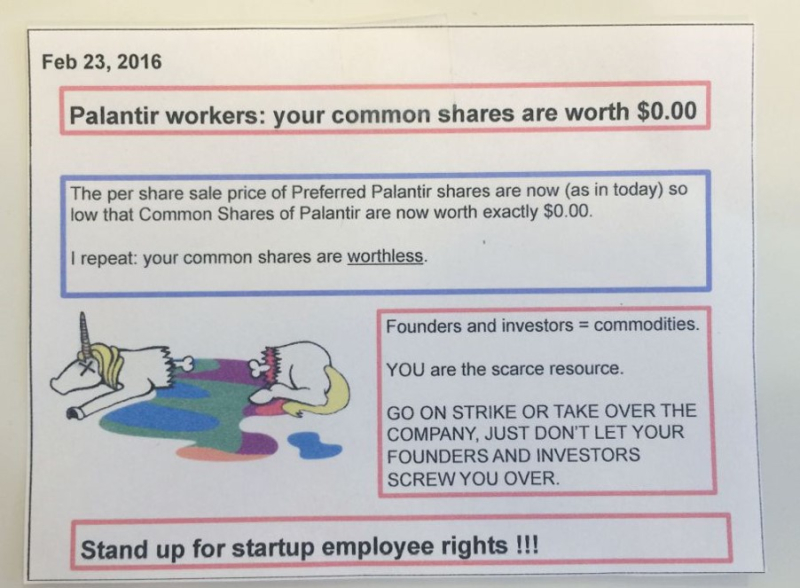
Palantir

On Wednesday, I had the great pleasure of delivering an address at the North American Securities Administrators Association’s annual training conference for its corporate finance division.  I spoke about equity compensation for employees in private companies (you may recall that Joan linked to Anat Alon-Beck’s paper on that subject a couple of weeks ago).  Equity compensation to employees is exempt from federal registration under Rule 701 – and the SEC is currently deciding whether to broaden that exemption – but is still subject to state regulation.  Most states, however, simply follow the federal rules.  The purpose of my talk was to discuss some of the risks posed to employee-investors when companies stay private for prolonged periods, and to suggest that state securities regulators may want to consider if there is a need for additional oversight.

Under the cut, I offer the (massively) abridged (but still probably too long) version of my remarks.  For those interested in further reading on the subject, in addition to Anat’s paper highlighted by Joan, I recommend Abraham Cable’s excellent breakdown of the issues in Fool’s Gold? Equity Compensation and the Mature Startup.

[More under the jump]

A new paper from Colleen Honigsberg and Matthew Jacob sheds light on how to think about FINRA’s controversial expungement process.  As I explained in a post a couple years back, FINRA’s expungement process leaves its own paper trail behind, making it possible for firms and more sophisticated individuals to see whether a broker has scrubbed complaints from their record:

You should also know that these studies work off compromised databases.  BrokerCheck only shows a partial picture because many financial advisers have managed to have complaints expunged from their records.  In instances where an investor settles an arbitration claim against a financial adviser, FINRA arbitrators routinely agree to expunge the existence of the complaint from the public record.  One study found that FINRA arbitrators granted 90% of these requests for expungement.  In some instances, state regulators have even struggled to block the expungement of complaints from the public record.

Like Harry Potter’s Mad-Eye Moody, you too can see the invisible.  You can uncover whether (and possibly how many times) a financial adviser has used this process to scrub records by checking a different database.  FINRA makes its arbitration awards available.  While complaints may not show up on BrokerCheck, you may find whether a financial adviser has had complaints