It’s not that there isn’t other news, it’s just that this is swimming in warm water.  A few days ago, SurveyMonkey filed an S-1 for its forthcoming IPO, and there are a few things that jumped out at me.

First, there’s a survey!

Survey3

Survey4

(Okay, I’m feeling a little attacked right now.)

Second, there’s a warning!  I previously warned about warnings; poorly drafted ones can warn the registrant right out of a truth on the market/materiality defense if there’s a subsequent securities fraud claim.  SurveyMonkey seems to get it right, though:

Warning1

So, unlike warnings that have gotten issuers into trouble in the past, this one doesn’t explicitly tell anyone not to rely on external information.  It’s just warning you that external information isn’t attributable to SurveyMonkey.

(Which, incidentally, highlights the artificiality of the entire exercise; does anyone seriously believe that from an investor/market perspective, there’s any real difference between “you should only rely on us” language and “we have not authorized anyone else” language?)

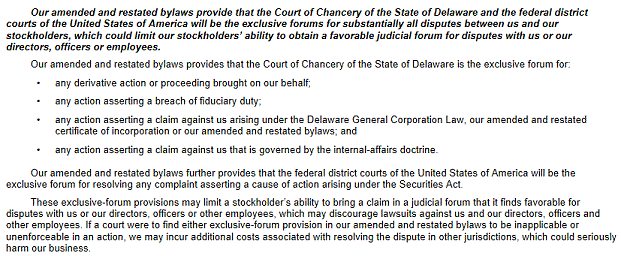
And finally, as I promised in my subject line, there’s the litigation limit:

Forum1

Okay, so much to talk about here.  First, if you’ve been following along, you know that I’ve repeatedly posted about – and written

The New York Times recently published a compelling article about a dispute a woman had with J.P. Morgan Securities after she discovered odd activity in her mother’s account.  The account, which was to help provide for her mother through retirement, had losses at times when the market otherwise rallied:

Around the time of her mother’s move, Ms. Dewart noticed what looked like unusual activity in the account, which she and her older sister had overseen for about four years. A closer look revealed that it was down $100,000 in a month.

“My own accounts were rallying, so I thought this was strange,” she said.

She notified the firm that something seemed awry. As someone who does research and policy analysis for a living, she also put her own skills to work.

She pored over piles of statements and trade confirmations, built spreadsheets and traded phone calls and emails with the broker who handled the account, Trevor Rahn, his manager and the manager’s manager. She hired a lawyer and worked with a forensic consultant.

After about six months, she learned that the account, worth roughly $1.3 million at the start of 2017, had been charged $128,000 in commissions that year —

If you’re like me, you’ve been riveted by the Tesla drama and Elon Musk’s off-the-cuff, possibly Ambien-high, tweet announcing that he planned to take the company private at $420 per share, only to finally admit yesterday that, no, Tesla would stay public after all.

In any event, back when the idea was first floated, and investors (and, I assume, Musk’s counsel) demanded more information about this take-private scheme, Musk vaguely announced that he expected most shareholders – perhaps as many as two-thirds – would stay with the company, and roll over their shares into a special purpose vehicle.  He even invited shareholders to remain invested, writing, “I would like to structure this so that all shareholders have a choice. Either they can stay investors in a private Tesla or they can be bought out at $420 per share.”

Much has been written about this proposal, including all the reasons why it didn’t make financial sense, and the evidence that no, he never had funding or a plan, and now the SEC is investigating, and so forth, but there’s really one aspect I want to focus on, which is, the proposal never could

While states often enact the same model legislation, each state’s public enforcement resources also shape the legal and business environment.   Most academic writing about law seems focused more on the substantive side without as much devoted to considering necessary resources for state and federal institutions to give actual meaning to legislation.  This focus is understandable.  Writing about the need for more forensic accountants and sophisticated database systems may appear tedious and dull and few academics with the freedom to pick their projects might be drawn to these issues.

Yet thinking about the “how” for business law and financial regulation seems just as important as discussions about what the law should be.  For example, Public enforcement resources directly affect the white collar crime environment.  In recent decades, federal institutions shifted massive resources toward counter terrorism and other priorities.   As resources flow toward those enforcement priorities, other concerns, such as white collar crime, get less attention. 

The metrics measuring public enforcement effectiveness may tilt resource allocation.  If prosecutors pride themselves on cases closed and guilty please secured, white collar criminal prosecutions may not be pursued.  After all, it may take a forensic accountant, significant time, and expert witnesses to secure convictions.  Consider

I try to explain to people that the motion to dismiss in a securities case is a unique animal; the complaints, and the briefing, are not like motions to dismiss in any other area of law.  When it comes to securities cases – especially class actions – the motion to dismiss is really a mini motion for summary judgment.  This week, in a case called Khoja v. Orexigen Therapeutics, No. 16-56069, the Ninth Circuit tried to draw a line in the sand, but as far as I’m concerned, did not go nearly far enough.

It all begins with the Private Securities Litigation Reform Act, which heightens the pleading requirements in securities cases.  Among other things, the Act requires that plaintiffs “specify each statement alleged to have been misleading, the reason or reasons why the statement is misleading, and, if an allegation regarding the statement or omission is made on information and belief, the complaint shall state with particularity all facts on which that belief is formed.” Additionally, plaintiffs must “state with particularity facts giving rise to a strong inference that the defendant acted” intentionally or recklessly. 15 U.S.C. §78u-4.

As Hillary Sale has documented in the context

Gary Shteyngart has a new book out, titled Lake Success Capital.  It’s about a narcissistic hedge fund manager on the run from the SEC.  Although I’m still waiting on my copy to arrive, the marketing for the book is impressive.  Ben Stiller joined Gary for a promotional video:

The video tweaks the hedge fund industry for its insularity and tendency to draw its talent from a narrow pool of sources.  Lake Success seems to be recruiting new employees from the lacrosse teams at fourteen elite schools.  With these schools absorbing a significant chunk off the nation’s wealthy scions, it’s particularly funny when they describe accredited investors as “your moms.”  

I wanted to flag for this audience because others might also enjoy reading it.