It’s Saturday morning, and I’m guessing a lot of us are watching apprehensively as Irma heads for Florida (others of us are probably trying desperately to escape the storm’s path, possibly receiving an impromptu lesson in dynamic pricing).  Meanwhile, Jose and Katia are close behind, even as Houston faces years-long recovery efforts from Harvey, and then there’s, well:

Resize golf

It’s impossible to consider these events – which, in addition to the human toll, will inflict billions if not trillions of dollars of damage – without thinking that this is what climate change looks like.

The reason I mention it on this blog is that climate change is an increasingly popular subject for shareholder proposals.  More and more, shareholders are seeking information from companies about how they are responding to climate change, including the precautions being taken, and the expected costs of disasters. 

Considering that we are now being treated to a dramatic demonstration of just how climate change can have a devastating impact on economies generally and individual companies in particular, isn’t it time for critics of the shareholder proposal mechanism to at least admit that climate change proposals belong in the “corporate governance” category, and not the

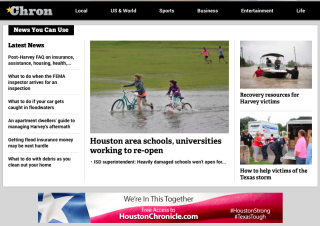
Screenshot 2017-09-03 19.09.35

Now that Hurricane Harvey’s threat to the United States has dissipated, we can begin to fully appreciate the damage it has caused to person, property, and business.  It’s staggering.  The screenshot included above was captured from the Houston Chronicle’s website yesterday.  Although I am not sure how one calculates such things, Wikipedia notes that, “[b]ased on current damage estimates made by multiple agencies, Hurricane Harvey is likely to be at least the second-most costly natural disaster in U.S. history, behind only Hurricane Katrina in 2005.”  I am heartbroken for all those who have lost so much, yet grateful for those who survived such a wicked storm, including the BLPB’s own Doug Moll.

I am confident that too many folks are using this holiday weekend–one they had hoped to spend enjoying last-of-summer moments with family and friends–mourning the loss of life and digging out from the mess at their homes or workplaces.  The damage in Tennessee from the related rain and winds was significant but pales in comparison to what the folks have suffered and continue to contend with in Houston and the surrounding areas.  Luckily, the storm threw very little at Knoxville, since the heart of it passed to the

So last week I posted about the problem of buyer/customer discrimination; we have laws to deal with discrimination by employers, by businesses that sell to the public, by landlords – but there isn’t much to address discrimination that runs in the other direction.

It was timely, then, that this article has been making the internet rounds:

When Penelope Gazin and Kate Dwyer decided to start their own online marketplace for weird art, they didn’t expect it to be easy. After all, the L.A.-based duo of artists were bootstrapping the project with a few thousand dollars of their own money and minimal tech skills. But it wasn’t just a tight budget that added friction to the slow crawl toward launching; the pair also faced their share of doubt from outsiders, spanning from the condescending to the outright sexist.

…  After setting out to build Witchsy, it didn’t take long for them to notice a pattern: In many cases, the outside developers and graphic designers they enlisted to help often took a condescending tone over email. These collaborators, who were almost always male, were often short, slow to respond, and vaguely disrespectful in correspondence. In response to one request, a developer

As Anne Tucker pointed out, there was a flurry of news items a couple of years ago suggesting that hedge fund activists were more likely to target female CEOs over male CEOs.

Well, someone’s now done a systematic study of the issue and confirmed – yes!  That is a thing that happens!

In their paper, Do Activist Hedge Funds Target Female CEOs? The Role of CEO Gender in Hedge Fund Activism, authors Bill Francis, Victor Shen, and Qiang Wu control for a variety of firm characteristics, including the “glass cliff” (that women are more likely to be elevated to CEO in times of turbulence), and still find that the presence of a woman CEO makes it more likely that a company will be targeted by activists.  They attribute the difference to a couple of things.  First, they find that women CEOs respond differently to activist attacks: instead of going into a defensive posture, they are more likely to cooperate.  As a result, activists seek cooperative measures like board seats, and settle without proxy fights.  The more cooperative posture of women CEOs makes it easier – and thus more profitable – for activists to target them.  This finding, they

Eclipse2017(totality)

So, it happened.  A total eclipse of the sun.  (And how many of you are still singing one of these songs in honor of the occasion?)  Where were you?  What did you see and do?  My best Android phone photo of totality is above.

I spent the day enjoying both the event and the charm of Charleston, South Carolina with my hubby, sister-in-law, brother-in-law, and nephew (a student at the College of Charleston)–as well as many others.  The photo below shows how dark it got on the ground for us during the total eclipse.  The street lights came on!

Eclipse2017(totalityground)

A lot of people left the park we settled in for the eclipse soon after totality.  My husband and I stayed to watch the moon move away.  It all was so amazing.  Check out the little sliver of sun emerging from under the moon in the spot between the clouds in the photo below.  Yowza!  Here comes the sun!

Eclipse2017(post)

I am sure the business and business law stories from the total eclipse of 2017 will take some time to resolve themselves.  But I did note this WaPo article from earlier today reporting that the run-up to the eclipse, at